

Balochistan Independence Claim Explained: Why Pakistan and China Are Under Global Spotlight
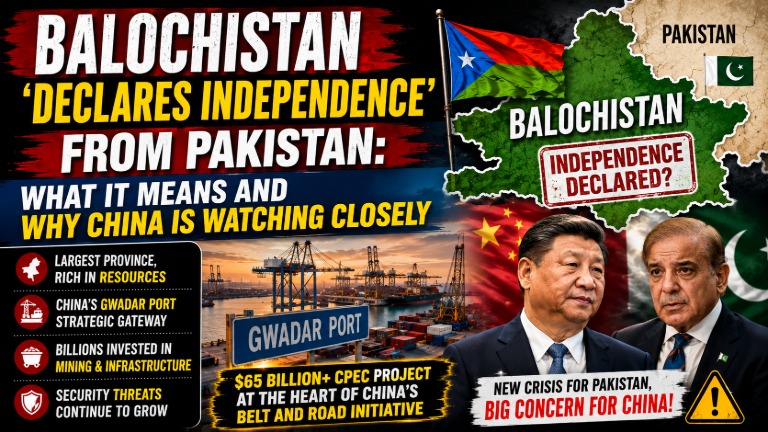
A viral document claiming that Balochistan has declared independence from Pakistan has triggered widespread discussion across international media and social media platforms. While there is no official or independent confirmation that Balochistan has become an independent country, the letter has once again brought global attention to one of South Asia’s longest-running separatist movements.
The development has also renewed focus on China’s massive strategic investments in the province under the China-Pakistan Economic Corridor (CPEC), making Balochistan far more than just a domestic issue for Pakistan.
As speculation grows, experts believe the latest developments could have significant implications for regional security, global trade routes, and China’s Belt and Road Initiative (BRI).
Has Balochistan Officially Declared Independence?
The latest controversy began after a document allegedly issued in the name of the “Republic of Balochistan” circulated online.
The letter claims that separatist groups now control large parts of the province and have declared independence from Pakistan.
However, these claims have not been independently verified, and neither Pakistan nor international organisations have officially recognised any such declaration.
Despite the uncertainty, the viral document has reignited discussions surrounding the decades-old conflict in Pakistan’s southwest.
Why Is Balochistan So Important?
Balochistan is Pakistan’s largest province by area, accounting for nearly 44% of the country’s total landmass.
Despite its size, it remains one of Pakistan’s least populated and economically underdeveloped regions.
The province possesses enormous natural wealth, including:
- Copper
- Gold
- Natural Gas
- Coal
- Rare Earth Minerals
Apart from natural resources, Balochistan occupies a highly strategic location along the Arabian Sea, connecting South Asia with the Middle East and Central Asia.
For decades, several Baloch nationalist organisations have accused Pakistan’s central government of exploiting the province’s natural resources while providing limited economic development to local communities.
These grievances have fueled an insurgency that has continued for decades.
Why China Is Watching the Situation Closely
China’s interest in Balochistan goes far beyond politics.
The province is the backbone of the China-Pakistan Economic Corridor (CPEC)—a project valued at more than $65 billion.
CPEC is one of the flagship components of China’s ambitious Belt and Road Initiative (BRI).
Its primary objective is to connect western China directly to the Arabian Sea through Pakistan, reducing China’s dependence on the strategically vulnerable Strait of Malacca for global trade.
If successful, the corridor would significantly shorten shipping routes between China, the Middle East, Africa, and Europe.
Because much of this infrastructure passes through Balochistan, any instability in the province directly affects Beijing’s long-term strategic ambitions.
Gwadar Port: The Centrepiece of China’s Strategy
Perhaps the most valuable Chinese investment in Balochistan is Gwadar Port.
Situated on Pakistan’s Arabian Sea coastline, Gwadar is considered one of the most strategically important deep-water ports in the region.
China has invested billions of dollars to develop:
- Gwadar Deep Sea Port
- Eastbay Expressway
- Modern highways
- Energy infrastructure
- New Gwadar International Airport
- Logistics and industrial zones
Beijing envisions Gwadar becoming a major international shipping hub connecting Asia, Africa, and Europe.
For China, the port provides an alternative maritime gateway that reduces transportation costs while improving energy security.
China’s Growing Mining Interests
China’s investments are not limited to ports and highways.
Balochistan’s rich mineral reserves have attracted several Chinese companies over the past two decades.
One of the most significant projects is the Saindak Copper-Gold Project in Chagai district, operated by the Metallurgical Corporation of China (MCC).
Chinese firms are also exploring opportunities involving:
- Copper mining
- Gold extraction
- Lithium and rare minerals
- Renewable energy resources
These minerals are increasingly important for global electric vehicle production, electronics, and renewable energy technologies.
Why Separatist Groups Oppose Chinese Projects
Several Baloch separatist organisations, particularly the Balochistan Liberation Army (BLA), have consistently opposed Chinese investments in the province.
These groups allege that while billions of dollars have been invested under the China-Pakistan Economic Corridor (CPEC), local communities continue to suffer from poverty, unemployment, displacement, and limited access to basic services.
According to the separatist groups, natural resources extracted from Balochistan largely benefit Pakistan’s central government and foreign investors rather than the province’s residents.
As a result, Chinese nationals, engineers, and infrastructure projects linked to CPEC have repeatedly become targets of attacks over the past several years.
Security Challenges Continue to Threaten CPEC
Despite Pakistan deploying thousands of security personnel under dedicated protection forces, attacks on Chinese projects have continued.
Some of the major security concerns include:
- Armed attacks on Chinese engineers.
- Suicide bombings targeting CPEC infrastructure.
- Ambushes on security convoys.
- Sabotage of highways and development projects.
- Threats against mining operations.
Because of these incidents, Pakistan has significantly increased military deployment across Balochistan to safeguard Chinese investments.
Security experts believe that continued instability could delay several major infrastructure and mining projects planned under CPEC.
Could Balochistan Really Become Independent?
Although the viral letter has generated significant global attention, most geopolitical analysts believe that an internationally recognised independent Balochistan remains highly unlikely in the near future.
Pakistan continues to exercise administrative and military control over the province, and no major international government has recognised the reported declaration.
However, experts also point out that:
- The separatist movement remains active.
- Security incidents continue to occur.
- Political dissatisfaction still exists in parts of the province.
- International attention on the region is increasing due to China’s investments.
Therefore, while immediate independence appears unlikely, continued unrest could create long-term political and security challenges for Pakistan.
What Would Independence Mean for China?
If Balochistan were ever to gain greater autonomy or independence, China’s strategic interests could face significant uncertainty.
A new administration could potentially:
- Review contracts signed under CPEC.
- Renegotiate infrastructure agreements.
- Seek greater local control over mineral resources.
- Invite investment from other international partners.
- Reassess Gwadar Port’s operational arrangements.
Any such developments could directly affect China’s Belt and Road Initiative, making Balochistan one of Beijing’s most strategically sensitive overseas investments.
Global Implications
The situation extends far beyond Pakistan.
Because Balochistan borders Iran and Afghanistan while providing direct access to the Arabian Sea, instability in the province has wider geopolitical implications.
Potential consequences include:
- Increased security risks for international shipping.
- Delays in Belt and Road Initiative projects.
- Reduced investor confidence in Pakistan.
- Rising tensions between regional powers.
- Greater strategic competition involving China, the United States, and neighbouring countries.
As global trade routes increasingly depend on secure maritime access, developments in Balochistan are being closely monitored worldwide.
Frequently Asked Questions (FAQs)
Has Balochistan officially become an independent country?
No. While a viral letter claims independence, there is currently no independent confirmation or international recognition of Balochistan as a separate country.
Why is China heavily invested in Balochistan?
China views Balochistan as the gateway to the Arabian Sea through the China-Pakistan Economic Corridor (CPEC), which supports its Belt and Road Initiative.
What is Gwadar Port?
Gwadar Port is a deep-sea port in Balochistan developed with significant Chinese investment. It serves as the centrepiece of CPEC.
Why do separatist groups oppose CPEC?
They argue that local communities do not receive adequate benefits from the projects and believe the province’s natural resources are being exploited without fair economic development.
Is the situation likely to affect global trade?
If instability increases around Gwadar Port or regional shipping routes, it could influence trade flows, investor confidence, and energy transportation across the Arabian Sea.
Conclusion
The latest claims surrounding Balochistan’s independence have once again drawn international attention to one of South Asia’s most complex geopolitical issues. Although the viral declaration remains unverified, it highlights the longstanding tensions between separatist groups and Pakistan’s central government.
For China, the province represents far more than a regional security concern. Billions of dollars invested through CPEC, including Gwadar Port and major mining projects, make Balochistan central to Beijing’s long-term economic and strategic ambitions.
As events continue to unfold, the region will remain under close observation by governments, investors, and international security analysts.
Disclaimer
This article is based on publicly available reports and official statements available at the time of publication. Claims regarding Balochistan’s declaration of independence have not been independently verified. Readers are advised to follow official government announcements for confirmed developments.
Do Follow For More Info @ http://roydailyupdate.in
Do Connect WhatsApp @ https://chat.whatsapp.com/K5POJK9KbpN8egjjOCaOw6