

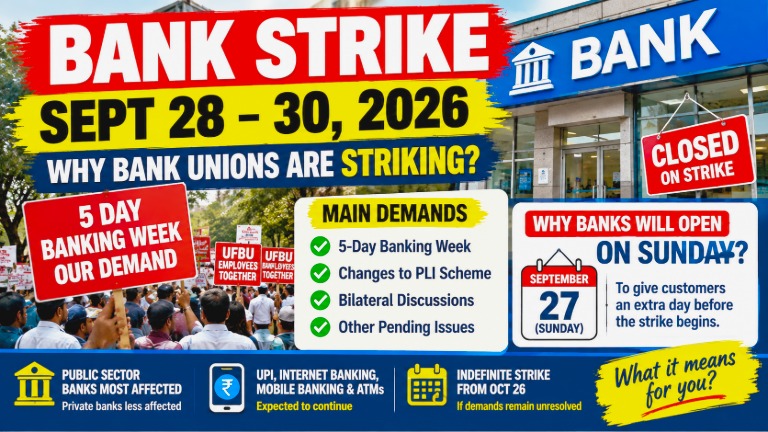
Bank Strike September 28–30: Why Bank Unions Are Striking and Why Banks Will Open on Sunday
Bank customers are facing a major change in the banking calendar this week as bank unions have called a three-day nationwide strike from September 28 to 30, 2026.
The strike has been called by the United Forum of Bank Unions (UFBU), an umbrella body representing seven bank unions. According to the supplied source, the unions represent around eight lakh employees, or roughly 90% of the banking workforce.
The main issue behind the strike is the long-pending demand for a five-day banking week. Bank unions also want changes to the government’s performance-linked incentive (PLI) scheme, bilateral discussions on the scheme and resolution of other pending issues.
There is also a major question for customers: Why will banks open on Sunday, September 27, when Sunday is normally a bank holiday?
The answer is directly linked to the three-day strike that follows.
When Is the Bank Strike?
The UFBU has called a nationwide bank strike for:
Monday, September 28, 2026
Tuesday, September 29, 2026
Wednesday, September 30, 2026
The unions have also threatened an indefinite strike from October 26 if their demands remain unresolved.
For customers, the impact is expected to be greatest at physical bank branches, particularly those operated by public sector banks.
Digital banking services are expected to continue functioning.
Why Are Bank Employees Going on Strike?
The central demand is the implementation of a five-day banking week.
At present, bank branches generally remain closed on the second and fourth Saturdays of each month. Banks normally operate on the first and third Saturdays, and on a fifth Saturday when there is one.
Bank unions want all Saturdays to become holidays.
The unions argue that the move to a five-day working week does not necessarily mean a reduction in customer-facing working hours.
Under the proposal, working hours on weekdays could be increased so that the required working time is accommodated between Monday and Friday.
According to the UFBU, the five-day banking proposal was already agreed to and signed as part of the last wage revision settlement in March 2024, but its implementation is still pending.
What Are the Other Demands?
Although five-day banking is the immediate flashpoint, the unions have several other concerns.
1. Five-Day Banking Week
The unions want all Saturdays to become holidays for bank employees.
Currently, only the second and fourth Saturdays are holidays for bank branches.
2. Changes to the PLI Scheme
Another major issue is the performance-linked incentive (PLI) scheme.
The system was introduced as part of the 2020 wage settlement and links incentives to the performance of individual banks.
A revised government scheme for senior bank officials has led to objections from bank officers’ associations.
According to the supplied source, the revised PLI covers Grade 4 and above officers, while lower-scale officers are excluded.
3. Bilateral Discussions on PLI
The unions are also seeking bilateral discussions regarding the PLI scheme.
4. Other Pending Issues
The UFBU has also raised other unresolved employee-related issues as part of the strike.
Why Will Banks Open on Sunday, September 27?
This is the most important point for bank customers.
September 27, 2026, falls on a Sunday.
Normally, bank branches would remain closed.
However, public sector banks and regional rural banks are expected to open on Sunday ahead of the three-day strike.
The reason is to prevent customers from facing an extended period of disruption.
The sequence would otherwise be:
Saturday → Sunday → Strike Day 1 → Strike Day 2 → Strike Day 3
That could effectively create a five-day period in which customers would have limited access to physical branch services.
Therefore, the Sunday opening provides customers with an additional opportunity to complete important branch transactions before the strike begins.
According to the supplied source, the Reserve Bank of India has approved the full operation of bank branches, offices, ATM-linked branches and currency chests on September 27.
What Services Could Be Affected During the Strike?
The biggest impact is expected at physical bank branches.
Customers who need branch-based services may experience delays or disruption, including:
Cash deposits
Cash withdrawals at branches
Cheque-related work
Account-related services
Certain documentation and verification work
Other counter-based banking services
Customers with urgent branch transactions are therefore advised to complete them before the strike.
Will UPI and Online Banking Work During the Strike?
The strike does not mean that the entire banking system will shut down.
According to the supplied source, digital banking services are expected to continue.
Customers should generally be able to use:
UPI
Internet banking
Mobile banking
ATMs
Other digital payment services
However, customers who depend on physical branch services should plan ahead because branch operations are expected to be affected.
Will Private Banks Also Be Affected?
The biggest impact is expected at public sector bank branches, because the strike is being organised by participating bank unions.
Private sector banks are expected to be less affected, although the exact impact can vary depending on employee participation and individual bank operations.
Customers should check directly with their bank if they have an urgent branch-related transaction during the strike period.
Why Is September 30 Particularly Important?
September 30 is the half-yearly closing date for banks.
This makes the timing of the strike particularly sensitive.
The end of the half-year involves important banking activities such as:
Reconciliation
Provisioning
Treasury operations
Market-related operations
Financial reporting and closing activities
A three-day strike immediately before and during the half-year closing period could therefore create additional operational pressure for banks.
What Has the Government Said?
The government and bank managements have asked the unions to defer the strike and continue discussions.
The Finance Ministry has said that the five-day banking proposal remains under consideration.
The government has also indicated that multiple stakeholders need to be considered before a final decision is taken.
At the same time, preparations are being made to maintain essential banking services during the strike.
The Finance Ministry has asked public sector banks and regional rural banks to ensure adequate cash availability in ATMs and take steps to maintain essential services.
What Happened to the PLI Issue?
According to the supplied source, the Indian Banks’ Association (IBA) and the Department of Financial Services (DFS) participated in conciliation meetings conducted through the Labour Ministry.
The IBA and DFS agreed to keep the PLI scheme in abeyance.
However, the major unresolved issue remains the five-day banking demand.
The DFS representatives said the proposal was under consideration but that a specific timeline could not be provided.
What Happens If the Strike Is Not Resolved?
The immediate strike is scheduled for September 28–30.
However, bank unions have warned of a much larger action if their demands remain unresolved.
The UFBU has threatened an indefinite strike beginning October 26, 2026.
Whether that happens will depend on the outcome of discussions between the unions, banks and government.
What Should Bank Customers Do?
Customers who need physical branch services should plan their transactions carefully.
Before September 27
If possible, complete important branch-related work before the strike period.
This could include:
Large cash deposits or withdrawals
Cheque-related work
Documentation
Account-related requests
Other transactions requiring branch staff
On Sunday, September 27
Public sector banks and regional rural banks are expected to open as part of the special arrangement ahead of the strike.
This gives customers an additional opportunity to complete essential branch transactions.
During September 28–30
Customers can use available digital channels wherever possible.
UPI, mobile banking, internet banking and ATMs are expected to remain available, although individual service availability can vary.
Bank Strike 2026: Important Dates
Date What Happens
September 27, 2026 Sunday bank opening ahead of strike
September 28, 2026 Day 1 of nationwide strike
September 29, 2026 Day 2 of nationwide strike
September 30, 2026 Day 3 of strike and half-yearly closing date
October 26, 2026 Indefinite strike threatened if issues remain unresolved
What Is the Five-Day Banking Week Demand?
The five-day banking proposal would make every Saturday a bank holiday.
Currently, banks generally close on the second and fourth Saturdays, while operating on other Saturdays.
The unions argue that weekday working hours can be adjusted to compensate for the additional Saturday holidays.
The proposal has reportedly been under consideration for more than two years following the IBA’s agreement to the demand and its submission to the government for approval.
Will Customers Lose Banking Services Under a Five-Day Week?
The unions’ position is that a five-day week would not necessarily reduce customer-facing banking hours because working time could be adjusted from Monday to Friday.
The final structure, however, would depend on the terms under which the proposal is implemented.
As of the information provided in the source, the government had not announced a final implementation timeline.
Key Points at a Glance
🔴 Bank strike: September 28–30, 2026
🏦 Who is calling it? United Forum of Bank Unions (UFBU)
👥 Employees represented: Around 8 lakh, according to the source
📅 Main demand: Five-day banking week
🟡 Current Saturday holidays: Second and fourth Saturdays
📱 Digital services: UPI, mobile banking, internet banking and ATMs expected to continue
🏦 Sunday opening: September 27
📊 September 30: Half-yearly bank closing date
⚠️ Further action: Indefinite strike threatened from October 26 if demands remain unresolved
Frequently Asked Questions
Are banks closed from September 28 to 30?
Bank unions have called a nationwide strike for September 28, 29 and 30. The extent of disruption may vary between banks and services.
Why are banks opening on Sunday, September 27?
The Sunday opening is intended to give customers an additional opportunity to complete essential branch transactions before the three-day strike.
What are bank unions demanding?
The principal demand is implementation of a five-day banking week. Other demands include changes to the PLI scheme, bilateral discussions on PLI and resolution of pending issues.
Will UPI work during the bank strike?
UPI and other digital banking channels are expected to continue functioning, according to the supplied source. Customers should still check with their individual bank if they require a specific service.
Will ATMs work during the bank strike?
ATMs are expected to remain operational. Banks have also been asked to maintain adequate cash availability in ATMs during the strike period.
Will private banks be affected?
Private sector banks are expected to be less affected because the strike is principally associated with participating unions and public sector banking operations. The exact impact can vary by bank.
What happens if the demands are not resolved?
The UFBU has threatened an indefinite strike from October 26, 2026, if the issues remain unresolved.
Final Takeaway
The September 28–30 bank strike is primarily centred on the long-pending demand for a five-day banking week, along with disputes concerning the PLI scheme and other employee issues.
For customers, the unusual Sunday opening on September 27 is especially important. Banks are expected to open that day to provide an additional opportunity for customers to complete essential branch transactions before the three-day strike.
Digital banking services such as UPI, internet banking, mobile banking and ATMs are expected to continue, meaning the strike is not a complete shutdown of banking services.
However, customers who need physical branch services should plan ahead, particularly because September 30 is also the half-yearly closing date.
The bigger question now is whether discussions between the government, banks and unions can resolve the five-day banking and PLI disputes before the strike begins. If no settlement is reached, the threatened indefinite strike from October 26 could create a much larger disruption.
Disclaimer
This article is based on the source information provided for publication. Bank holiday schedules, branch operations and digital service availability may vary by bank and location. Customers should check their bank’s official communication before visiting a branch or planning an urgent transaction. Strike-related developments and government decisions may also change.
Do Follow For More Info @ http://roydailyupdate.in
Do WhatsApp @ https://chat.whatsapp.com/K5POJK9KbpN8egjjOCaOw6
About the Author
Ravi H Irannanavar is a blogger and digital content creator covering business, banking, stocks, jobs, breaking news, sports, entertainment and trending stories. He focuses on presenting important developments in a clear and reader-friendly format.