

India’s First Hydrogen-Powered Train Ready for Passenger Service: Everything You Need to Know
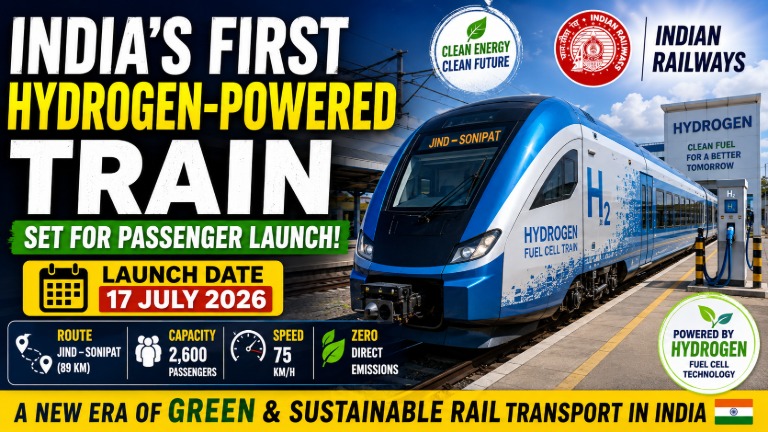
India is set to achieve another major milestone in sustainable transportation as Indian Railways prepares to launch the country’s first hydrogen-powered passenger train on July 17, 2026. The project marks a significant step toward reducing carbon emissions and supporting India’s ambitious clean energy goals under the National Green Hydrogen Mission.
According to railway officials, the hydrogen fuel cell train will begin commercial passenger operations between Jind and Sonipat in Haryana, making India one of the few countries in the world to deploy hydrogen-powered passenger rail technology.
Reports suggest that Prime Minister Narendra Modi is expected to flag off the inaugural journey, highlighting the importance of the project in India’s transition toward greener transportation.
What Makes India’s Hydrogen Train Special?
Unlike conventional diesel trains, the new train operates using hydrogen fuel cell technology, which generates electricity by combining hydrogen with oxygen.
The only by-products of this process are:
- Water vapour
- Heat
This means the train produces zero direct carbon emissions, making it one of the cleanest forms of railway transport currently available.
Hydrogen-powered trains are considered an ideal solution for routes where complete railway electrification is either expensive or technically challenging.
Key Features of India’s First Hydrogen Train
The newly developed train comes equipped with several advanced features.
Train Specifications

- Launch Date: July 17, 2026
- Route: Jind – Sonipat (Haryana)
- Distance: 89 kilometres
- Operational Speed: 75 km/h
- Passenger Capacity: Around 2,600 passengers
- Coaches: 10
- Power Source: Two hydrogen fuel cells
- Fuel Cell Capacity: 1.2 MW each
Indian Railways says the train has been designed to deliver reliable performance while significantly reducing environmental impact.
Dedicated Hydrogen Refueling Station Built in Haryana
One of the biggest achievements of this project is not just the train—but the complete hydrogen ecosystem developed to support it.
A dedicated hydrogen production and refuelling station has been established in Jind, Haryana.
The facility includes:
- Hydrogen generation unit
- High-pressure storage tanks
- Compression system
- Automated dispensing station
This integrated setup ensures uninterrupted train operations without depending on external hydrogen supply chains.
Hydrogen Production Capacity
The hydrogen station will be powered by a 1 MW Proton Exchange Membrane (PEM) electrolysis system developed by GreenH Electrolysis.
Its production capability includes:
- Hydrogen Production: Up to 430 kilograms per day
- Hydrogen Storage Capacity: 3,000 kilograms
- Refuelling Pressure: 350 bar
The hydrogen generated at the facility will directly fuel the passenger train operating on the Jind-Sonipat corridor.
Why Indian Railways Is Investing in Hydrogen
Indian Railways has already electrified more than 99% of its broad-gauge railway network, making it one of the world’s largest electrified rail systems.
However, officials believe hydrogen-powered trains can play an important role in:
- Remote railway sections
- Heritage rail routes
- Difficult terrains
- Areas where complete electrification is not economically viable
Instead of relying on diesel locomotives, hydrogen offers a clean alternative while maintaining operational efficiency.
A Step Towards India’s Green Hydrogen Mission
The launch aligns closely with the Government of India’s National Green Hydrogen Mission, which aims to make India a global leader in green hydrogen production.
The mission targets:
- Annual production of 5 million tonnes of green hydrogen
- Reduced fossil fuel dependence
- Lower greenhouse gas emissions
- Increased renewable energy adoption
- Development of hydrogen-based industries
Transportation has been identified as one of the priority sectors for hydrogen adoption, making Indian Railways a key participant in this transformation.
Global Hydrogen Railway Movement
India joins a growing list of countries investing in hydrogen-powered rail transport.
Recent international developments include:
- Germany operating hydrogen passenger trains
- Romania purchasing 12 hydrogen-powered trains from Siemens
- Expansion of hydrogen-powered buses across Europe
- Delhi Metro introducing hydrogen fuel-cell buses earlier this year
With the successful deployment of this project, India aims to strengthen its position in clean mobility innovation.
Environmental Benefits of Hydrogen Trains
Hydrogen-powered trains are widely regarded as one of the cleanest alternatives to diesel locomotives. Unlike diesel engines that emit carbon dioxide, nitrogen oxides, and particulate matter, hydrogen fuel cell trains produce only water vapour and heat during operation.
Some of the major environmental benefits include:
- Zero direct carbon emissions
- Reduced air pollution
- Lower greenhouse gas emissions
- Quieter operations compared to diesel locomotives
- Improved energy efficiency through fuel cell technology
As India moves towards cleaner transportation, hydrogen trains are expected to play an important role in achieving the country’s long-term climate goals.
Challenges Ahead
While hydrogen technology offers significant environmental advantages, there are still challenges that need to be addressed before large-scale deployment.
These include:
- High infrastructure costs for hydrogen production and storage.
- Expensive fuel cell systems.
- Need for dedicated refuelling stations.
- Scaling up green hydrogen production.
- Long-term maintenance and operational expertise.
Experts believe that continued investment and technological advancements will gradually reduce these costs over the coming years.
What This Means for Indian Railways
The launch of India’s first hydrogen-powered train is more than just a technological achievement—it signals the beginning of a new chapter in sustainable railway transportation.
If the Jind–Sonipat pilot project proves successful, Indian Railways may introduce similar trains on:
- Remote railway routes
- Heritage railway lines
- Non-electrified branch lines
- Eco-sensitive regions
This could eventually reduce dependence on diesel-powered trains while supporting India’s commitment to clean energy and carbon reduction.
A Boost for India’s Hydrogen Economy
The project also strengthens India’s ambitions to become a global leader in green hydrogen.
Hydrogen demand is expected to grow rapidly across multiple sectors, including:
- Railways
- Public transportation
- Heavy industries
- Shipping
- Aviation
- Power generation
Successful implementation in Indian Railways could encourage wider adoption of hydrogen technology across the country’s transportation ecosystem.
Future Expansion Plans
Industry experts believe the launch of the first hydrogen-powered train is only the beginning.
In the coming years, Indian Railways could:
- Develop additional hydrogen train corridors.
- Build more hydrogen production facilities.
- Expand refuelling infrastructure.
- Integrate renewable energy for hydrogen generation.
- Reduce operational costs through domestic manufacturing.
Such initiatives would further strengthen India’s position as a global clean-energy leader.
FAQs
When will India’s first hydrogen-powered train start?
The train is scheduled to begin passenger service on July 17, 2026.
Where will the hydrogen train operate?
It will run on the 89-kilometre Jind–Sonipat route in Haryana.
How many passengers can the train carry?
The train has a capacity of approximately 2,600 passengers across 10 coaches.
How fast will the train run?
Its operational speed is 75 km/h.
How does a hydrogen train work?
It uses hydrogen fuel cells that generate electricity by combining hydrogen with oxygen. The process produces only water vapour and heat.
Why is this train important?
It represents India’s first hydrogen-powered passenger train and supports the country’s transition towards environmentally friendly transportation under the National Green Hydrogen Mission.
Conclusion
The launch of India’s first hydrogen-powered passenger train marks a historic milestone for Indian Railways and the nation’s clean-energy ambitions. By combining advanced fuel cell technology with dedicated hydrogen production infrastructure, India is taking a significant step towards sustainable mobility.
Although challenges remain in expanding hydrogen infrastructure nationwide, the successful rollout of this project could pave the way for a new generation of zero-emission trains across the country. As India continues investing in green hydrogen and renewable energy, projects like this demonstrate the nation’s commitment to building a cleaner, more sustainable transportation future.
Disclaimer
This article is published for informational and educational purposes only. The information is based on official announcements, publicly available reports, and credible news sources available at the time of publication. While every effort has been made to ensure accuracy, details may change as new information becomes available. RoyDailyUpdate does not claim ownership of third-party content or images used for reference and encourages readers to verify important information through official sources such as Indian Railways and the Ministry of Railways before making any decisions.
Do Follow For More Info @ http://roydailyupdate.in
Do connect WhatsApp @ https://chat.whatsapp.com/K5POJK9KbpN8egjjOCaOw6