

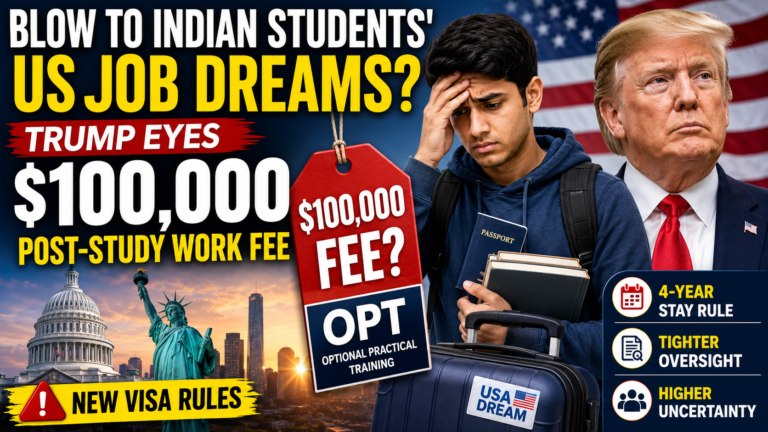
Trump’s Proposed $100,000 OPT Fee Could Shake Indian Students’ American Dream
What It Means for Future Graduates
Introduction
The United States has long been one of the most preferred destinations for Indian students seeking world-class education and global career opportunities. Every year, thousands of students invest significant amounts of money to pursue higher education in American universities, hoping to gain valuable international work experience after graduation through the Optional Practical Training (OPT) programme.
However, that pathway may soon become much more expensive and uncertain.
The administration of US President Donald Trump is reportedly considering a proposal that would require international graduates to pay a massive $100,000 (approximately ₹95 lakh) fee to work in the United States after completing their studies under the Optional Practical Training (OPT) programme.
Alongside this proposal, the administration has also introduced plans to tighten student visa rules by limiting the duration international students can stay in the US without additional government approval.
If implemented, these measures could significantly reshape the future of international education in America—especially for Indian students, who form one of the largest overseas student communities in the country.
Why Is This Proposal Making Headlines?
According to reports, the US Department of Homeland Security (DHS) is evaluating a proposal that would introduce a $100,000 fee for international graduates who wish to work in the United States under the Optional Practical Training programme after finishing their academic courses.
Although the proposal has not yet been approved, it has already sparked widespread concern among universities, employers, education consultants, and international students worldwide.
Experts believe such a high fee could become one of the biggest financial barriers ever imposed on foreign graduates seeking employment in the United States.
What Is Optional Practical Training (OPT)?
For many international students, the OPT programme is one of the primary reasons for choosing the United States over other study destinations.
Optional Practical Training allows students studying on an F-1 student visa to remain in the United States after graduation and work in jobs directly related to their field of study.
Currently:
Most graduates can work for up to one year after completing their degree.
Students pursuing Science, Technology, Engineering and Mathematics (STEM) courses can receive an additional extension, allowing them to work for up to three years.
The programme helps graduates:
Gain professional work experience.
Build international careers.
Improve employability.
Transition to longer-term work visas such as the H-1B visa.
For thousands of Indian students, OPT acts as the bridge between education and employment in the US.
The Proposed $100,000 Fee Explained
Reports indicate that the Trump administration is considering charging $100,000 for participation in the OPT programme.
At present, government officials have not finalized several important aspects of the proposal, including:
Whether students themselves will pay the fee.
Whether employers hiring international graduates will bear the cost.
Whether the fee will apply to all graduates or selected categories.
The proposal is reportedly still under internal discussions within the Department of Homeland Security and has not yet become official policy.
However, even the possibility of such a fee has created uncertainty among international students planning their future careers.
Why Does OPT Matter So Much?
For most Indian families, studying in the United States represents one of the biggest financial investments they will ever make.
Tuition fees, accommodation expenses, insurance, transportation, and living costs can easily run into several lakhs—or even crores—of rupees over the course of a degree.
The opportunity to work through OPT helps graduates:
Recover part of their educational investment.
Gain valuable international work experience.
Build professional networks.
Improve their chances of obtaining permanent employment.
Without OPT, many students would struggle to justify the enormous financial commitment required to study abroad.
How Could the Proposal Affect Employers?
The proposal may not only impact students but also companies hiring international talent.
If employers are required to pay the proposed $100,000 fee, many businesses could reconsider recruiting foreign graduates due to the additional financial burden.
Instead, companies may choose to hire American citizens or permanent residents to avoid the extra costs.
If students themselves are expected to pay the amount, many graduates may simply be unable to afford it, forcing them to return to their home countries immediately after graduation.
In either scenario, experts believe the proposal could significantly reduce employment opportunities for international graduates.
Universities Raise Concerns
Higher education institutions across the United States have also expressed concern over the proposal.
American universities compete globally to attract talented international students, who contribute billions of dollars annually to the US economy through tuition fees and living expenses.
Education experts warn that introducing such a substantial financial requirement could discourage students from choosing the United States in favor of countries like:
Canada
Australia
Germany
United Kingdom
Ireland
These countries continue offering comparatively more predictable post-study work opportunities for international graduates.
Nearly 4.2 Lakh Students Could Be Affected
According to available figures, approximately 419,000 international graduates were working under the Optional Practical Training programme in 2024.
Any major changes to OPT could therefore affect hundreds of thousands of students currently studying or planning to study in the United States.
For Indian students—who make up one of the largest international student communities in America—the proposal has generated widespread concern about future career prospects after graduation.
New Four-Year Student Visa Rule Adds More Uncertainty
The proposed $100,000 OPT fee is not the only change under consideration. The Trump administration has also introduced a major reform to how long international students can legally remain in the United States.
For many years, students entered the US under a system known as “Duration of Status (D/S).” Under this rule, students could stay in the country as long as they maintained full-time student status and complied with visa conditions.
The new proposal would replace this flexible system with a fixed stay period.
Under the revised framework:
Most international students would receive permission to stay in the US for up to four years.
Students enrolled in longer programmes such as PhDs, medical degrees, or research-based courses would need to apply for an extension from the Department of Homeland Security (DHS) before their authorised stay expires.
Similar rules would also apply to several exchange visitors and foreign journalists.
The regulation is still subject to legislative approval before it officially comes into force.
Why Is the US Tightening Student Visa Rules?
According to the Trump administration, the proposed changes are aimed at strengthening immigration oversight and protecting the integrity of the US immigration system.
A spokesperson from the Department of Homeland Security stated that no proposal should be considered final until officially announced but added that the department is continuously evaluating measures to improve monitoring of legal immigration programmes.
Over the past year, the administration has already introduced stricter immigration measures, including tighter scrutiny of student visas and reforms related to the H-1B work visa programme. Officials have also indicated that broader changes to the Optional Practical Training (OPT) programme may be announced later this year.
What Could This Mean for Indian Students?
Indian students are among the largest international student communities in the United States, with more than 3.3 lakh students currently enrolled in American colleges and universities.
If the proposed measures are implemented, Indian students could face several challenges:
A significantly higher financial burden if they wish to work after graduation.
Reduced job opportunities if employers hesitate to pay the proposed OPT fee.
Greater uncertainty regarding long-term career planning in the US.
Additional paperwork and approvals for students enrolled in courses exceeding four years.
For students currently planning higher education in America, the proposals do not require immediate changes to their plans because they have not yet become law. However, they signal a shift toward stricter immigration and post-study employment policies.
Students Should Stay Updated
Education consultants recommend that prospective students continue monitoring official announcements from:
US Department of Homeland Security (DHS)
US Citizenship and Immigration Services (USCIS)
US Department of State
American universities
Since both proposals are still under discussion, important details—including implementation dates, exemptions, and payment responsibilities—could change before any final decision is made.
Final Thoughts
The United States has long attracted international students by combining world-class education with opportunities to gain professional experience through programmes like OPT.
The proposed $100,000 OPT fee and the planned four-year student visa limit represent one of the most significant shifts in US international education policy in recent years.
If approved, these changes could make studying and working in the United States more expensive, more regulated, and less predictable—particularly for Indian students, who rely heavily on post-study work opportunities to recover their educational investment.
While the proposals are not yet official, they highlight the importance of staying informed about evolving immigration policies before making major education and career decisions.
FAQs
Has the US approved the $100,000 OPT fee?
No. The proposal is still under consideration by the Department of Homeland Security and has not yet been approved.
What is OPT?
Optional Practical Training (OPT) allows international students on F-1 visas to work in the United States after graduation in jobs related to their field of study.
How long can students currently work under OPT?
Most graduates can work for one year, while eligible STEM graduates may work for up to three years through an extension.
Will Indian students be affected?
Yes. If implemented, Indian students—who form one of the largest international student groups in the US—could face higher costs and increased uncertainty regarding post-study employment.
Has the four-year visa rule taken effect?
No. The proposed four-year stay rule has not yet been implemented and still requires further approval.
Disclaimer
This article is based on publicly available reports and official statements available at the time of writing. The proposed $100,000 OPT fee and related student visa changes have not yet been officially implemented. Readers should refer to official announcements from the US Department of Homeland Security (DHS), USCIS, and the US Department of State for the latest updates before making education or immigration decisions.
Do Follow For More Info @ http://roydailyupdate.in
Do WhatsApp @ https://chat.whatsapp.com/K5POJK9KbpN8egjjOCaOw6