

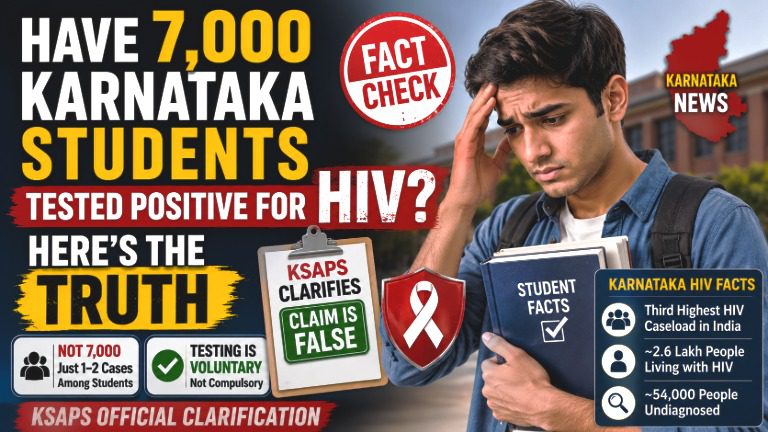
Fact Check: Karnataka Government Debunks Viral Claim That 7,000 Students Tested HIV Positive
A viral claim suggesting that 7,000 college students in Karnataka tested HIV positive has been officially denied by the Karnataka State AIDS Prevention Society (KSAPS).
The clarification comes after several media reports incorrectly interpreted HIV data, leading to widespread concern among students, parents, and educational institutions across the state.
According to KSAPS, the figure being circulated is completely inaccurate, and there is no official data showing that 7,000 students have been diagnosed with HIV.
Why Did the Confusion Start?
The controversy began after reports claimed that around 7,000 students aged between 18 and 25 years had tested positive for HIV in Karnataka.
Several reports cited data from the National AIDS Control Organisation (NACO) and suggested that the infections were primarily among college students.
However, Karnataka health officials have now clarified that this interpretation is factually incorrect.
KSAPS Issues Official Clarification
The Karnataka State AIDS Prevention Society (KSAPS) has urged media organisations to immediately correct the misleading reports.
Officials explained that:
HIV data is not classified by profession or educational status.
There is no database identifying 7,000 HIV-positive students.
The figure originated from an incorrect interpretation of cumulative age-group statistics.
KSAPS warned that spreading incorrect information can create unnecessary panic and increase stigma surrounding HIV.
What Do the Official Numbers Actually Say?
KSAPS Project Director Padma Basavanthappa clarified that:
Approximately 39,000 people aged between 18 and 35 years have tested HIV positive cumulatively since 2004.
These individuals include people from all professions and backgrounds, not just students.
There is no official record showing that 7,000 college students are HIV positive.
She further stated that the actual number of HIV-positive college-going students is only one or two reported cases, not thousands as claimed online.
Why Are Colleges Organising Health Camps?
The Karnataka government has recently directed:
Government colleges
Government-aided colleges
Private engineering colleges
Degree colleges
to organise Integrated Health Camps (IHCs).
These camps include:
HIV awareness
Health counselling
Voluntary HIV testing
General health screening
Preventive healthcare education
Officials emphasised that the initiative aims to improve public health awareness—not because thousands of students have been infected.
Is HIV Testing Compulsory in Karnataka Colleges?
No.
KSAPS has categorically stated that reports claiming HIV testing has been made compulsory for college students are false and misleading.
Under the HIV and AIDS (Prevention and Control) Act, 2017, no individual can be forced to undergo an HIV test without informed consent.
The Integrated Health Camps being organised in colleges are intended to:
Increase awareness about HIV/AIDS.
Provide voluntary counselling.
Offer optional HIV testing.
Promote early diagnosis and preventive healthcare.
Educate students about safe health practices.
Participation in HIV testing remains entirely voluntary.
Karnataka Continues HIV Awareness Efforts
Although the viral claim is false, Karnataka remains one of the states with a relatively high HIV burden.
According to the National AIDS Control Organisation (NACO):
Karnataka has the third-highest HIV caseload in India.
Around 2.6 lakh people are estimated to be living with HIV in the state.
Nearly 54,000 people are believed to remain undiagnosed.
Health experts say early testing, awareness campaigns, counselling, and timely treatment are essential to reducing new infections.
Why False HIV Reports Are Dangerous
Medical experts warn that misinformation surrounding HIV can have serious consequences.
False reports may:
Create unnecessary panic among students and parents.
Increase discrimination against people living with HIV.
Discourage individuals from getting tested voluntarily.
Spread fear instead of awareness.
Undermine public health campaigns.
KSAPS has therefore appealed to media organisations and social media users to verify information before sharing it publicly.
Understanding HIV
Human Immunodeficiency Virus (HIV) attacks the body’s immune system.
Without proper treatment, HIV can gradually develop into Acquired Immunodeficiency Syndrome (AIDS).
However, with modern antiretroviral therapy (ART):
People living with HIV can live long, healthy lives.
Early diagnosis significantly improves treatment outcomes.
HIV transmission can be greatly reduced with proper medical care.
According to the World Health Organization (WHO), HIV has claimed more than 44 million lives worldwide, making awareness and early intervention critically important.
Key Takeaways
The viral claim that 7,000 Karnataka students tested HIV positive is false.
KSAPS says the figure resulted from a misinterpretation of cumulative HIV data.
Official records do not classify HIV cases by student status.
HIV testing in Karnataka colleges is voluntary, not compulsory.
Integrated Health Camps are intended to improve awareness and preventive healthcare.
Frequently Asked Questions (FAQs)
Did 7,000 Karnataka students really test HIV positive?
No. KSAPS has officially clarified that this claim is false.
Is HIV testing compulsory in Karnataka colleges?
No. HIV testing remains voluntary under the HIV and AIDS (Prevention and Control) Act, 2017.
Why are colleges conducting health camps?
The camps aim to spread awareness, provide counselling, offer voluntary health screening, and encourage preventive healthcare.
Does Karnataka have a high HIV burden?
Yes. According to NACO, Karnataka has one of India’s highest HIV caseloads, but the viral claim specifically about 7,000 students is incorrect.
What should people do before sharing such reports?
Always verify health-related claims through official government agencies or trusted public health organisations before sharing them.
Conclusion
The Karnataka State AIDS Prevention Society has made it clear that reports claiming 7,000 students tested HIV positive are incorrect. The confusion arose from an inaccurate interpretation of cumulative HIV statistics rather than official student-specific data.
As misinformation can cause unnecessary fear and stigma, relying on verified information from official sources remains essential. While Karnataka continues to strengthen HIV awareness through voluntary health camps and counselling, there is no evidence supporting the viral claim that thousands of college students have been diagnosed with HIV.
Disclaimer
This article is intended for informational purposes only and is based on official clarifications issued by the Karnataka State AIDS Prevention Society (KSAPS) and publicly available information. Readers should rely on official government announcements and qualified healthcare professionals for medical guidance. Avoid sharing unverified health-related information that may contribute to misinformation or stigma.
Do Follow For More Info @ http://roydailyupdate.in
Do WhatsApp @ https://chat.whatsapp.com/K5POJK9KbpN8egjjOCaOw6