

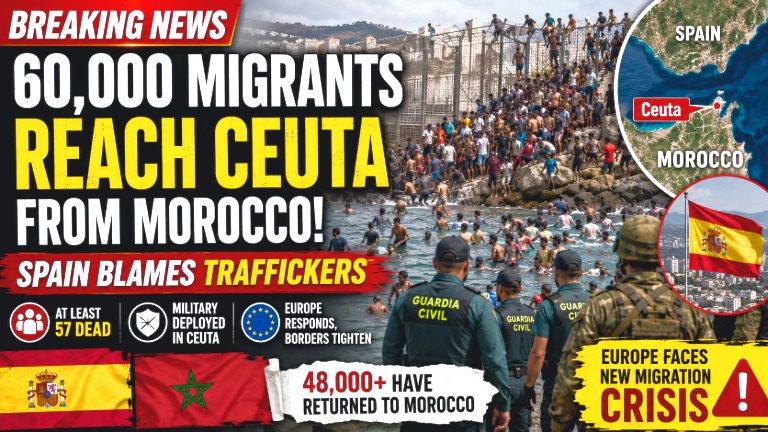
Spain Blames Human Traffickers After 60,000 Migrants Reach Ceuta from Morocco; Europe Tightens Border Security
Key Highlights
Around 60,000 migrants crossed from Morocco into Spain’s North African enclave of Ceuta in one of the largest migration surges in recent European history.
At least 57 people reportedly died during the dangerous crossings, according to authorities and media reports.
Spanish Prime Minister Pedro Sánchez blamed human trafficking networks, saying they misrepresented a recent court ruling to encourage crossings.
Spain deployed military and additional security forces to Ceuta and Melilla.
Italy temporarily introduced additional travel checks with Spain under Schengen rules, while several European leaders called for stronger external border protection.
More than 48,000 migrants had voluntarily returned to Morocco by Friday evening, according to Spanish officials.
Spain Faces One of Its Biggest Migration Challenges
Spain is dealing with an unprecedented migration emergency after tens of thousands of migrants crossed into Ceuta, a Spanish territory on the North African coast bordering Morocco.
Authorities estimate that roughly 60,000 people entered Ceuta within about 24 hours, overwhelming local infrastructure, border personnel, and emergency services. The sudden influx has drawn international attention and intensified debate over migration policy, border security, and humanitarian responsibilities across Europe.
The incident has become one of the most significant migration events in Europe in recent years.
PM Pedro Sánchez Blames Human Trafficking Networks
Speaking during a visit to Ceuta, Spanish Prime Minister Pedro Sánchez rejected suggestions that the recent Spanish Supreme Court ruling itself caused the crisis.
Instead, he argued that human trafficking organizations deliberately misrepresented the legal decision, convincing thousands of migrants that reaching Ceuta would allow them to remain in Spain without immediate return.
According to Sánchez:
Criminal trafficking networks spread false information.
Rumors circulated rapidly through social media and messaging platforms.
The misinformation encouraged thousands of people to attempt dangerous sea crossings simultaneously.
He described the incident as a violation of Spain’s territorial integrity and pledged stronger cooperation with Morocco to restore order.
A Dangerous Journey Claims Lives
The humanitarian cost of the crisis has been severe.
Many migrants attempted to reach Ceuta by:
Swimming around border barriers.
Crossing rough coastal waters.
Climbing difficult rocky shorelines.
Entering through overcrowded border areas.
Authorities reported that at least 57 people died, with fatalities linked to drowning and crowd-related incidents during the chaotic crossings.
The tragedy has renewed concerns about the deadly risks faced by migrants attempting irregular journeys into Europe.
Thousands Return to Morocco
Despite the massive influx, Spanish officials stated that over 48,000 migrants voluntarily returned to Morocco within a short period after entering Ceuta.
Many migrants cited difficult conditions inside the overcrowded enclave and the dangers of the journey.
Authorities continue processing remaining arrivals while coordinating closely with Moroccan officials on returns and humanitarian assistance.
Military Deployed to Secure Ceuta
As border facilities became overwhelmed, Spain deployed:
Military personnel
National Police
Civil Guard officers
Additional emergency teams
Security forces strengthened patrols around both Ceuta and Melilla, Spain’s two autonomous cities in North Africa.
The government also announced plans to review border protection measures and reinforce cooperation with Moroccan authorities to prevent further mass crossings.
Italy and Europe React
The migration surge quickly became a broader European issue.
Italy announced temporary additional travel checks on passengers traveling between Spain and Italy under Schengen provisions, citing public security concerns.
European leaders expressed varying views:
Some called for stronger protection of the EU’s external borders.
Others emphasized solidarity with Spain while supporting humanitarian assistance.
The European Commission described the situation as unacceptable and urged coordinated action.
Why Is Ceuta So Important?
Ceuta occupies a unique geopolitical position.
Although located on the North African coast, it is Spanish territory and therefore part of the European Union.
Key facts:
Shares a land border with Morocco.
Represents one of the EU’s only land borders with Africa.
Has long been a focal point for irregular migration.
Frequently experiences attempted crossings by land and sea.
Because of its location, Ceuta remains one of Europe’s most sensitive migration corridors.
Humanitarian Challenges
The sudden arrival of tens of thousands of people created immediate pressure on:
Emergency shelters
Medical services
Food supplies
Local security
Transportation
Sanitation
Many arrivals included women, children, and unaccompanied minors, requiring additional humanitarian support alongside border management efforts.
What Happens Next?
Spanish authorities are expected to continue:
Returning eligible migrants under existing legal procedures.
Investigating trafficking networks.
Working with Moroccan authorities on border enforcement.
Reviewing legal and operational measures following the Supreme Court ruling.
European institutions are also expected to discuss broader migration and border security policies in light of the incident.
Expert Analysis: Why Did the Ceuta Migration Crisis Happen?
The sudden arrival of around 60,000 migrants in Ceuta is the result of multiple interconnected factors rather than a single event. Experts say migration flows toward Europe are often influenced by legal developments, economic hardship, organized trafficking networks, and geopolitical tensions.
1. Human Trafficking Networks
Spanish Prime Minister Pedro Sánchez said criminal trafficking organizations misrepresented a recent Spanish Supreme Court ruling, convincing migrants that they could easily remain in Spain if they reached Ceuta.
Trafficking groups often use:
Social media
Messaging apps
False promises
Rumours about immigration laws
These campaigns encourage dangerous sea crossings despite the high risk of injury or death.
2. Economic Challenges in North Africa
Many migrants leave their homes because of:
High unemployment
Rising living costs
Limited job opportunities
Political uncertainty
Better economic prospects in Europe
For many young people, Europe represents hope for employment, education, and a better future.
3. Ceuta’s Strategic Location
Ceuta is one of the European Union’s most unique territories.
Although it belongs to Spain, it is located on the North African coast and shares a land border with Morocco.
This makes Ceuta one of the most important entry points into Europe.
Why Is Ceuta So Important?
Ceuta covers only about 18 square kilometres, yet it holds enormous strategic importance.
Key Facts
Spanish autonomous city
Located in North Africa
European Union territory
Shares border with Morocco
One of only two EU land borders with Africa (the other being Melilla)
Because entering Ceuta means reaching European Union territory, it has remained a major migration hotspot for decades.
Spain–Morocco Relations
Migration has long been a sensitive issue between Spain and Morocco.
Although both countries cooperate on border security, disagreements occasionally arise over:
Border management
Migration policy
Territorial disputes involving Ceuta and Melilla
Maritime issues
Despite political differences, both governments frequently work together to prevent irregular migration.
Europe’s Migration Challenge
Migration remains one of the European Union’s biggest political challenges.
Thousands of migrants attempt to enter Europe every year through routes including:
Mediterranean Sea
The world’s deadliest migration route.
Canary Islands
Growing route from West Africa.
Balkan Route
Connecting the Middle East with Central Europe.
Ceuta & Melilla
Direct land access into EU territory.
European governments continue debating how to balance:
Humanitarian obligations
Border security
International law
Refugee protection
Anti-smuggling operations
Humanitarian Concerns
The Ceuta crisis highlights the human cost of irregular migration.
Many migrants face:
Dangerous sea crossings
Dehydration
Exhaustion
Injury
Exploitation by traffickers
Aid organizations often stress that migrants should be protected from criminal networks while governments maintain secure borders.
Security Implications
Large-scale migration events create challenges for authorities.
Security agencies must quickly provide:
Border control
Medical assistance
Temporary shelters
Food and water
Child protection
Identity verification
Managing such a large influx requires coordination between local authorities, national governments, and European institutions.
What Role Did Social Media Play?
Spanish authorities suggested that rumours spread rapidly online encouraged many migrants to attempt the crossing.
Experts note that social media can:
Spread false immigration information
Advertise smuggling routes
Coordinate group movements
At the same time, it also helps humanitarian organizations share emergency information and safety advice.
What Happens Next?
Authorities are expected to focus on:
Returning migrants through legal procedures where applicable
Investigating trafficking networks
Strengthening border security
Expanding cooperation with Morocco
Reviewing migration policies
The European Union may also discuss additional measures to improve external border management.
Frequently Asked Questions (FAQs)
Q1. Where is Ceuta?
Ceuta is a Spanish autonomous city located on the North African coast, bordering Morocco.
Q2. Why is Ceuta important?
It is one of only two European Union land borders with Africa and has long been a major migration route.
Q3. Why did so many migrants arrive?
Spanish authorities say trafficking networks spread misinformation about a recent court ruling, encouraging mass crossings.
Q4. How many migrants reached Ceuta?
Spanish officials reported that approximately 60,000 migrants crossed into Ceuta during the surge.
Q5. What has Spain done?
Spain deployed military personnel, reinforced border security, and coordinated with Morocco to manage the situation.
Q6. Why are traffickers involved?
Organized criminal groups often profit by charging migrants to facilitate dangerous journeys using false promises and misleading information.
Conclusion
The Ceuta migration surge has highlighted the complex intersection of humanitarian concerns, border security, migration policy, and international cooperation.
While Spain attributes the crisis to organized trafficking networks exploiting legal confusion, the tragedy also underscores the risks faced by migrants seeking better opportunities and the continuing challenges confronting Europe in managing irregular migration.
As investigations continue and governments coordinate their response, the events in Ceuta are likely to influence future European migration policy and border management discussions.
Disclaimer:
This article is intended for informational and educational purposes only. It is based on publicly available reports and official statements available at the time of publication. RoyDailyUpdate does not independently verify all claims, casualty figures, or developing events mentioned in the article. Information may change as authorities release new updates. Readers are encouraged to refer to official government announcements and trusted news sources for the latest developments. The views or statements quoted belong to their respective individuals or organizations and do not necessarily reflect the views of RoyDailyUpdate.
Do Follow For More Info @ http://roydailyupdate.in
Do WhatsApp @ https://chat.whatsapp.com/K5POJK9KbpN8egjjOCaOw6