

Bengaluru 5-Star Hotel Food Safety Shock: Expired Meat, Milk Seized at Taj, Radisson, Lalit; Hotels Respond
Bengaluru Hotel Food Safety Raid 2026: A major food-safety inspection drive across Bengaluru’s three-star and five-star hotels has triggered concern after officials reported finding expired food, improper storage, poor hygiene conditions and other alleged violations at several establishments.
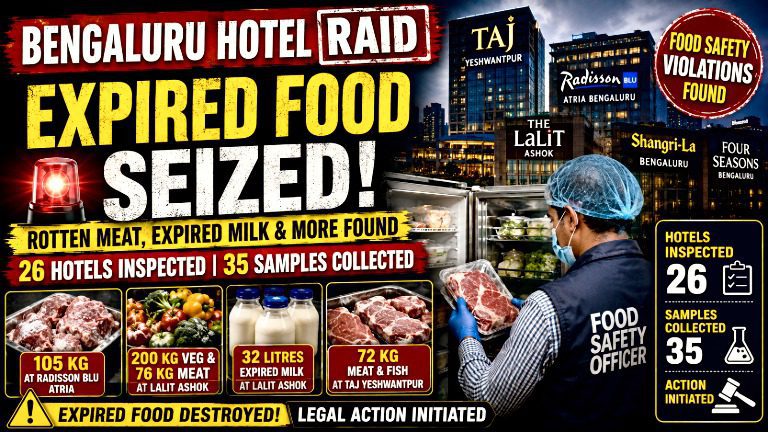
The inspection exercise covered 26 hotels across Bengaluru Urban district, with officials collecting 35 food samples for laboratory testing. According to reports, authorities also seized and destroyed food items that they considered expired or unsafe, including meat, fish, vegetables, bakery products and milk.
Among the prominent hotels named in reports are Taj Yeshwantpur, Vivanta Bengaluru Whitefield, The Lalit Ashok, Shangri-La Bengaluru, Four Seasons Hotel Bengaluru and Radisson Blu Atria Bengaluru.
However, it is important to note that being named in reports about the inspection does not by itself establish that every allegation has been finally proved. Laboratory reports, regulatory proceedings and responses from the concerned establishments will determine the next steps.
The development has put the spotlight on food-storage practices inside Bengaluru’s premium hospitality sector, where customers often pay significantly higher prices expecting stringent standards of hygiene, quality and safety.
What Happened During the Bengaluru Hotel Inspections?
The Karnataka Food Safety and Drug Administration reportedly deployed 30 teams for the inspection operation.
The teams examined hotels across the different BBMP zones and checked compliance with India’s food-safety requirements, including provisions under the Food Safety and Standards Act, 2006 and related regulations.
The inspection was not limited to cooked food.
Officials reportedly checked raw materials, food-storage systems, labelling, kitchen hygiene and the handling of vegetarian and non-vegetarian products.
A total of 35 samples were collected for laboratory examination. These reportedly included chicken, mutton, fish, milk, edible oil, spices, tea powder, cheese, tomato sauce and lemon juice.
The laboratory results could therefore become an important part of determining whether further regulatory action is required.
Bengaluru 5-Star Hotel Food Safety Shock
What Food-Safety Violations Were Reported?
Reports about the inspection listed several categories of alleged violations.
These included:
Expired food products
Improper food storage
Poor hygiene and handling practices
Fungal growth on vegetables
Misbranded products
Labelling violations
Improper segregation of vegetarian and non-vegetarian products
Expired dairy products
Meat and fish that officials considered unsafe or unfit for use
The findings are particularly significant because food-storage practices are an important part of preventing contamination and foodborne illness.
Keeping raw meat, fish, dairy and vegetables at appropriate temperatures and within their permitted shelf life is essential in large commercial kitchens.
The inspection also reportedly found situations where vegetarian and non-vegetarian food materials were not stored separately.
The Lalit Ashok: Meat, Vegetables and Expired Milk Seized
THE LALIT ASHOK was among the properties named in reports concerning the inspection.
According to the reported enforcement details, officials at The Lalit Ashok (Annex South) confiscated and destroyed:
76 kg of meat
200 kg of vegetables
32 litres of expired milk
The quantity of vegetables was particularly large, while the reported discovery of expired milk raised questions about storage and inventory-control practices.
However, the regulatory process does not end with seizure. The authorities’ findings, laboratory reports where applicable and the hotel’s response will be relevant in determining the eventual outcome.
Radisson Blu Atria Reportedly Had the Largest Recovery
Radisson Blu Atria Bengaluru was also named in reports on the inspection.
The reported seizure at the property was among the largest in the operation.
Authorities reportedly destroyed 105 kg of expired food, including chicken, meat, fish and vegetables.
The figure has attracted attention because of the quantity involved.
The hotel’s official website confirms that Radisson Blu Atria Bengaluru operates multiple dining facilities and serves as a full-service hotel in central Bengaluru, making food-safety compliance an important operational requirement.
The inspection findings, however, should not be interpreted as a final legal determination until the regulatory proceedings are completed.
Taj Yeshwantpur Named in the Inspection Reports
Taj Yeshwantpur, Bengaluru was another major hotel mentioned in reports concerning the food-safety operation.
According to the reported inspection findings, authorities seized 72 kg of meat and fish from the property.
Taj Yeshwantpur is an established luxury hotel on Tumkur Road in Yeshwantpur and operates multiple dining facilities. Its official property information lists its address as 2275 Tumkur Road, Yeshwantpur, Bengaluru.
But there is an important counterpoint.
IHCL, the company behind the Taj and Vivanta brands, has disputed the allegations reported against its Bengaluru properties.
In a statement quoted in the source material, an IHCL spokesperson said no rotten vegetables, fruits, meat or fish were found at any IHCL hotels, including Taj and Vivanta properties in Bengaluru, and said no food samples were taken for laboratory testing at those hotels.
That response should be included whenever reporting the allegations to ensure readers understand that the matter is disputed.
Vivanta Bengaluru Whitefield Also Mentioned
Vivanta Bengaluru, Whitefield was also mentioned in reports about the inspection.
The reported seizure involved 3 kg of expired bakery products, which officials reportedly destroyed.
Vivanta Bengaluru Whitefield is a five-star property located on Whitefield Main Road near the International Technology Park Bengaluru.
Again, the IHCL response is important here because the company has disputed the reports concerning its Taj and Vivanta properties.
Shangri-La Bengaluru and Four Seasons Also Named
Shangri-La Bengaluru was reportedly found with 15 kg of meat seized during the inspection.
Four Seasons Hotel Bengaluru at Embassy ONE reportedly had 19 kg of meat confiscated.
These figures are based on the reported enforcement action and should not be treated as proof that the hotels routinely serve unsafe food.
The inspections are part of a regulatory exercise designed to identify potential violations and ensure that food businesses comply with safety requirements.
Why 35 Food Samples Were Collected
The seizure of expired or unsafe food is only one component of the investigation.
The authorities also collected 35 food samples for laboratory analysis.
Those samples reportedly included:
Chicken: to assess quality and safety of poultry products.
Mutton: to check the condition and compliance of meat products.
Fish: to examine the quality and safety of seafood.
Milk: to verify freshness and compliance.
Edible oil: to assess whether the product meets required standards.
Spices and tea powder: to check quality, labelling and possible adulteration.
Cheese: to assess the dairy product.
Tomato sauce and lemon juice: to examine processed and prepared food ingredients.
The laboratory findings could therefore become an important factor in the next stage of the regulatory process.
What Happens After Food-Safety Notices?
When officials identify suspected violations, the process does not necessarily mean an establishment is immediately shut down.
Food-safety authorities can issue notices to the relevant Food Business Operators and initiate proceedings where violations are established.
The nature of the action can depend on the type and severity of the violation, laboratory findings and other evidence gathered during the inspection.
In this case, reports indicate that notices were issued and adjudication proceedings were expected where violations were established.
That distinction matters.
A notice or inspection finding is not the same thing as a final conviction or final regulatory finding.
For responsible reporting, it is therefore better to say that a hotel was “named in the inspection” or that officials “reported finding” a particular item rather than declaring that the hotel definitively served rotten food to customers.
Why Food Storage Is So Important in Hotels
Large hotels operate kitchens that handle enormous quantities of food every day.
Unlike a small household kitchen, hotel kitchens may simultaneously manage meat, seafood, dairy, vegetables, sauces, bakery products and prepared meals.
This creates a complex food-safety environment.
Hotels need to maintain:
Correct refrigeration temperatures
Proper freezer conditions
Clear expiry-date monitoring
Appropriate stock rotation
Separate storage for different food categories
Clean preparation areas
Proper pest-control systems
Safe handling practices
Accurate food labels
Hygienic equipment
Trained food handlers
Even one weak link in this chain can increase the risk of contamination.
That is why inspections of large hotels are particularly important.
What Does FSSAI Compliance Mean for Hotels?
The Food Safety and Standards Authority of India, commonly known as FSSAI, establishes the regulatory framework governing food safety in India.
Hotels, restaurants and other food businesses are expected to maintain standards relating to food handling, storage, hygiene, labelling and other operational requirements.
The Bengaluru inspection reportedly checked several of these areas.
Officials reportedly found issues involving labelling and the storage of vegetarian and non-vegetarian products.
Such findings can become important because proper segregation helps reduce the risk of cross-contamination.
Bengaluru’s Premium Hotel Sector Under the Scanner
The inspection has generated wider questions about whether food-safety enforcement should be conducted more frequently in premium hotels.
Five-star properties often have multiple restaurants, banquet operations, buffets, room-service facilities and large kitchens.
The volume and variety of food handled can be significantly greater than at many smaller establishments.
At the same time, customers often associate luxury hotels with premium hygiene and quality.
Therefore, when food-safety allegations emerge from high-end establishments, the public reaction can be particularly strong.
The issue is not only about individual hotels.
It is about the broader standards expected across Bengaluru’s hospitality industry.
Hotels Have Also Responded
One of the most important aspects of this story is that not every reported allegation is uncontested.
IHCL issued a statement disputing reports about rotten food at its Bengaluru Taj and Vivanta properties.
The company said:
“Food safety and hygiene remain non-negotiable priorities for us.”
IHCL further stated that no rotten vegetables, fruits, meat or fish were found at its Bengaluru Taj and Vivanta hotels and disputed reports claiming that rotten food was discovered at those properties.
This response should be considered alongside the authorities’ reported inspection findings.
As the process continues, laboratory reports and official proceedings may provide additional clarity.
What Bengaluru Residents Should Know
The inspection does not mean that customers should automatically assume that food served at all five-star hotels in Bengaluru is unsafe.
Instead, the incident highlights why food-safety monitoring is necessary even at premium establishments.
Customers can also take basic precautions when dining out.
They should pay attention to food temperature, freshness, unusual smell or appearance and overall cleanliness.
If someone believes they have experienced a food-safety problem, they can preserve relevant information such as the bill, restaurant details and photographs and report the matter through the appropriate food-safety channels.
The Bigger Question: Can Bengaluru Strengthen Food Safety?
Bengaluru’s rapid growth has created a massive hospitality and food-service ecosystem.
From five-star hotels to independent restaurants, cafes, cloud kitchens and street-food businesses, thousands of establishments serve food every day.
Regular inspections can help ensure that businesses maintain standards even after obtaining their licences.
The latest hotel inspections show that food safety cannot be treated as a one-time compliance exercise.
Stock rotation, refrigeration, labelling, kitchen cleanliness and employee hygiene all require continuous monitoring.
For hotels, maintaining those standards is not only a regulatory requirement but also a fundamental part of protecting customers and preserving brand reputation.
Final Takeaway
The Bengaluru food-safety inspection has brought renewed attention to hygiene and food-storage practices inside the city’s premium hotels.
Officials reportedly inspected 26 three-star and five-star hotels, collected 35 food samples and seized or destroyed substantial quantities of food that they considered expired or unsafe. The reported recoveries included 105 kg at Radisson Blu Atria, 76 kg of meat and 200 kg of vegetables along with 32 litres of expired milk at The Lalit Ashok, 72 kg of meat and fish at Taj Yeshwantpur, 15 kg of meat at Shangri-La and 19 kg of meat at Four Seasons.
At the same time, IHCL has strongly disputed reports concerning its Taj and Vivanta properties, making it important to wait for the official process and available laboratory findings before drawing final conclusions about those establishments.
For Bengaluru residents and visitors, the bigger takeaway is straightforward: food safety standards must apply equally to small eateries and luxury hotels. Regular inspections, transparent enforcement and strict kitchen hygiene remain essential to ensuring that customers can eat out with confidence.
This story will be updated if Karnataka food-safety authorities release additional laboratory results, notices, penalties or clarifications.
Disclaimer:
This article is based on reports and information available at the time of publication. Allegations or inspection findings involving individual hotels should not be interpreted as final legal or regulatory findings unless officially established by the competent authorities. The concerned establishments may provide their own explanations or responses, and those responses should be considered alongside the authorities’ findings. Readers should refer to official statements from Karnataka’s food-safety authorities and the concerned hotel companies for subsequent updates. Roy Daily Update does not intend to make any unverified allegation against any individual, company or establishment.
Do Follow For More Info @ http://roydailyupdate.in
Do WhatsApp @ https://chat.whatsapp.com/K5POJK9KbpN8egjjOCaOw6
About the Author
Ravi H Irannanavar is a blogger and digital content creator who covers breaking news, Karnataka updates, business, stock-market developments, entertainment, technology and other trending stories. Through Roy Daily Update, he focuses on presenting important developments in a clear, reader-friendly format while adding relevant background and context for readers.