

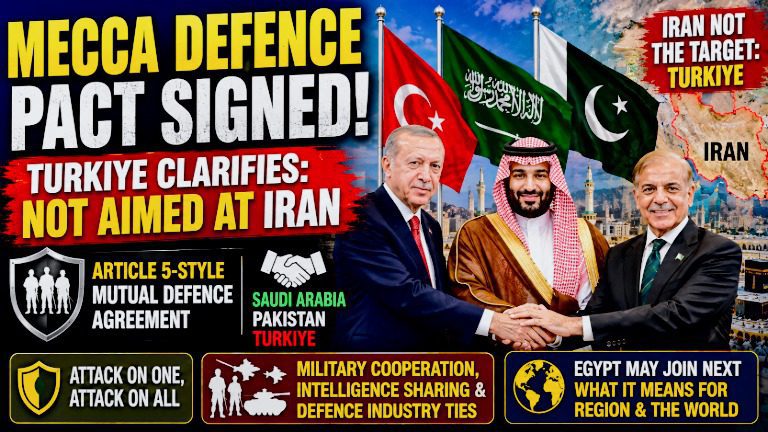
Turkiye Says Mecca Defence Pact Is Not Against Iran: What the Saudi-Pakistan-Turkiye Deal Really Means
Turkiye has moved to clarify the purpose of the newly signed Mecca Joint Defence Agreement with Saudi Arabia and Pakistan, saying the pact is not directed against Iran or any other specific country.
The clarification came one day after Turkish President Recep Tayyip Erdogan, Saudi Crown Prince Mohammed bin Salman and Pakistani Prime Minister Shehbaz Sharif signed the trilateral defence agreement in Mecca on August 7.
The agreement contains an important mutual-defence provision: an armed attack against one of the three countries would be regarded as an attack against all three. Turkish Foreign Minister Hakan Fidan has described the mechanism as technically similar to NATO’s Article 5, although the actual response under the new pact would depend on the circumstances of an attack.
The development is significant because it comes at a time of intense military and diplomatic uncertainty across the Middle East. Iran’s relations with several regional powers remain tense, while Saudi Arabia is seeking stronger regional security arrangements and Turkiye and Pakistan are expanding their defence cooperation.
However, Ankara insists the pact should not be interpreted as the creation of an anti-Iran military bloc.
What is the Mecca Joint Defence Agreement?
The Mecca Joint Defence Agreement is a trilateral security and defence arrangement involving Saudi Arabia, Turkiye and Pakistan.
The central principle is straightforward: if one member is attacked, the other two would regard the attack as affecting the entire group.
However, the agreement does not appear to establish an automatic military response in every situation.
Turkish Foreign Minister Hakan Fidan said the agreement is technically comparable to NATO’s Article 5 collective-defence principle, but assistance would depend on the nature of the crisis.
According to Fidan, a country facing an attack would first request assistance and identify the type of support it requires. That assistance could include intelligence, logistics, ammunition or the deployment of military personnel.
This distinction is important because the pact should not automatically be interpreted as a promise that all three countries would immediately enter a war whenever one member comes under attack.
The agreement also plans to create political and military committees involving foreign and defence ministers and military chiefs. A permanent secretariat is expected to be established in Saudi Arabia.
The three countries are also expected to strengthen cooperation in military training, intelligence sharing, logistics, threat assessments and interoperability.
Why is Turkiye saying the pact is not aimed at Iran?
The timing of the agreement naturally raised questions about Iran.
The Middle East is already experiencing heightened tensions, and Saudi Arabia has faced security threats linked to regional conflicts. Iran’s military capabilities and its relationships with armed groups across the region have also made Tehran a major factor in Gulf security calculations.
Despite this backdrop, Fidan stressed that Iran has not been named as a common enemy in the agreement.
“There is no common threat that we have put in writing,” Fidan said, according to Turkish state media.
He also indicated that countries that do not attack the three members would not be considered targets.
This is an important diplomatic message.
By explicitly refusing to identify Iran as an enemy, Ankara appears to be trying to prevent the new arrangement from being interpreted as a formal anti-Iran alliance.
The pact can therefore be presented by its members as a regional collective-security mechanism rather than an alliance created specifically to confront Tehran.
Reuters and other international reporting similarly highlighted that the agreement contains a collective-defence commitment but does not identify a specific adversary.
How would the Article 5-style mechanism work?
The comparison with NATO’s Article 5 has attracted considerable attention.
NATO’s Article 5 establishes the principle that an armed attack against one member is considered an attack against the alliance. But even within NATO, the response is not necessarily identical in every circumstance.
Fidan’s explanation suggests that the Mecca agreement follows a similar principle.
If Saudi Arabia, Pakistan or Turkiye were attacked, the affected country could request assistance. The other members would then determine the appropriate response.
That response could range from intelligence and logistical assistance to military equipment, ammunition or troops.
This flexibility could become one of the most important characteristics of the new agreement.
Instead of creating an automatic military intervention mechanism, the pact appears designed to give the three governments room to decide how far they want to go in any particular crisis.
The agreement also intends to improve military interoperability, meaning the three armed forces would become better prepared to communicate, coordinate and potentially operate together.
Why Saudi Arabia is interested in stronger defence partnerships
For Saudi Arabia, the agreement comes at a time when regional security has become a much more complicated issue.
The kingdom has traditionally relied heavily on the United States for defence and security support. At the same time, Riyadh has increasingly sought to strengthen relationships with regional powers and diversify its strategic partnerships.
Saudi Arabia already has a longstanding military relationship with Pakistan.
In September 2025, Saudi Arabia and Pakistan signed their own Strategic Mutual Defence Agreement, which stated that aggression against either country would be considered aggression against both. Saudi Arabia has also hosted Pakistani military personnel and aircraft during the current regional crisis.
The new trilateral arrangement therefore builds on an existing Saudi-Pakistani security relationship while adding Turkiye’s military capabilities and defence-industry strength.
For Riyadh, this could provide additional options for intelligence, training, military technology and regional coordination.
Turkiye brings defence technology and NATO experience
Turkiye’s role makes the agreement particularly significant.
Ankara has developed a large domestic defence industry and has become increasingly influential in areas such as drones, electronic warfare, missiles and other military technologies.
Saudi Arabia and Turkiye have already been working together on defence-industrial cooperation.
Saudi Arabia signed agreements with Turkish defence companies in 2023 involving drone acquisition and localisation of defence manufacturing, including cooperation with companies such as Baykar, Aselsan and Roketsan.
The new pact could therefore go beyond traditional military cooperation.
Defence production, technology transfer, joint development and training could become important pillars of the relationship.
Fidan said defence-industry cooperation was among the key subjects discussed by the three leaders in Mecca.
That could eventually mean more joint projects and greater integration between the defence industries of the three countries.
Pakistan’s role is also important
Pakistan brings another major strategic dimension to the agreement.
Islamabad has maintained close military ties with Saudi Arabia for decades, including training and defence cooperation.
Pakistan also possesses one of the region’s most experienced conventional military establishments and has nuclear weapons, although the new agreement does not publicly establish any commitment involving Pakistan’s nuclear arsenal.
That distinction is important.
The pact should not automatically be interpreted as a nuclear-sharing agreement. The publicly described framework focuses on collective security, military cooperation, intelligence, logistics, training and defence capabilities.
Nevertheless, Pakistan’s military weight gives the arrangement additional significance.
The earlier Saudi-Pakistan agreement had already formalised a mutual-defence relationship, while the new trilateral pact expands that framework to include Turkiye.
Iran’s reaction: Tehran is not ignoring the pact
Turkiye’s statement that Iran is not the target has not prevented Iranian officials from commenting on the agreement.
Iranian lawmakers have questioned whether the pact would actually provide Saudi Arabia with additional security.
Some Iranian officials have described the agreement dismissively, while Iranian Foreign Minister Abbas Araghchi urged regional countries to rely on themselves and emphasised Iran’s military preparedness.
This suggests that Tehran is likely to watch how the agreement develops rather than simply accepting Ankara’s explanation.
The key question for Iran will be whether the pact remains a broad regional security arrangement or gradually develops into a more structured military bloc.
If the three countries increase joint exercises, intelligence cooperation and defence-industry integration, Tehran could view the development differently from the way it views the initial declaration.
Could Egypt join the defence pact?
One of the biggest developments surrounding the agreement is the possibility of expansion.
Fidan said Turkiye wants the arrangement to grow beyond the original three members.
Egypt has been identified as a potential future participant.
This is particularly significant because Egypt is one of the Middle East’s major military powers and occupies an important geographical position linking North Africa, the Red Sea and the wider Middle East.
Egypt, Saudi Arabia, Turkiye and Pakistan have already participated in regional consultations.
In June 2026, the four countries held a consultative meeting in Cairo and discussed regional developments, peace, security and stability. Their joint statement also highlighted risks to energy markets, maritime routes, global supply chains and international trade.
If Egypt eventually joins the defence arrangement, the pact could evolve from a three-country agreement into a broader regional security framework.
What does the pact mean for the United States?
The agreement also carries implications for the United States.
Saudi Arabia remains an important US security partner, while Turkiye is a NATO member. Pakistan has also maintained a long history of security cooperation with Washington.
Therefore, the pact should not necessarily be viewed as a rejection of the United States.
Instead, it could indicate that regional countries increasingly want greater control over their own security arrangements.
Fidan argued that external powers entering the region do not necessarily solve regional problems and said regional countries should take greater responsibility for their own security.
That could become one of the most important long-term consequences of the Mecca agreement.
If more Middle Eastern countries begin establishing regional defence mechanisms, the traditional security architecture of the region could gradually change.
What does the pact mean for India?
India is also likely to watch the development carefully because Pakistan is one of the three signatories and Turkiye has deepened its strategic relationship with Islamabad.
However, the Saudi dimension is more complicated.
India has built an increasingly broad strategic and economic relationship with Saudi Arabia, including cooperation in energy, investment, infrastructure and security.
When Saudi Arabia and Pakistan signed their bilateral defence pact in 2025, India’s Ministry of External Affairs said it would study the implications for national security and regional and global stability. New Delhi also emphasised that its strategic partnership with Riyadh should take mutual interests and sensitivities into account.
Therefore, the immediate Indian response is likely to focus on monitoring how the new trilateral framework develops rather than assuming that the agreement automatically changes India’s relations with Saudi Arabia.
Could the pact affect oil prices and global markets?
The economic implications could become important if regional tensions increase.
Saudi Arabia is one of the world’s most important oil producers, while the broader Gulf region is critical to global energy supplies.
Any escalation involving Saudi Arabia, Iran or major shipping routes could increase the geopolitical risk premium in crude oil prices.
Conversely, if the new defence arrangement contributes to deterrence and discourages attacks, markets could eventually interpret it as a stabilising factor.
The Strait of Hormuz remains particularly important for global energy markets. Recent developments around proposed arrangements for reopening or stabilising shipping through the waterway have already influenced oil-market sentiment. Oil prices recently reacted to developments surrounding the Iran-Oman negotiations, showing how sensitive energy markets remain to geopolitical news.
For India, higher crude prices could have broader consequences because the country imports a large share of its oil requirements.
A sustained increase in oil prices can affect the rupee, inflation expectations, transportation costs and corporate margins.
Therefore, investors should watch not only the defence pact itself but also whether it contributes to escalation or de-escalation across the region.
Defence stocks could also remain in focus
The agreement may have longer-term implications for the defence industry.
Turkiye’s expanding defence sector, Saudi Arabia’s efforts to localise military manufacturing and Pakistan’s established defence-production capabilities create opportunities for joint procurement and technology cooperation.
Saudi Arabia has already pursued localisation of Turkish defence technology, particularly in drones and related systems.
If the Mecca agreement produces new contracts, joint ventures or technology-sharing arrangements, defence companies connected to the three countries could receive greater attention.
However, investors should distinguish between a political agreement and actual commercial orders.
The signing of a defence pact does not automatically mean that companies will immediately receive new contracts or that stock prices will rise.
Actual investment implications would depend on subsequent procurement announcements, budgets, production agreements and government approvals.
What happens next?
The most important test for the Mecca Joint Defence Agreement will be implementation.
The pact has established a political framework, but many practical questions remain.
How quickly will the military committees begin functioning?
How will intelligence be shared?
What happens if two members disagree about the nature of an attack?
How quickly can military assistance be deployed?
What types of joint exercises will be conducted?
And most importantly, how will the arrangement respond if one of the three countries faces a serious military threat?
These questions will determine whether the agreement remains primarily a diplomatic statement or develops into a functioning regional security structure.
The planned permanent secretariat in Saudi Arabia and the proposed military and political committees suggest that the signatories want the arrangement to have an institutional structure rather than remain a one-time declaration.
Bottom line
Turkiye’s message is clear: the Mecca Joint Defence Agreement is not officially directed against Iran or any other specific country.
Yet the agreement has been signed at a moment when Iran’s relations with several regional powers are under severe pressure, making Tehran an unavoidable part of the strategic conversation.
The pact brings together Saudi Arabia’s financial and strategic weight, Turkiye’s defence technology and NATO experience, and Pakistan’s military capabilities and longstanding relationship with Riyadh.
Its Article 5-style language is significant, but the agreement does not appear to guarantee an automatic military response. Assistance would depend on the circumstances and the request of the country under attack.
The potential inclusion of Egypt could make the framework even more influential.
For now, the most important development will be whether the three countries turn the agreement into practical military cooperation through joint training, intelligence sharing, defence-industry projects and coordinated planning.
If that happens, the Mecca pact could become more than a symbolic agreement. It could represent the early stages of a new regional security architecture in which Middle Eastern and neighbouring powers take a larger role in determining their own collective defence.
For global markets, the key issue will remain regional stability. Any escalation affecting Gulf energy infrastructure or shipping routes could quickly influence crude oil prices, inflation expectations and financial markets, while genuine de-escalation could have the opposite effect.
The Mecca agreement therefore matters not only for defence and diplomacy, but also for energy markets, global trade and the wider geopolitical balance across West Asia.
Disclaimer:
This article is intended for general news and informational purposes only. It is based on publicly available reports and official statements available at the time of publication. Geopolitical developments can change rapidly, and subsequent events may alter the information or analysis presented here.
Do Follow For More Info @ http://roydailyupdate.in
Do WhatsApp @https://chat.whatsapp.com/K5POJK9KbpN8egjjOCaOw6
About the Author
Ravi H. Irannanavar is a blogger and digital content creator who covers breaking news, business, stock-market developments, government updates, jobs, technology, entertainment and major international events. His articles focus on presenting developing stories in a clear, reader-friendly format with relevant context and updates for Indian audiences.