

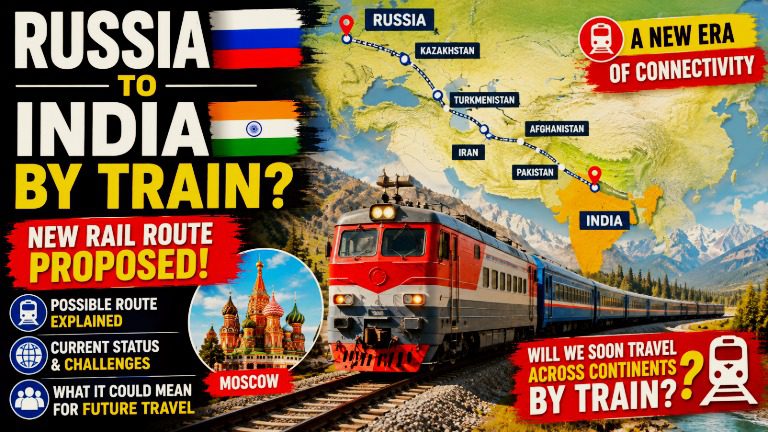
Russia to India by Train: Proposed Rail Route, Possible Path, Current Status and What It Could Mean for Future Travel
Russia to India by train could become a reality someday, but there is an important distinction between the headline and the current proposal. Russia has started exploring the possibility of developing a railway connection towards the Indian Ocean and India, but there is no confirmed direct passenger train, ticket, launch date or continuous railway line between Russia and India at present.
The idea was raised by Russian Deputy Prime Minister Marat Khusnullin, who said Russia should examine alternative routes that could provide access to India and reduce dependence on vulnerable maritime routes. One possible alignment discussed could pass through Central and South Asia before reaching India.
The proposal has generated considerable interest because a functioning Russia–India land corridor could transform freight movement between the two countries and, in the longer term, potentially open the door to a remarkable transcontinental passenger journey.
Russia to India Train: What Has Actually Been Proposed?
The proposal is still at an exploratory stage.
Khusnullin suggested that Russia should look at railway routes towards the Indian Ocean, with possible connectivity through countries including Turkmenistan, Iran, Afghanistan and Pakistan before reaching India. He also indicated that Moscow would consider different options if they could provide reliable access to the Indian market.
This does not mean that construction of a Moscow-to-India passenger railway has been approved.
There is currently no announced:
Direct Russia–India passenger train
Passenger ticket price
Launch date
Confirmed train operator
Final railway alignment
Continuous railway line from Moscow to an Indian city
Therefore, claims that passengers will soon be able to board a train in Moscow and travel directly to India should be treated cautiously.
What Could the Russia–India Route Look Like?
There are several possibilities because Russia’s proposal is not yet a final route.
One option mentioned in current reporting would broadly move south from Russia through Turkmenistan, Iran, Afghanistan and Pakistan before reaching India.
Another important framework already exists: the International North-South Transport Corridor (INSTC).
The INSTC is a roughly 7,200-kilometre multimodal transport network designed to connect Russia with Iran and India using a combination of railways, roads and maritime links.
Its eastern branch runs through Kazakhstan and Turkmenistan before entering Iran. From Iran, freight can move towards Bandar Abbas, from where cargo can be transported to India by sea.
This distinction is important.
The route is not currently one continuous railway
At present, the Russia–India connectivity network involves different modes of transportation.
A potential freight journey could look something like:
Russia → Kazakhstan/Turkmenistan → Iran → Bandar Abbas → India by sea
Meanwhile, the newly discussed concept involving Afghanistan and Pakistan could eventually provide another overland approach if the necessary infrastructure and political agreements were developed.
So, rather than thinking of this immediately as a single Moscow-to-Delhi train, it is more accurate to view it as an evolving Eurasian transport network.
What Is the International North-South Transport Corridor?
The INSTC is one of the most important pieces of the Russia–India connectivity puzzle.
India, Russia and Iran originally signed the agreement establishing the corridor in 2000. The broader network was designed to create a faster alternative for freight moving between India, Iran, Russia and Europe.
The corridor combines:
Rail transport
Road transport
Caspian Sea shipping
Iranian ports
Indian maritime connections
The objective is to make cargo movement faster and potentially reduce dependence on longer maritime routes through the Suez Canal.
The corridor is already moving beyond the purely conceptual stage. A July 2026 update from Turkmenistan’s State Service for Maritime and River Transportation said container transportation along the North-South corridor had doubled during the year, with growth recorded across its western, Trans-Caspian and eastern branches.
India and Russia Already Support the INSTC
The idea of improving transport connectivity between India and Russia is not new.
India and Russia have repeatedly identified the INSTC as an important strategic transport project.
In their bilateral statements, the two countries have expressed support for expanding logistics links and increasing infrastructure capacity along the INSTC. They have also discussed the Chennai–Vladivostok Eastern Maritime Corridor and other transport options.
India and Russia have specifically said that greater use of the INSTC could reduce cargo transportation time and costs while improving connectivity across Eurasia.
This means the latest railway proposal is better understood as part of a much larger effort to strengthen Russia–India connectivity rather than as an entirely new project appearing from nowhere.
Why Is Russia Looking at a New Route to India?
One of the major reasons is the changing geopolitical and logistical environment.
Russia wants more reliable access to Asian markets while reducing its dependence on vulnerable maritime chokepoints.
Khusnullin specifically highlighted concerns surrounding routes such as the Bosphorus and Strait of Hormuz and argued that alternative land connections could provide additional options.
For Russia, a stronger southbound transport network could provide:
Greater access to Indian markets
Alternative routes for exports
More resilient supply chains
Improved access to the Indian Ocean
Stronger trade links with Central and South Asia
For India, the benefits could include greater access to Russian commodities and potentially faster overland connectivity with Central Asian markets.
Could You Travel From Russia to India by Train Today?
Not as a single direct passenger journey.
Parts of such a journey can theoretically be completed using existing railway networks and other forms of transportation. However, travellers would have to deal with multiple countries, border crossings, visas, transport operators and changes between rail and sea or road services.
There is currently no single Russia–India passenger train ticket covering the entire journey.
A traveller attempting such a journey today would therefore face considerable logistical complexity.
The proposed corridor is primarily focused on freight and strategic connectivity, not tourism.
Why a Passenger Train Would Be Much More Difficult
Building a freight corridor and operating a passenger train are two very different challenges.
A passenger service would require international agreements covering:
1. Immigration and visas
Passengers would potentially cross several international borders.
Each country would have its own immigration, customs and visa requirements. A truly seamless journey would require extensive coordination.
2. Railway infrastructure
Different countries use different railway systems and technical standards.
Railway gauge compatibility, signalling systems, electrification and rolling-stock requirements would all have to be considered.
3. Security
A passenger route crossing several politically sensitive regions would require strong security arrangements and international cooperation.
4. Passenger facilities
Freight trains do not require the same infrastructure as passenger services.
A long-distance passenger train would need stations, immigration facilities, sleeping arrangements, catering, medical support, luggage systems and reliable schedules.
5. Cross-border coordination
A direct international passenger service would require railway authorities in every participating country to coordinate timetables, locomotive changes, crew arrangements, border checks and emergency procedures.
These factors explain why a future passenger train would likely take considerably longer to develop than a freight corridor.
What About Pakistan and Afghanistan?
This is one of the most complicated aspects of the proposal.
A route through Afghanistan and Pakistan could potentially create a more direct overland connection towards India, but it would also introduce significant geopolitical and infrastructure challenges.
The region would require substantial railway development, cross-border agreements and long-term political stability before a regular international passenger service could be considered.
There are also existing efforts to improve Central Asia–Afghanistan–Pakistan railway connectivity. A proposed Trans-Afghan railway has been discussed as a way to connect Central Asian countries with Pakistan’s southern ports.
For a Russia–India passenger train to use such a network, several independent infrastructure projects would first have to align.
Could the Route Eventually Reach India Without a Sea Journey?
Potentially, but this remains speculative.
The existing INSTC relies partly on maritime links. For example, freight can reach Bandar Abbas in Iran and then travel by sea to India.
A completely overland Russia–India railway would require additional railway infrastructure extending through the countries between the two nations.
That would be a much more ambitious project than simply increasing the use of the existing INSTC.
For this reason, a future Russia–India transport network could develop in stages:
Stage 1: Improve freight connectivity.
Stage 2: Expand railway infrastructure between Central Asia and South Asia.
Stage 3: Improve cross-border logistics and customs systems.
Stage 4: Explore passenger services if commercially and politically viable.
What Could This Mean for Indian Travellers?
If a direct or near-direct passenger service eventually becomes possible, it could become one of the world’s most unusual long-distance rail journeys.
Travellers could potentially experience several regions of Eurasia during one trip.
A future route could offer access to:
Russian cities
Central Asian landscapes
Iranian cultural destinations
South Asian cities
Historic Silk Road locations
Instead of reaching Russia by air within a few hours, travellers could spend days travelling across Eurasia by rail.
For adventure travellers, the journey itself could become the destination.
Could It Become a New Silk Road for Tourists?
That is one of the most interesting long-term possibilities.
The historic Silk Road connected large parts of Eurasia through trade, culture and migration.
A modern Russia–India railway network could recreate some of that connectivity in a completely different form.
Passengers could potentially travel through Central Asian cities and historical trading centres before reaching South Asia.
Such a service could create opportunities for:
Multi-country tourism
Cultural exchanges
Rail tourism
Backpacking routes
Cross-border business travel
Student travel
New tourism circuits
However, these possibilities should not be confused with confirmed plans.
Economic Importance Could Be Greater Than Tourism
The biggest impact of the proposal may not be passenger travel at all.
Freight could be the real driver.
A reliable land-based network could help transport goods such as:
Machinery
Agricultural products
Fertilizers
Industrial materials
Energy-related products
Consumer goods
Minerals
Pharmaceuticals
India and Russia have already committed to improving logistics connectivity and expanding the use of transport corridors such as the INSTC.
A stronger transport network could therefore support the two countries’ broader goal of increasing bilateral trade.
Russia–India Trade Connectivity Is Already Expanding
The two countries have set ambitious economic targets.
India and Russia have discussed increasing bilateral trade and improving the balance of trade by expanding Indian exports to Russia.
The 2024 India–Russia strategic economic statement highlighted the importance of increasing cargo turnover through the INSTC, the Northern Sea Route and the Chennai–Vladivostok maritime connection.
This makes transport infrastructure a central part of the wider economic relationship.
Is This a New Train Project or an Expansion of Existing Corridors?
It is better described as a new connectivity proposal built around existing and planned transport corridors.
The INSTC already provides a framework connecting Russia, Iran and India through multimodal transport.
The latest proposal raises the possibility of developing additional railway links that could eventually provide more direct access to the Indian Ocean and India.
Therefore, the headline “Russia to India by train” represents a potential future outcome rather than an already approved train service.
When Could Russia–India Train Service Start?
There is currently no confirmed launch date.
No official timeline has been announced for a direct passenger train.
The immediate focus appears to be on evaluating transport routes and strengthening freight connectivity.
Any passenger service would likely come much later, if the required railway infrastructure, political agreements, border arrangements and commercial demand are established.
Russia to India by Train: What We Know So Far
Question Current status
Has Russia proposed stronger rail connectivity to India? Yes
Who raised the latest proposal? Russian Deputy PM Marat Khusnullin
Is there a confirmed direct passenger train? No
Is there a confirmed ticket price? No
Is there a launch date? No
Is freight connectivity the immediate priority? Yes
Does the INSTC already connect Russia and India through multimodal transport? Yes
Could future passenger travel become possible? Potentially, but unconfirmed
Could the route involve Central and South Asia? Yes
Is a final route approved? No
The Bigger Picture
The most significant part of this development is not necessarily the prospect of tourists boarding a train in Moscow.
It is the possibility of a new Eurasian transport architecture connecting Russia more directly with India and the Indian Ocean.
Russia is looking for alternatives that can make its trade routes more resilient. India is seeking stronger connectivity with Russia and Central Asia. The INSTC provides an existing foundation, while additional railway links could expand that network over time.
If these projects develop successfully, passenger travel could eventually follow freight.
But that is a long-term possibility, not a current service.
Final Takeaway
The dream of travelling from Russia to India by train has taken a step closer to the realm of serious discussion, but it is still far from becoming a reality for ordinary passengers.
Russia’s latest proposal is primarily about developing alternative transport links towards the Indian Ocean and strengthening freight connectivity. The possible routes involve complex combinations of existing railways, new infrastructure and, in some cases, maritime transport.
For now, there is no direct Moscow-to-India passenger train, no ticket booking and no confirmed launch date.
However, if the INSTC and future railway projects across Central and South Asia continue to expand, the possibility of a spectacular Russia–India rail journey could become more realistic in the years ahead.
For travellers dreaming of crossing Eurasia by train, the journey may not be available yet—but the infrastructure that could eventually make it possible is already taking shape.
Frequently Asked Questions
1. Is there a direct train from Russia to India?
No. There is currently no confirmed direct passenger train connecting Russia and India.
2. What did Russia recently propose?
Russian Deputy Prime Minister Marat Khusnullin proposed exploring railway routes towards the Indian Ocean that could eventually provide access to India.
3. Which countries could the proposed route pass through?
One possible route mentioned in current reporting could pass through Turkmenistan, Iran, Afghanistan and Pakistan before reaching India. Other connectivity options could use the existing INSTC network through Kazakhstan and Turkmenistan.
4. What is the INSTC?
The International North-South Transport Corridor is a multimodal network connecting India with Iran, Russia and other Eurasian markets using rail, road and maritime transportation.
5. Can tourists travel from Russia to India using trains today?
Not as a single direct train journey. Parts of the route can be travelled using existing transport networks, but it would require multiple modes, border crossings and separate arrangements.
6. Will there be a Russia–India passenger train in the future?
It is possible, but there is no confirmed passenger service at present. The immediate emphasis is on freight and strategic connectivity.
7. Why does Russia want an alternative route to India?
Russia wants to diversify transport routes and reduce exposure to disruptions affecting important maritime chokepoints, while improving access to markets in India and Asia.
8. What could the project mean for India?
A stronger corridor could improve India’s connectivity with Russia and Central Asia, support trade and potentially create opportunities for future tourism and passenger rail services.
Disclaimer:
This article is based on publicly available reports and official statements available at the time of publication. The proposed Russia–India railway connection is still under discussion and should not be interpreted as a confirmed passenger train service. Route, infrastructure, participating countries, timelines and other details may change as negotiations and feasibility studies progress.
Do Follow For More Info @ http://roydailyupdate.in
Do WhatsApp @ https://chat.whatsapp.com/K5POJK9KbpN8egjjOCaOw6
About the Author
Ravi H Irannanavar is a digital content creator and blogger who covers the latest entertainment news, trending stories, Karnataka updates, jobs, business and breaking news. Through Roy Daily Update, he aims to deliver important stories in a simple, engaging and reader-friendly format, keeping readers updated with the latest developments across India.