

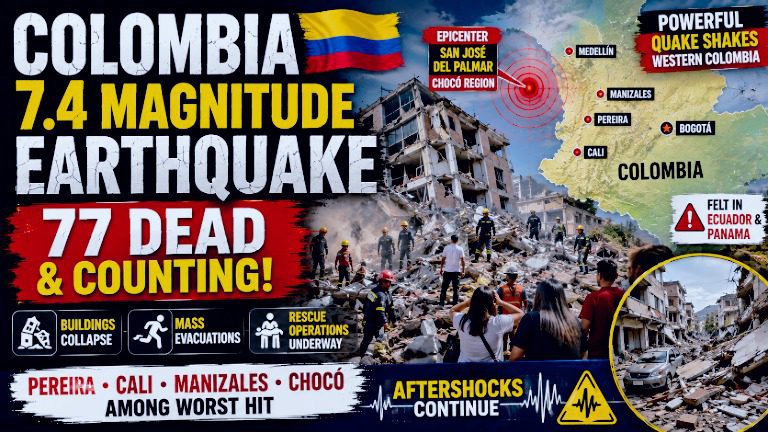
Colombia Earthquake: 7.4-Magnitude Quake Kills 77, Buildings Collapse Across Western Region
Colombia Earthquake Latest News: A powerful 7.4-magnitude earthquake struck western Colombia on Monday, August 10, 2026, killing at least 77 people and causing widespread destruction across several cities. Buildings collapsed, residents were trapped under rubble and thousands of people rushed out of their homes as strong shaking was felt across the country.
The earthquake was centred near San José del Palmar in the Chocó region, roughly 400 kilometres west of Bogotá. According to the United States Geological Survey, the earthquake occurred at a depth of about 107 kilometres. The tremor was also felt in neighbouring Ecuador and Panama.
Rescue teams were deployed across the worst-affected areas as authorities searched collapsed buildings for survivors. Officials warned about the possibility of further aftershocks while emergency workers assessed damage to homes, public buildings, transport infrastructure and airports.
Colombia Earthquake Death Toll Rises
The death toll increased rapidly as rescue operations continued.
The latest Reuters report put the number of people killed at at least 77, with the hardest-hit areas including Risaralda and other parts of western Colombia. Earlier reports had given lower figures as emergency authorities were still assessing the scale of the disaster.
The changing casualty figures highlight the difficulty of conducting rescue and recovery operations immediately after a major earthquake. Authorities are still checking damaged structures and searching areas where people may remain trapped.
Several cities reported deaths and injuries, while emergency teams continued to work through collapsed buildings and debris.
San José del Palmar Was Near the Epicentre
The earthquake’s epicentre was near San José del Palmar, a relatively small community in Colombia’s Chocó region.
The area lies in a mountainous part of western Colombia, where difficult terrain can make emergency response particularly challenging.
Although the epicentre was away from Bogotá, the earthquake was strong enough to be felt in the capital and numerous other parts of the country.
The USGS initially identified the earthquake as magnitude 7.4 and located it near San José del Palmar.
Pereira Among the Worst-Hit Cities
Pereira, one of the major cities in the affected region, suffered significant damage.
Buildings were damaged or collapsed, and residents were seen fleeing into the streets after the powerful shaking began.
Images from Pereira showed damage inside the airport, including portions of the ceiling falling while people sought shelter. Emergency workers and local residents joined efforts to search damaged areas.
According to Reuters, Risaralda was among the hardest-hit areas, with a large share of the reported fatalities.
The earthquake also disrupted air travel, with several regional airports temporarily suspending flights while authorities assessed possible structural damage.
Buildings Collapse in Cali
The earthquake also caused major concern in Cali, Colombia’s third-largest city.
Authorities reported collapsed buildings and people trapped under debris. Rescue personnel were sent to affected locations to search for survivors.
The scale of the damage raised concerns about the structural condition of older buildings, particularly in densely populated urban areas.
Cali’s large population meant that even damage to a relatively small number of structures could create a significant emergency response challenge.
Damage Reported in Manizales
Manizales, a mountainous city in Colombia’s coffee-growing region, was another major urban area affected by the earthquake.
One of the towers of the city’s historic neo-Gothic cathedral was reported to have collapsed onto the nave.
Local authorities also reported deaths in Manizales and urged residents to remain cautious because of the possibility of aftershocks.
The city’s mountainous terrain adds another challenge for emergency services, particularly when roads and structures are damaged.
Chocó Region Faces Major Damage
The Chocó region, where the earthquake was centred, also reported injuries and structural damage.
Because the epicentre was located in the region, authorities were closely monitoring communities around San José del Palmar.
Emergency teams were working to determine the full extent of the damage, while rescue operations continued in affected municipalities.
Colombia’s Interior Ministry said more than 20 municipalities had been affected by the earthquake, according to the initial reports.
Earthquake Felt in Ecuador and Panama
The powerful tremor was not limited to Colombia.
People in neighbouring Ecuador and Panama also felt the earthquake, although initial reports indicated comparatively limited damage in those countries.
The regional impact demonstrates the strength of the earthquake and the extensive area over which the seismic waves travelled.
No tsunami threat was reported following the earthquake, according to the latest reports.
Aftershocks Raise Further Concerns
After the main earthquake, additional tremors were recorded.
Authorities warned residents to remain alert because damaged buildings can become even more dangerous following aftershocks. People were urged to stay away from unstable structures while emergency crews conducted inspections.
The USGS and Colombian authorities continued monitoring seismic activity following the major earthquake.
For residents who had evacuated their homes, the possibility of additional shaking added to the uncertainty.
Strongest Earthquake in Colombia in a Decade
Colombia’s Geological Service described the earthquake as the highest-magnitude earthquake registered in Colombia in the last decade, according to reports carried by AP.
The country experiences frequent smaller earthquakes, particularly in central and western regions, but earthquakes above magnitude 6 are much less common.
Colombia’s location in a highly active seismic region makes it vulnerable to earthquakes and related hazards such as landslides.
The disaster also revived memories of Colombia’s previous deadly earthquakes. In 1999, a magnitude 6.2 earthquake near Armenia killed more than 1,100 people.
Colombia’s New President Takes Charge of Response
The earthquake has become an early major emergency for newly inaugurated Colombian President Abelardo de la Espriella.
The president said he had personally taken charge of the government’s response to the emergency in San José del Palmar.
He assured affected residents that the government was responding to the crisis and that emergency authorities would work to assist communities hit by the earthquake.
The government response includes rescue operations, damage assessments and coordination between local and national emergency agencies.
Rescue Operations Continue
The immediate priority remains finding survivors and helping people affected by collapsed buildings.
Residents, police officers, firefighters, rescue workers and other emergency personnel have been involved in search-and-rescue efforts.
Authorities are also assessing hospitals, roads, airports and other critical infrastructure.
The difficult terrain around some affected areas could slow rescue operations, making coordination between emergency teams particularly important.
Officials are expected to provide further updates as rescue teams reach more affected communities.
Why the Earthquake Caused So Much Damage
Earthquake damage depends on several factors, including magnitude, depth, distance from populated areas, building quality and local geological conditions.
Although the earthquake occurred at significant depth, its magnitude was powerful enough to cause severe shaking and structural damage across western Colombia.
The presence of older or vulnerable buildings can increase the risk of collapse during strong earthquakes.
Mountainous terrain can also complicate emergency response and increase the risk of landslides, blocked roads and isolated communities.
Colombia Earthquake: What Happens Next?
The focus now shifts from the initial emergency response to search and rescue, medical assistance and damage assessment.
Authorities will need to determine:
The final death and injury toll
The number of buildings destroyed or damaged
Whether additional people remain trapped
The condition of roads and bridges
The safety of airports and public infrastructure
The scale of the economic damage
Whether further aftershocks cause additional destruction
The death toll could change as rescue teams reach areas that remain difficult to access.
For residents, the immediate concern is safety, particularly around buildings that may have suffered structural damage.
A Developing Disaster
The August 10, 2026 Colombia earthquake is one of the country’s most significant seismic disasters in recent years.
With a magnitude of 7.4, widespread damage and a rapidly rising death toll, the earthquake has triggered a major national emergency.
The latest available reports put the death toll at at least 77, but authorities are still carrying out search and rescue operations, meaning the figure could change.
As emergency teams continue searching through rubble in Pereira, Cali, Manizales, Chocó and other affected areas, Colombia is now facing the difficult task of rescuing survivors, treating the injured and assessing the full scale of the destruction.
Colombia Earthquake FAQs
What was the magnitude of the Colombia earthquake?
The earthquake had a magnitude of 7.4, according to the USGS.
Where was the Colombia earthquake epicentre?
The epicentre was near San José del Palmar in Colombia’s Chocó region, around 400 kilometres west of Bogotá.
How many people have died in the earthquake?
The latest Reuters report said at least 77 people had been killed, although the toll remains subject to change as rescue operations continue.
Which Colombian cities were badly affected?
Pereira, Cali, Manizales, Quibdó and areas of Chocó were among the locations reporting deaths, building damage and other impacts.
Was the earthquake felt outside Colombia?
Yes. The earthquake was also felt in Ecuador and Panama, although initial reports indicated limited damage there.
Are aftershocks possible?
Yes. Additional tremors have already been reported, and authorities are warning residents to remain cautious around damaged structures.
Is there a tsunami threat?
No tsunami threat was reported in the latest reports following the earthquake.
Disclaimer:
This article is based on information available at the time of publication. Earthquake casualty figures, damage assessments and rescue updates can change rapidly as authorities continue search-and-rescue operations. Readers should refer to official Colombian authorities and emergency agencies for the latest safety instructions.
Do Follow For More Info @ http://roydailyupdate.in
Do WhatsApp @ https://chat.whatsapp.com/K5POJK9KbpN8egjjOCaOw6
About the Author
Ravi H. Irannanavar is the founder and author of Roy Daily Update, covering breaking news, national and international developments, business, technology, jobs, and trending stories. He focuses on presenting important updates in a clear, reader-friendly format while highlighting the key facts behind major events.