

BSE Replaces Wipro in Nifty 50: What Drove the Index Reshuffle?
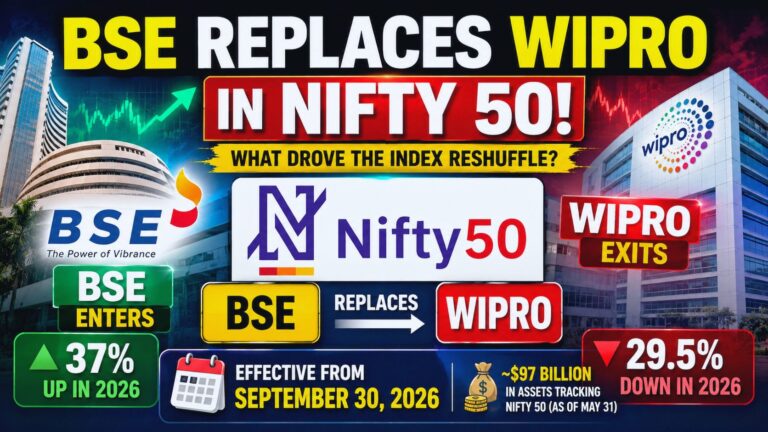
BSE will replace Wipro in the Nifty 50 from September 30, 2026, after its six-month average free-float market capitalisation crossed the required threshold. The move highlights the contrasting fortunes of India’s capital-market ecosystem and the traditional IT services sector.
India’s benchmark Nifty 50 index is set for a notable change this September, with BSE Ltd. replacing Wipro Ltd. in the 50-stock index.
The change was announced by NSE Indices as part of its latest semi-annual review. According to the official index announcement, the replacement will take effect from September 30, 2026, after the market close on September 29.
The reshuffle is more than a routine index adjustment. It reflects a significant change in the relative market value of two very different parts of India’s economy: the rapidly expanding capital-markets ecosystem and the traditional IT-services industry.
Why Is BSE Entering the Nifty 50?
The primary reason is free-float market capitalisation.
Nifty 50 constituents are selected using a methodology that considers factors including average free-float market capitalisation and trading liquidity. NSE Indices said BSE’s six-month average free-float market capitalisation reached approximately ₹1.41 lakh crore, compared with about ₹55,930 crore for Wipro.
Importantly, BSE’s six-month average free-float market capitalisation was at least 1.5 times that of Wipro, which was the smallest existing Nifty 50 constituent under the relevant criteria.
That allowed BSE to qualify for inclusion in the benchmark.
NSE Indices also noted that only stocks available for trading in the NSE Futures & Options segment are eligible for inclusion in the Nifty 50.
BSE vs Wipro: A Sharp Difference in Stock Performance
The index reshuffle comes after a striking divergence in the performance of the two stocks.
According to Reuters, BSE shares had gained roughly 37% in 2026 by August 10, while Wipro shares had declined about 29.5% over the same period. BSE shares rose around 4% on August 10 following the announcement.
This performance gap has played an important role in changing their relative market capitalisations.
BSE’s rise
BSE has benefited from growing interest in India’s capital markets, increasing participation from retail investors and expanding activity across equities and derivatives.
The exchange is also positioned to benefit from India’s broader financialisation trend, in which more household savings are finding their way into financial products and market-linked investments.
As trading activity and investor participation increase, market infrastructure companies can benefit through higher transaction volumes and stronger earnings expectations.
Wipro’s decline
Wipro, meanwhile, has faced a more challenging environment.
Indian IT-services companies are dealing with questions surrounding global technology spending, slower discretionary IT spending in some markets and the potential disruption caused by artificial intelligence.
Investors are increasingly assessing whether AI will reduce demand for some traditional outsourcing services while simultaneously creating new opportunities for companies capable of adapting their business models.
Reuters noted that investor concerns about AI-related risks to Indian IT exporters are among the broader factors surrounding the reshuffle.
What Is Free-Float Market Capitalisation?
Free-float market capitalisation is different from a company’s total market capitalisation.
It generally reflects the value of shares that are available for trading in the public market, excluding certain holdings that are not considered readily available for public trading.
For index construction, this measure helps ensure that companies with a larger publicly tradable share base receive appropriate representation.
In the latest Nifty 50 review, NSE Indices compared the six-month average free-float market capitalisation of eligible companies.
BSE’s figure of approximately ₹1,40,879 crore comfortably exceeded the threshold required to replace Wipro, whose corresponding figure was approximately ₹55,930 crore.
Why Didn’t TVS Motor or Divi’s Laboratories Enter the Nifty 50?
An interesting part of the official announcement is that BSE was not the only company close to consideration.
NSE Indices identified TVS Motor Company and Divi’s Laboratories as the next two eligible companies, with six-month average free-float market capitalisations of approximately ₹84,566 crore and ₹82,930 crore respectively.
However, they were not selected because the average free-float market capitalisation of the two lowest-ranked remaining Nifty 50 constituents did not meet the required 1.5-times threshold for their inclusion.
This means the reshuffle was not simply a matter of ranking companies by market capitalisation. The specific index methodology and eligibility thresholds also mattered.
What Does BSE’s Nifty 50 Entry Mean?
Joining the Nifty 50 can be a major milestone for a company.
The index is one of India’s most widely followed equity benchmarks and is closely monitored by domestic investors, international institutions, fund managers and passive investment products.
According to Reuters, passive funds tracking the Nifty 50 had approximately $97 billion in assets under management as of May 31, 2026.
Because of this, changes in the index can result in portfolio adjustments.
Index funds and exchange-traded funds that aim to replicate the Nifty 50 generally need to adjust their holdings when the index composition changes.
Could BSE See More Institutional Demand?
Potentially, yes.
Once BSE becomes a Nifty 50 constituent, index-tracking funds will need to account for it in their portfolios.
This can create additional institutional interest and may increase the stock’s visibility among global and domestic investors.
However, investors should not assume that index inclusion automatically guarantees further gains.
The actual price impact will depend on factors such as the stock’s valuation, trading liquidity, institutional positioning, broader market conditions and expectations regarding BSE’s future earnings.
What Does Wipro’s Exit Mean?
Wipro’s removal from the Nifty 50 does not mean that the company is fundamentally failing or that its business has become irrelevant.
Wipro remains one of India’s major IT-services companies.
However, index membership is determined by a defined methodology rather than by a company’s historical importance or brand recognition.
The latest reshuffle shows how quickly index composition can change when market valuations and free-float capitalisation shift.
Wipro’s exit also highlights the pressure facing several established IT-services companies as investors reassess growth expectations in the era of AI.
A Bigger Shift in India’s Stock Market
The BSE-Wipro reshuffle can also be viewed as a snapshot of a wider transformation in India’s equity market.
Over recent years, retail participation, demat-account ownership, mutual-fund investments and systematic investment plans have helped deepen domestic participation in equities.
India’s financial-market infrastructure has consequently become increasingly important.
Stock exchanges, brokers, asset managers, clearing corporations and other market-linked businesses can benefit when trading activity and financial participation expand.
BSE’s strong stock-market performance reflects some of this optimism.
At the same time, India’s IT sector faces a different set of questions. Traditional outsourcing models are being reshaped by generative AI, automation and changing client spending patterns.
That does not necessarily mean the IT sector will decline. Instead, investors are increasingly differentiating between companies based on their ability to adapt to the next phase of technology-driven demand.
When Will the Nifty 50 Change Take Effect?
The official NSE Indices announcement states that the replacement will become effective from September 30, 2026, after the close of September 29.
The change is:
Nifty 50 inclusion: BSE Ltd.
Nifty 50 exclusion: Wipro Ltd.
Effective date: September 30, 2026
Review: Semi-annual index review
The change will also apply to the Nifty50 Equal Weight Index, according to NSE Indices.
What Investors Should Watch Next
Investors following BSE should watch several factors rather than focusing solely on its Nifty 50 inclusion.
1. Trading volumes
Higher activity across India’s equity and derivatives markets could support the exchange’s business prospects.
2. Valuation
Strong share-price gains can increase expectations. Investors therefore need to assess whether the company’s valuation is justified by future earnings growth.
3. Competition
India’s capital-markets ecosystem remains highly competitive. Changes in market share, trading volumes and product offerings can influence future performance.
4. Regulatory developments
Stock exchanges operate in a highly regulated environment. Changes in trading rules, derivatives regulations or market infrastructure can affect revenue and profitability.
5. Wipro’s recovery prospects
For Wipro, investors will be watching whether AI-led transformation, improved deal wins and stronger technology spending can revive growth.
Does Nifty 50 Inclusion Make BSE a Buy?
Not necessarily.
Index inclusion is an important milestone, but it should not by itself be treated as a buy signal.
BSE’s share price has already experienced a substantial rise during 2026, meaning expectations may already be reflected partly in its valuation.
Investors should separately evaluate earnings growth, valuation, competitive positioning, regulatory risks and the sustainability of trading activity.
Similarly, Wipro’s removal from the Nifty 50 should not automatically be interpreted as a sell signal. A company’s index status and its long-term investment prospects are two different questions.
Bottom Line
The decision to replace Wipro with BSE in the Nifty 50 is a significant reflection of India’s changing market landscape.
BSE’s six-month average free-float market capitalisation reached approximately ₹1.41 lakh crore, more than enough to satisfy the methodology’s threshold against Wipro’s approximately ₹55,930 crore figure.
The contrast in stock performance is equally striking: BSE had gained roughly 37% in 2026 by August 10, while Wipro had fallen about 29.5%.
For BSE, entering the Nifty 50 could increase visibility and create portfolio-rebalancing demand from index-tracking funds. For Wipro, the exit highlights the challenges facing traditional IT-services companies as investors reassess growth in an increasingly AI-driven technology environment.
Ultimately, the reshuffle is not simply about one company replacing another. It is a sign of how India’s stock market is evolving — with financial-market businesses gaining prominence while traditional sectors face new competitive and technological pressures.
FAQs
Why is BSE replacing Wipro in the Nifty 50?
BSE is replacing Wipro because its six-month average free-float market capitalisation met the Nifty 50 inclusion threshold and was at least 1.5 times that of Wipro, the smallest constituent under the review criteria.
When will BSE enter the Nifty 50?
The change becomes effective from September 30, 2026, following the market close on September 29.
Why is Wipro being removed from the Nifty 50?
Wipro was the smallest Nifty 50 constituent based on the relevant six-month average free-float market capitalisation criteria, allowing BSE to replace it during the semi-annual review.
What was BSE’s six-month average free-float market capitalisation?
NSE Indices reported approximately ₹1,40,879 crore for BSE, compared with ₹55,930 crore for Wipro.
Will BSE’s Nifty 50 inclusion affect its share price?
It could create additional demand from index-tracking funds, but the eventual market impact will depend on valuations, fund positioning, liquidity and broader market conditions.
Does Wipro leaving the Nifty 50 mean investors should sell it?
No. Index removal alone does not determine whether a stock is fundamentally attractive. Investors should separately evaluate Wipro’s earnings, valuation, growth prospects and competitive position.
Which other companies were considered for Nifty 50 inclusion?
TVS Motor Company and Divi’s Laboratories were the next two eligible companies identified in the NSE Indices review, but they did not meet the required threshold for inclusion.
Disclaimer
This article is for informational and educational purposes only and should not be considered investment advice, a recommendation to buy or sell any stock, or a guarantee of future returns. Stock prices can be volatile and may be affected by market conditions, company performance, regulations and global economic developments. Investors should conduct their own research and consult a qualified financial adviser before making investment decisions.
Do Follow For More Info @ http://roydailyupdate.in
Do WhatsApp @ https://chat.whatsapp.com/K5POJK9KbpN8egjjOCaOw6
About the Author
Ravi H Irannanavar is a blogger and digital content creator who covers the latest developments in the Indian stock market, business, breaking news and important public-interest updates. Through Roy Daily Update, he focuses on presenting market movements, company developments and trending news in a simple, reader-friendly format.