

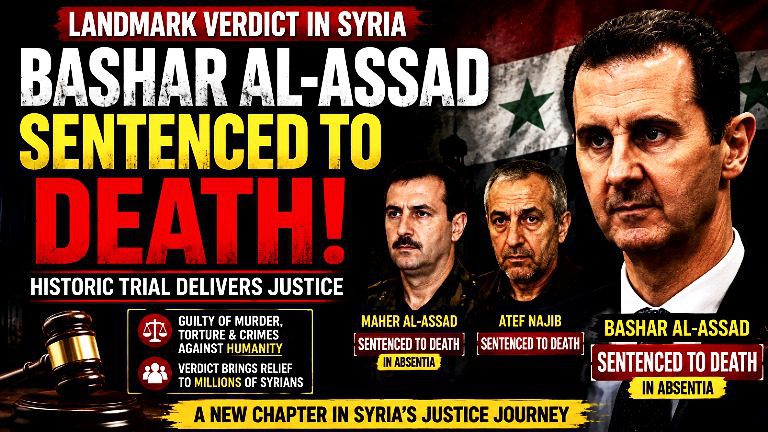
Bashar al-Assad Sentenced to Death: Landmark Syria Trial Delivers Historic Verdict
Former Syrian President Bashar al-Assad, his brother Maher al-Assad and former security official Atef Najib have been sentenced to death in a landmark trial in Damascus, marking a major moment in Syria’s post-Assad transition and efforts to hold senior figures of the former regime accountable.
A Damascus criminal court on Tuesday sentenced former Syrian President Bashar al-Assad to death in absentia after finding him guilty of serious crimes committed during Syria’s nearly 14-year conflict. His younger brother, Maher al-Assad, was also sentenced to death in absentia.
Former Syrian security official Atef Najib, who was present in court, was separately sentenced to death over crimes linked to the violent suppression of protests in Daraa in 2011. Reuters and Al Jazeera reported that the verdict represents the first conviction of Bashar al-Assad by Syria’s transitional authorities.
Bashar al-Assad gets death sentence in absentia
The court in Damascus found Bashar al-Assad guilty of charges including premeditated murder, torture, arbitrary arrest and crimes against humanity.
Because Assad fled Syria after his government collapsed in December 2024 and is now living in Moscow, the sentence was issued in absentia. This means he was not physically present in the courtroom when the verdict was delivered.
The ruling marks a dramatic reversal for a leader who ruled Syria for more than two decades after succeeding his father, Hafez al-Assad, in 2000.
The Assad family had dominated Syrian political life for decades. Bashar al-Assad’s government faced widespread protests beginning in 2011, and the subsequent crackdown contributed to the transformation of the uprising into a devastating civil war.
According to the court, Assad was regarded as the highest-level decision-maker responsible for the crimes covered by the case. Judge Fakhr al-Din al-Aryan said witness testimony demonstrated Assad’s role in using state institutions to facilitate the alleged crimes.
Maher al-Assad also sentenced to death
Bashar al-Assad’s younger brother Maher al-Assad was also handed a death sentence in absentia.
Maher was a powerful military figure during the former regime and was closely associated with Syria’s security and military apparatus.
The court convicted him over charges including premeditated murder and torture. Like his brother, Maher is outside Syria and therefore was not physically present during the proceedings.
The verdict against the two brothers is significant because it places the former president and one of his closest military allies directly at the centre of Syria’s transitional justice process.
However, the practical enforcement of the sentences remains uncertain because both men are outside the jurisdiction of the Syrian authorities.
Who is Atef Najib?
Atef Najib is a former senior Syrian security official and a cousin of Bashar al-Assad.
He previously headed the Political Security Branch in Daraa in southern Syria, where the 2011 uprising began.
Najib was arrested by Syrian authorities in January 2025 after the fall of the Assad government. He subsequently became the central defendant in one of the first major trials against senior figures associated with the former regime.
Unlike Bashar and Maher al-Assad, Najib appeared personally in the Damascus courtroom.
He stood in the defendants’ cage wearing a prison uniform as the judge announced his sentence.
The charges against him included murder, torture and crimes against humanity. The court also referred to the killing of children under the age of 15 and torture that resulted in deaths.
Why Daraa is central to the case
Daraa holds enormous significance in the history of the Syrian conflict.
In 2011, anti-government protests erupted in the southern city after a group of children were detained and reportedly mistreated after writing anti-government messages on walls.
The authorities’ response helped turn local demonstrations into a broader uprising.
The protests eventually spread across Syria, followed by a military crackdown and the emergence of armed opposition groups. The conflict developed into a complex war involving Syrian government forces, opposition factions, extremist organisations and foreign powers.
Najib’s position as the head of political security in Daraa made him one of the key officials associated with the early crackdown.
A Syrian human-rights legal analysis published earlier this year described the trial as the first major test of the transitional authorities’ ability to prosecute prominent former regime officials using Syria’s existing legal framework.
A major test for Syria’s transitional justice system
The verdict is much bigger than a single criminal case.
It represents an early test of how Syria’s new authorities will deal with alleged crimes committed under the former government.
After Assad’s removal in December 2024, the transitional authorities faced enormous pressure from victims’ families, displaced Syrians and human-rights groups to investigate alleged abuses committed during the previous government’s rule.
The trial involving Najib began in Damascus in April 2026 and later expanded to include prominent figures who were being tried in absentia, including Bashar and Maher al-Assad.
The proceedings have therefore attracted considerable attention both inside Syria and internationally.
Supporters of the cases argue that accountability is essential if Syria is to move beyond decades of repression and conflict. At the same time, the trials will be closely scrutinised over due process, evidence, defence rights and the use of the death penalty.
Syrians react to the historic verdict
For many Syrians who lost relatives, homes and livelihoods during the conflict, the verdict represents a long-awaited moment of accountability.
Al Jazeera reported that the ruling was expected to provide a sense of relief for people who had waited years to see senior figures from the former government face justice.
The significance goes beyond Bashar al-Assad himself.
Victims and their families have repeatedly called for accountability for the wider network of security officials, military commanders and other figures accused of abuses during the conflict.
The prosecution of Najib could therefore become a precedent for future cases.
What happens to Bashar al-Assad now?
Despite the death sentence, Bashar al-Assad is unlikely to be immediately arrested or executed.
The former Syrian president is currently living in Russia after fleeing Syria during the collapse of his government in December 2024.
Because the sentence was handed down in absentia, its implementation would require Assad to come under the control of Syrian authorities or another mechanism capable of enforcing the judgment.
This makes the political and diplomatic dimension of the verdict particularly important.
The case could also put further focus on Syria-Russia relations and the question of whether Moscow will continue providing protection to the former Syrian leader.
Why the verdict matters for Syria’s future
The death sentences mark an extraordinary turning point in Syria’s modern history.
For years, Bashar al-Assad controlled the country’s political institutions, security services and military forces. Now, less than two years after his government was overthrown, a Syrian court has formally convicted him and imposed the country’s most severe criminal punishment.
The verdict could strengthen the transitional government’s efforts to establish a new system of justice.
However, the process will not be easy.
Syria continues to face political, economic and security challenges, while questions remain about how broadly transitional justice will be applied and whether alleged abuses committed by actors outside the former Assad government will also be investigated.
A landmark moment, but not the end of Syria’s justice process
The sentencing of Bashar al-Assad, Maher al-Assad and Atef Najib is likely to become one of the defining legal moments of Syria’s post-Assad era.
The court’s decision provides victims with an official judicial finding against some of the most prominent figures associated with the former regime.
But the verdict is only one part of a much larger accountability process.
Thousands of families continue to seek information about missing relatives, while survivors of detention, torture and displacement are demanding recognition and justice.
For Syria, the challenge now is to ensure that future trials are credible, transparent and capable of standing up to legal scrutiny.
The death sentences may therefore represent not an endpoint, but the beginning of a much wider attempt to confront the legacy of the Assad era.
Key Takeaways
Bashar al-Assad has been sentenced to death in absentia by a Damascus court.
His brother Maher al-Assad also received a death sentence in absentia.
Former Daraa security chief Atef Najib was sentenced to death after appearing in court.
The charges include murder, torture and crimes against humanity.
Najib’s alleged role in the 2011 Daraa crackdown makes his case particularly significant.
Assad is currently living in Russia, meaning the sentence cannot be immediately enforced.
The verdict represents a major test of Syria’s post-Assad transitional justice process.
Further trials of former regime figures are expected as Syria continues its accountability efforts.
Disclaimer:
This article is intended for informational purposes and is based on publicly reported developments. Legal proceedings and political circumstances in Syria may change, and further court decisions or appeals could alter the situation described above.
Do Follow For More Info @ http://roydailyupdate.in
Do WhatsApp @ https://chat.whatsapp.com/K5POJK9KbpN8egjjOCaOw6
About the Author
Ravi H Irannanavar is a blogger and digital content creator who covers breaking news, international developments, Indian affairs, business, stock-market updates and other important stories. Through Roy Daily Update, he focuses on presenting major developments in a clear, simple and reader-friendly format, with emphasis on timely and informative news coverage.