

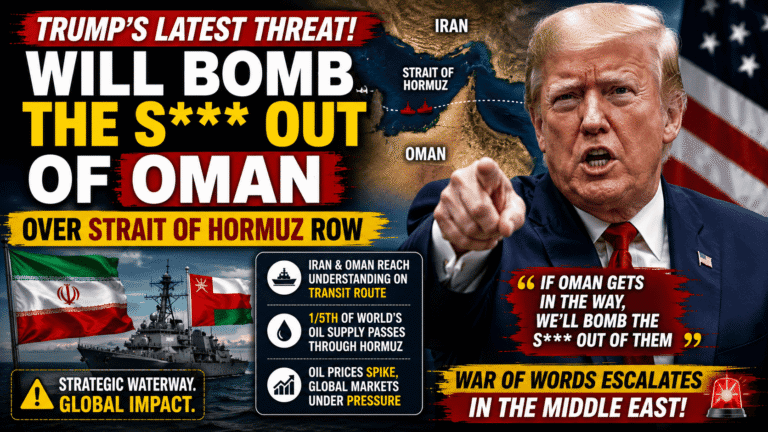
Trump Threatens Oman Over Strait of Hormuz Blockade Row
US President Donald Trump has issued a fresh warning to Oman amid an escalating dispute over the Strait of Hormuz, saying Washington could take military action if Oman interferes with the US blockade of Iranian shipping. The remarks come as Iran and Oman work on a possible arrangement to allow ships to transit the strategically vital waterway.
US President Donald Trump has issued one of his strongest warnings yet over the continuing dispute surrounding the Strait of Hormuz, threatening military action against Oman if the Gulf nation interferes with Washington’s efforts to restrict Iranian shipping.
In an interview cited by Fox News journalist Trey Yingst, Trump said the United States would respond forcefully if Oman “gets in the way” of the blockade.
Trump also said Iran should surrender and indicated that he was not working toward a fixed deadline for ending the conflict.
The comments come at a particularly sensitive moment, with Iran and Oman reportedly working on a plan for ships to transit the Strait of Hormuz, potentially easing one of the most important disruptions to global energy and commercial shipping.
What did Trump say about Oman?
Trump’s latest remarks were directed at Oman’s involvement in discussions with Iran over the Strait of Hormuz.
According to Yingst’s account of his interview with Trump, the US president warned:
“If Oman gets in the way, we’ll bomb the shit out of them.”
Trump was referring to the ongoing talks between Oman and Iran concerning control and navigation through the strategically important waterway.
The threat adds another layer of tension to an already complicated diplomatic and military situation involving the United States, Iran and countries surrounding the Strait of Hormuz.
Trump also reportedly called on Iran to “put up the white flag of surrender.”
The remarks indicate that Washington continues to take a hard line toward Tehran even as diplomatic efforts to reach a longer-term settlement remain uncertain.
Trump says he is not in a hurry
Trump also addressed questions about how long the conflict could continue.
According to the interview account, he said:
“I have no time schedule. I’m not in a hurry.”
He also rejected the suggestion that domestic US political considerations, including the upcoming midterm elections, were determining his approach.
Trump said:
“The midterms have nothing to do with my thinking.”
The comments suggest that the administration is not publicly committing to a specific timeline for resolving the confrontation with Iran.
Why is the Strait of Hormuz so important?
The Strait of Hormuz is one of the world’s most strategically important maritime passages.
It connects the Persian Gulf with the Gulf of Oman and the Arabian Sea. Because several major oil-producing countries depend on the waterway to export energy supplies, disruptions can have consequences far beyond the Middle East.
According to the information in the supplied report, roughly one-fifth of the world’s traded oil supplies pass through the waterway.
That makes any prolonged disruption potentially significant for:
Global crude oil prices
Petrol and diesel costs
Natural gas markets
Shipping and insurance expenses
Inflation
Global supply chains
Energy security
The importance of the strait is also why any disagreement over navigation rights or shipping routes can quickly become an international economic issue.
Iran and Oman discuss a possible transit arrangement
While Trump was issuing his warning, Iran said it had reached an understanding with Oman regarding a possible route for ships travelling through the Strait of Hormuz.
Iranian Foreign Ministry spokesperson Esmail Baghaei said Monday that an understanding had been reached regarding the map of the transit route.
He said Iran and Oman were working to finalise the details in the form of a joint statement.
The precise operational details of the arrangement were not fully disclosed in the supplied report.
However, previously discussed proposals reportedly involve ships entering the strait through a route near Iran and leaving through a route near Oman.
Under the proposed interim arrangement, ships would reportedly be allowed to transit without paying fees or tolls.
Why is Oman involved?
Oman occupies a strategically important position near the Strait of Hormuz and has historically maintained diplomatic relationships with both Western countries and Iran.
That position has allowed Oman to play a role in sensitive regional diplomacy.
The current situation puts Muscat in a difficult position.
On one side, Oman is involved in discussions with Iran aimed at maintaining or restoring commercial shipping through the waterway.
On the other, the United States is seeking to pressure Iran and has warned against actions that could undermine its blockade or military strategy.
Trump’s latest comments therefore raise concerns about how Oman’s diplomatic role could be affected by the confrontation.
Iran says talks have been slow
Iranian officials acknowledged that discussions with Oman have not progressed quickly.
Baghaei reportedly said the talks had moved slowly but maintained that Tehran still intended to finalise the arrangement as a package involving both the proposed route map and a joint statement.
That means the reported understanding does not necessarily represent a fully implemented shipping agreement yet.
The precise terms, enforcement mechanism and practical arrangements for commercial vessels remain important questions.
How did the Strait of Hormuz become blocked?
According to the supplied report, Iran effectively closed the Strait of Hormuz after Israel and the United States attacked Iran on February 28.
The closure severely disrupted maritime traffic through one of the world’s most important energy corridors.
The resulting uncertainty has contributed to volatility in oil and gas markets.
For countries that rely heavily on imported energy, any prolonged disruption can translate into higher costs for fuel, transportation, manufacturing and electricity.
Oil prices and the US economy
The conflict has also created political pressure inside the United States.
The supplied report says oil and gas prices have risen because of the conflict, creating difficulties for Trump’s Republican Party ahead of the November midterm elections.
Higher energy prices can affect American consumers directly through petrol prices and indirectly through transportation, food and other goods.
For governments, the challenge is therefore not only military or diplomatic.
Energy market instability can quickly become a domestic political issue.
Trump’s statement that the midterms are not influencing his thinking appears intended to reject the argument that election considerations are shaping US policy toward Iran.
What could happen if the strait remains disrupted?
A prolonged disruption could have consequences well beyond the countries directly involved.
The Strait of Hormuz is a major route for oil exports from the Gulf region. If commercial vessels cannot safely pass through it, shipping companies could be forced to consider alternative routes or delay voyages.
That could increase:
Shipping costs: Longer routes generally mean higher fuel, crew and insurance expenses.
Oil prices: Reduced supply through a major export route can put upward pressure on crude prices.
Inflation: More expensive energy can increase transportation and production costs.
Global markets: Investors could become more cautious if the conflict threatens the wider global economy.
Asian economies: Countries that depend heavily on Gulf energy supplies could be particularly exposed to sustained disruptions.
Could the Iran-Oman arrangement reopen the waterway?
The proposed Iran-Oman arrangement could potentially provide a mechanism for commercial vessels to resume transit through the strait.
However, a practical agreement would need to address several issues, including the precise shipping route, security arrangements, communication between authorities and guarantees for commercial vessels.
The agreement would also need to operate against the backdrop of the wider US-Iran confrontation.
That makes the situation extremely fluid.
A transit arrangement between Iran and Oman could reduce pressure on global energy markets, but its durability would depend on whether the broader conflict continues to escalate.
Trump’s warning adds another layer of uncertainty
Trump’s threat against Oman is significant because Oman is not simply another country involved in the regional dispute.
Its geographic location and diplomatic relationship with Iran make it an important player in any effort to manage traffic through the Strait of Hormuz.
If tensions between Washington and Muscat increase, diplomatic efforts to establish a reliable shipping route could become more complicated.
At the same time, the Trump administration’s position indicates that the United States remains focused on pressuring Iran to change course rather than accepting an indefinite status quo.
What happens next?
The immediate focus will be on whether Iran and Oman can finalise their proposed transit arrangement and whether commercial shipping can safely resume through the Strait of Hormuz.
At the same time, international observers will be watching for signs of further US-Iran military escalation.
Several questions remain unanswered:
Will the Iran-Oman transit arrangement be formally finalised?
Will commercial ships begin using the proposed route?
How will Washington respond?
Could the dispute trigger further disruption to global oil supplies?
Will diplomatic talks between the US and Iran resume?
How long will the current blockade and military confrontation continue?
Trump’s statement that he has “no time schedule” suggests that the United States is not currently signalling a quick resolution.
Why the Strait of Hormuz matters to India
For India, developments around the Strait of Hormuz deserve particular attention because the country is a major energy importer.
Any sustained disruption to Gulf shipping can potentially affect crude oil prices, freight costs and India’s overall import bill.
Higher international oil prices can also influence domestic fuel prices, inflation and the broader economy.
India’s geographic and economic links with Gulf countries mean that stability in the region is particularly important for New Delhi.
Bottom line
Trump’s latest threat against Oman marks a sharp escalation in rhetoric surrounding the Strait of Hormuz.
At the same time, Iran and Oman are reportedly working toward an arrangement that could allow ships to transit the strategically important waterway.
The two developments highlight the contradiction at the centre of the current crisis: diplomatic efforts are attempting to restore shipping access while military and political tensions continue to rise.
For global markets, the biggest concern remains the possibility of a prolonged disruption to one of the world’s most important energy corridors.
Until the Iran-Oman arrangement is formally finalised and the wider US-Iran confrontation shows signs of easing, uncertainty around the Strait of Hormuz is likely to remain a major factor for oil prices, shipping markets and the global economy.
FAQs
Q1. Why did Donald Trump threaten Oman?
According to the supplied report, Trump warned Oman against interfering with Washington’s efforts to restrict Iranian shipping through the Strait of Hormuz. He said the US would respond militarily if Oman “gets in the way.”
Q2. What did Trump say about Oman?
Trump reportedly told Fox News journalist Trey Yingst that if Oman interfered, the United States would take extremely forceful military action against the country.
Q3. What is happening in the Strait of Hormuz?
The Strait of Hormuz has become a major flashpoint in the continuing US-Iran conflict. Disruption to shipping through the waterway has raised concerns about global oil supplies and energy prices.
Q4. What is the Iran-Oman Hormuz deal?
Iran says it has reached an understanding with Oman concerning a possible shipping transit route through the Strait of Hormuz. The two sides are reportedly working to finalise the details and a joint statement.
Q5. Why is the Strait of Hormuz important?
The Strait of Hormuz is one of the world’s most important energy shipping routes. The supplied report says roughly one-fifth of the world’s traded oil supplies pass through the waterway.
Q6. Did Iran and Oman finalise the agreement?
Not according to the supplied information. Iran said an understanding had been reached regarding the transit-route map, but officials were still working to finalise the broader package and joint statement.
Q7. What did Trump say about surrendering?
Trump reportedly called on Iran to “put up the white flag of surrender”, signalling that Washington continues to maintain a hard-line position toward Tehran.
Q8. Does Trump have a deadline for ending the conflict?
Trump reportedly said he has no fixed timetable and is “not in a hurry” to resolve the conflict.
Q9. Could the Strait of Hormuz crisis affect oil prices?
Yes. Any prolonged disruption to a major global oil-shipping route can create supply concerns and potentially put upward pressure on crude oil prices.
Q10. How could the crisis affect India?
A prolonged disruption could potentially increase crude oil prices, shipping costs and India’s energy import bill because India depends significantly on imported crude oil.
Disclaimer
Disclaimer: This article is based primarily on the source material provided for publication and reflects information available at the time of writing. Statements attributed to political leaders and officials are presented as reported and should be understood in that context. The situation involving the United States, Iran, Oman and the Strait of Hormuz is rapidly developing, and details may change as governments issue new statements or agreements are finalised. References to possible military action represent reported statements or threats and should not be interpreted as confirmation that such action will occur. Roy Daily Update does not independently endorse political statements or predictions presented in this article.
Do Follow For More Info @ http://roydailyupdate.in
Do WhatsApp @ https://chat.whatsapp.com/K5POJK9KbpN8egjjOCaOw6
About the Author
Ravi is a digital content writer and blogger at Roy Daily Update, covering breaking news, international affairs, Karnataka and Bengaluru updates, jobs, business, technology, entertainment and trending stories.
He focuses on presenting developing news in a clear, reader-friendly format, bringing together important facts and context to help readers understand major events and their potential impact.