

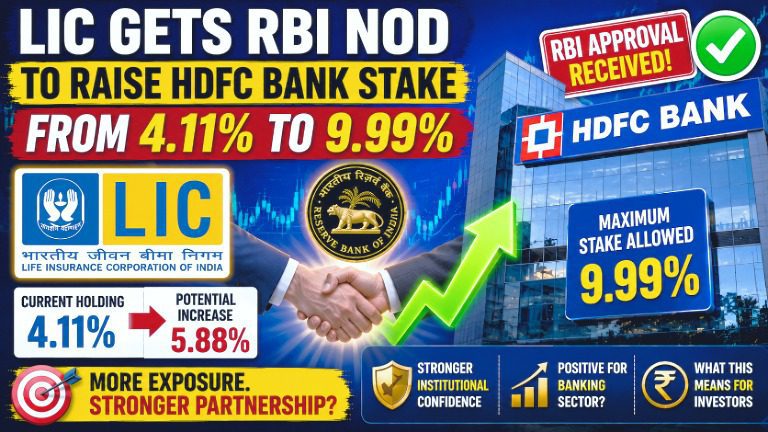
LIC Gets RBI Nod to Raise HDFC Bank Stake to 9.99%: What It Means for Investors
Life Insurance Corporation of India (LIC) has received approval from the Reserve Bank of India (RBI) to increase its holding in HDFC Bank to 9.99%, potentially making the insurer an even more significant institutional shareholder in one of India’s largest private-sector banks.
HDFC Bank disclosed the RBI approval in a regulatory filing. The RBI letter was dated August 19, 2026, and the bank said LIC held 4.11% of its total share capital as of August 14.
That means LIC has regulatory permission to potentially add another 5.88 percentage points to its HDFC Bank holding. However, the approval does not mean LIC has already bought the additional shares or that it must immediately increase its stake.
The permission is subject to several banking, foreign-exchange and securities-market regulations.
LIC can now potentially move from 4.11% to 9.99%
The key development is straightforward: LIC currently owns 4.11% of HDFC Bank, while the RBI has approved an aggregate holding of up to 9.99% of the bank’s paid-up share capital or voting rights.
In percentage terms:
Particular Stake
LIC’s current holding 4.11%
RBI-approved maximum 9.99%
Potential additional stake 5.88 percentage points
The approval was granted following LIC’s application to the RBI.
Importantly, investors should distinguish between regulatory approval and an actual acquisition of shares. LIC is permitted to increase its holding within the approved ceiling, but the insurer’s decision about whether, when and how much to buy remains separate.
What exactly did the RBI approve?
According to HDFC Bank’s disclosure, the RBI has permitted LIC to acquire an aggregate holding of up to 9.99% of HDFC Bank’s paid-up share capital or voting rights.
The approval is subject to compliance with the Banking Regulation Act, 1949, the RBI’s Commercial Banks — Acquisition and Holding of Shares or Voting Rights Directions, 2025, the Foreign Exchange Management Act, 1999, SEBI regulations and other applicable laws and guidelines.
This regulatory framework is particularly important because banks are strategically sensitive financial institutions. Large ownership positions in banks are therefore subject to tighter regulatory oversight than ordinary equity investments.
Why is the 9.99% level important?
A holding close to 10% is significant for an institutional investor.
LIC is already one of India’s largest institutional investors, while HDFC Bank is one of the country’s biggest private-sector lenders.
If LIC eventually moves from 4.11% towards the 9.99% ceiling, its economic exposure to HDFC Bank would increase substantially.
However, 9.99% should be viewed as the maximum approved level, not as a confirmed target purchase.
The RBI’s approval simply gives LIC regulatory room to build its position up to that level.
Will LIC immediately buy another 5.88%?
Not necessarily.
The RBI approval does not itself confirm that LIC will acquire the entire additional 5.88 percentage points.
LIC could decide to:
increase its holding gradually;
purchase a smaller additional stake;
wait for suitable market conditions;
or retain its existing holding.
The eventual stake will depend on LIC’s investment decisions and compliance with the conditions attached to the RBI approval.
This distinction is important for investors because an RBI approval should not automatically be interpreted as a guarantee of future buying activity.
Why the development matters for HDFC Bank shareholders
The approval comes at a time when HDFC Bank remains closely watched by investors because of its size, earnings trajectory, asset quality and institutional ownership.
A potential increase in LIC’s holding could be interpreted as a sign of continued institutional interest in HDFC Bank.
At the same time, investors should not treat LIC’s approval as a standalone reason to buy or sell HDFC Bank shares.
The bank’s operating performance, valuation, asset quality, margins, loan growth and management developments remain important factors.
HDFC Bank’s latest financial performance
The supplied report highlighted HDFC Bank’s first-quarter FY27 performance.
For the April-June quarter, the bank reported standalone net profit of approximately ₹19,059.72 crore, representing a 4.98% year-on-year increase.
Net interest income increased 6.7% year-on-year to ₹33,535.95 crore.
The reported net interest margin stood at:
3.26% on total assets
3.40% on interest-earning assets
The bank’s average deposits increased 10.8% year-on-year to ₹30,386 billion, while advances rose 13.3% to ₹30,115 billion.
Asset quality needs monitoring
One figure investors will continue watching is HDFC Bank’s gross non-performing asset ratio.
According to the supplied information, gross NPAs increased marginally to 1.17% of gross advances as of June 30, compared with 1.15% at the end of March.
The movement is relatively small, but asset quality remains a key consideration for any large bank because higher bad loans can eventually affect profitability and credit costs.
Therefore, while LIC’s potential increase in ownership is significant, investors should evaluate it alongside HDFC Bank’s operational numbers.
HDFC Bank shares reacted to the news
The RBI approval also attracted attention in the stock market.
NDTV Profit reported that HDFC Bank shares rose as much as 1.09% intraday to ₹728 after the news emerged.
However, another market report noted that the stock had recently traded at a 52-week intraday low of ₹715.05 before recovering and closing at ₹720.15 on August 19.
This highlights an important point: the LIC stake approval is only one of several factors influencing HDFC Bank’s share price.
LIC’s investment could increase its exposure to banking
For LIC, increasing its stake in HDFC Bank would deepen its exposure to the banking and financial-services sector.
LIC already has a large investment portfolio across Indian companies. A higher holding in HDFC Bank would increase the importance of the bank within its equity investments.
For HDFC Bank, meanwhile, a larger holding by a major domestic institutional investor could further strengthen the bank’s shareholder base.
But whether the approval ultimately results in a substantial increase in LIC’s ownership remains to be seen.
What investors should watch next
There are several developments worth monitoring following the RBI approval.
1. LIC’s actual buying activity
The biggest question is whether LIC starts acquiring additional HDFC Bank shares and, if so, how quickly.
2. Shareholding disclosures
Future beneficial-ownership data will indicate whether LIC’s stake has moved materially above 4.11%.
3. HDFC Bank’s earnings
Investors will continue to track loan growth, deposits, net interest income, margins and profit growth.
4. Asset quality
Gross and net NPA trends, credit costs and provisioning will remain important.
5. Regulatory compliance
LIC’s purchases must remain within the regulatory framework specified by the RBI and other authorities.
LIC-HDFC Bank development in simple terms
The development can be summarised in one line:
LIC currently owns 4.11% of HDFC Bank, and the RBI has now allowed it to potentially increase that holding to 9.99%.
That is an approval to acquire more—not confirmation that the additional shares have already been purchased.
The difference between those two points is particularly important for investors interpreting the news.
Bottom line
The RBI’s approval allowing LIC to raise its HDFC Bank holding to 9.99% is a significant institutional-ownership development.
LIC currently holds 4.11%, leaving room for a potential additional 5.88 percentage points if the insurer chooses to use the approval.
The approval is subject to India’s banking, foreign-exchange and securities regulations, and it does not compel LIC to immediately acquire the maximum permitted stake.
For HDFC Bank investors, the next major signal will therefore be LIC’s actual share purchases and subsequent ownership disclosures, rather than the RBI approval alone.
FAQs
Q1. What stake does LIC currently hold in HDFC Bank?
LIC held 4.11% of HDFC Bank’s total share capital as of August 14, 2026.
Q2. What stake can LIC acquire in HDFC Bank?
The RBI has approved LIC to acquire an aggregate holding of up to 9.99% of HDFC Bank’s paid-up share capital or voting rights.
Q3. How much more HDFC Bank stake can LIC potentially acquire?
Based on the reported 4.11% holding and 9.99% ceiling, LIC could potentially increase its stake by 5.88 percentage points.
Q4. Does RBI approval mean LIC has already bought the additional shares?
No. The approval gives LIC permission to acquire up to the approved limit. It does not mean that LIC has already purchased the additional shares.
Q5. When did RBI approve LIC’s HDFC Bank stake increase?
The RBI approval letter was dated August 19, 2026.
Q6. What regulations apply to LIC’s investment?
The approval is subject to the Banking Regulation Act, RBI’s 2025 directions on acquisition and holding of shares or voting rights in commercial banks, FEMA, SEBI regulations and other applicable laws.
Q7. Is the LIC stake increase positive for HDFC Bank shares?
It may be viewed as a sign of institutional interest, but the RBI approval alone does not determine HDFC Bank’s future share price. Earnings, valuation, asset quality, margins and broader market conditions also matter.
Q8. What was HDFC Bank’s latest quarterly net profit mentioned in the report?
HDFC Bank reported standalone net profit of approximately ₹19,059.72 crore for April-June FY27, according to the supplied article.
Disclaimer
Disclaimer: This article is for informational and educational purposes only and should not be considered investment advice, a recommendation to buy or sell HDFC Bank or LIC shares, or a guarantee of future stock performance. Regulatory approvals do not necessarily mean that an investment or stake acquisition will take place immediately. Investors should independently verify company filings and consult a qualified financial adviser before making investment decisions.
Do Follow For More Info @ http://roydailyupdate.in
Do WhatsApp @ https://chat.whatsapp.com/K5POJK9KbpN8egjjOCaOw6
About the Author
Ravi is a digital content writer and blogger at Roy Daily Update, covering stock market news, business, jobs, technology, Karnataka news, entertainment and major developments from India and around the world.
He focuses on presenting financial and current-affairs stories in a clear, reader-friendly format, highlighting important numbers, developments and context for everyday readers.