

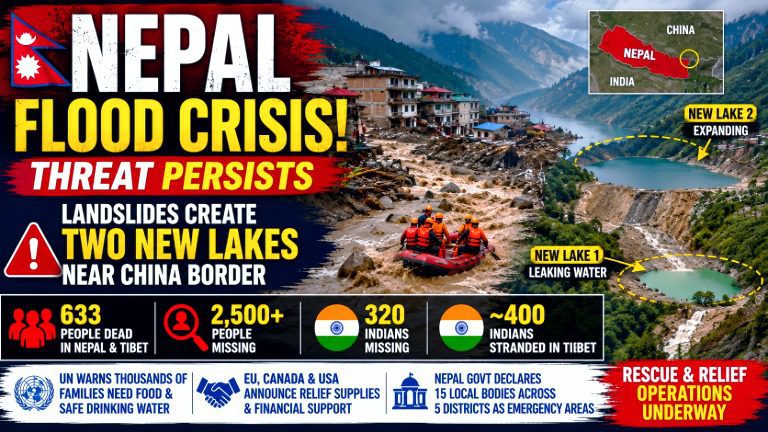
Nepal Flood Crisis: Two New Lakes Form Near China Border, 633 Dead and 2,500 Missing
Nepal Flood Crisis: Nepal continues to face a devastating flood and landslide emergency, with the danger persisting even after the initial disaster. Two new lakes have reportedly formed near the Nepal-China border following landslides, raising concerns that unstable terrain and rising water levels could trigger further flooding and landslides in nearby areas.
According to the information available in the report, 633 people have been reported dead across Nepal and Tibet, while around 2,500 people remain missing. The crisis has also affected Indian nationals, with 320 Indians reportedly among those missing and nearly 400 Indian citizens stranded in Tibet.
As rescue and relief operations continue, the United Nations has warned that thousands of families urgently need food and safe drinking water. Nepal’s government has also designated 15 local bodies across five districts as disaster-affected emergency areas in an effort to speed up rescue, relief and rehabilitation work.
Nepal flood crisis remains critical
The latest developments indicate that the emergency in Nepal has not ended with the first wave of flooding. The formation of two new lakes near the Nepal-China border has created a fresh layer of uncertainty for authorities and communities in vulnerable areas.
The lakes reportedly formed after landslides altered the natural flow of water. One of the newly formed lakes is continuously leaking, while the other is reportedly growing in size.
This development has raised concerns because water accumulating behind unstable landslide debris can create additional hazards. If the natural barriers surrounding such water bodies weaken or collapse, downstream areas could potentially face sudden flooding.
The situation is therefore being closely watched as rescue teams and authorities continue responding to the wider disaster.
Key developments at a glance
633 people reportedly dead across Nepal and Tibet
Around 2,500 people reported missing
320 Indians reportedly among those missing
Nearly 400 Indian nationals stranded in Tibet
Two new lakes formed near the Nepal-China border
One lake is reportedly leaking water
The second lake is reportedly expanding
UN warns thousands of families need food and safe drinking water
Nepal declares 15 local bodies across five districts as disaster-affected emergency areas
International agencies and several countries have announced assistance
How did the new lakes form?
The two new lakes are reportedly linked to landslides triggered during the disaster.
Landslides can dramatically alter the landscape, particularly in mountainous regions. Large quantities of mud, rocks, gravel and boulders can move downhill and block existing water channels. When water becomes trapped behind such material, a temporary or newly formed lake can develop.
In the current Nepal crisis, one of the lakes is reportedly leaking continuously, while the other is increasing in size. The difference between the two situations is important because changes in water levels can indicate that the landscape is still evolving.
Authorities and local communities therefore face a difficult situation. They must continue rescue operations while also monitoring areas where unstable slopes and newly formed water bodies could create secondary hazards.
Massive destruction caused by floods and landslides
The initial flooding reportedly caused widespread destruction across affected parts of Nepal and surrounding areas.
Powerful torrents carried mud, sand, gravel and large boulders into lower-lying areas. Such fast-moving floodwater can destroy roads, damage buildings and disrupt communications, making rescue operations significantly more difficult.
Mountainous terrain adds another challenge. Landslides can cut off roads and isolate communities, while damaged infrastructure can slow down the movement of rescue teams and emergency supplies.
For people already displaced by flooding, the emergence of new landslide-related lakes adds another concern: whether their homes and communities will remain safe as water levels and terrain conditions change.
633 deaths reported across Nepal and Tibet
The reported death toll has reached 633 across Nepal and Tibet, highlighting the scale of the disaster.
However, the report also states that around 2,500 people remain missing. This means the final impact of the disaster could change as search and rescue teams reach areas that have been cut off or difficult to access.
Missing-person figures are particularly difficult to establish during a major natural disaster. People can become separated from their families, communication networks can fail and entire communities may be temporarily inaccessible.
Consequently, casualty and missing-person numbers can continue to change as authorities receive additional information and rescue operations progress.
Hundreds of Indians affected
The disaster has also created serious concerns for Indian nationals.
According to the report, 320 Indians are among those reported missing, while nearly 400 Indian nationals remain stranded in Tibet.
The presence of a large number of Indian nationals among those affected makes the situation significant for India as well as Nepal and Tibet. Families waiting for information about relatives may face uncertainty while authorities attempt to establish contact and assess the condition of people in affected areas.
For stranded people, access to food, drinking water, shelter, communications and safe transportation becomes a major priority.
The situation also demonstrates how natural disasters in mountainous border regions can have consequences beyond national boundaries.
United Nations warns of urgent humanitarian needs
The United Nations has warned that thousands of families in Nepal urgently require food and safe drinking water.
Access to clean drinking water becomes especially important after major floods. Floodwater can contaminate local water sources, while damaged infrastructure can make it difficult to distribute clean water to affected communities.
Food supplies are another immediate concern. Flooded roads and landslides can interrupt normal supply chains, leaving communities dependent on emergency assistance.
Relief agencies therefore face the challenge of reaching people in areas where transportation routes may have been damaged or blocked.
The humanitarian response is expected to remain focused on providing basic necessities while rescue operations continue.
International assistance reaches Nepal
Several countries and international organisations have reportedly stepped up assistance following the disaster.
The European Union, Canada and the United States have announced relief supplies and financial support for Nepal, according to the supplied report.
International assistance can play an important role during a disaster of this scale. Relief supplies, financial resources and technical support can help local authorities strengthen emergency response operations and provide assistance to affected families.
However, delivering aid can be as challenging as arranging it when roads, bridges and other infrastructure have been damaged.
Nepal government declares emergency areas
The Nepal government has declared 15 local bodies across five districts as disaster-affected emergency areas.
The decision is intended to speed up relief, rescue and rehabilitation efforts in the regions worst affected by the floods and landslides.
Declaring specific areas as disaster-affected emergency zones can help authorities concentrate resources and coordinate operations more efficiently.
The immediate focus is expected to remain on saving lives, locating missing people, assisting stranded residents and providing essential supplies.
Longer-term rehabilitation will involve restoring infrastructure and helping affected communities recover after the immediate emergency has passed.
Why the two new lakes are causing fresh concern
The emergence of new water bodies following landslides is one of the most concerning developments in the latest update.
The report says that one lake is leaking water, while the other is expanding. These developments mean the situation near the Nepal-China border remains dynamic.
A newly formed lake created by a landslide can behave differently from a naturally established lake. Its surrounding terrain may be unstable, particularly if the water is being held back by accumulated earth, rocks and debris.
For communities downstream, sudden changes in water levels can create additional risks.
This is why monitoring the lakes and surrounding slopes is important alongside the broader rescue operation.
Rescue operations face difficult conditions
Rescue teams working during floods and landslides often have to deal with several problems at the same time.
Floodwater can make roads unusable, while landslides can block access routes. Large rocks and debris can also make movement difficult for vehicles and rescue equipment.
In remote mountainous regions, reaching affected communities can take longer than in areas with better-connected road networks.
Communication can also become a challenge when infrastructure is damaged. Families may therefore struggle to contact relatives and receive updates about their safety.
These difficulties make coordination between government authorities, emergency workers, local communities and international organisations particularly important.
The crisis is also a warning about secondary disasters
The latest developments show that a natural disaster does not necessarily end when the initial flooding begins to recede.
Floods can trigger landslides, while landslides can create new water bodies. Those water bodies can subsequently become another potential source of danger.
This chain of events makes disaster management particularly difficult in mountainous areas.
Authorities must therefore monitor not only flooded settlements but also hillsides, rivers, newly blocked waterways and unstable areas.
The two new lakes near the Nepal-China border demonstrate how quickly the physical landscape can change following an extreme natural event.
What happens next?
The immediate priority remains rescue, relief and the protection of vulnerable communities.
Authorities will need to continue tracking the two newly formed lakes and assessing whether the surrounding terrain remains stable. At the same time, search teams will have to continue efforts to locate people reported missing.
Providing food and safe drinking water will remain essential for displaced and affected families.
For Indian nationals affected by the disaster, establishing contact with missing and stranded citizens will also be an important priority.
The Nepal government’s decision to designate 15 local bodies as emergency areas is expected to support faster coordination of relief and rehabilitation efforts.
Nepal flood crisis: A developing disaster
The latest Nepal flood crisis is still developing, and the figures reported so far may change as rescue operations continue.
The reported 633 deaths and approximately 2,500 missing people underline the severity of the disaster. The reported impact on Indian nationals adds another dimension to the crisis, while the formation of two new lakes near the Nepal-China border has created fresh concerns.
The United Nations’ warning about urgent food and drinking-water requirements highlights the humanitarian challenges facing affected communities.
Meanwhile, international assistance from the European Union, Canada, the United States and other organisations could provide important support as Nepal moves from immediate rescue operations toward relief and rehabilitation.
For now, the most pressing concern remains the safety of people living in vulnerable areas. The continuing leakage and expansion of the newly formed lakes mean authorities must remain alert to the possibility of further changes in the landscape.
The Nepal disaster is therefore not only a story of devastating floods and landslides but also a reminder of how quickly natural hazards can create secondary threats. Continued monitoring, rapid rescue operations, international assistance and effective coordination will be crucial in the days ahead.
FAQs
Q1. What is the latest situation in the Nepal flood crisis?
According to the supplied report, the situation remains critical after severe floods and landslides. Two new lakes have formed near the Nepal-China border, creating concerns about further flooding and landslides.
Q2. How many people have died in the Nepal disaster?
The report states that 633 people have died across Nepal and Tibet.
Q3. How many people are still missing?
Around 2,500 people are reported missing, according to the information provided.
Q4. How many Indians are reportedly missing?
The report says 320 Indians are among those reported missing.
Q5. Are Indian nationals stranded in Tibet?
Yes. According to the supplied report, nearly 400 Indian nationals remain stranded in Tibet.
Q6. Why are the newly formed lakes causing concern?
One of the newly formed lakes is reportedly leaking water, while the other is continuing to expand. This has raised fears of additional flooding and landslides in surrounding areas.
Q7. What caused the new lakes?
The report says the lakes were formed after landslides near the Nepal-China border.
Q8. What has the United Nations said about the disaster?
The United Nations has warned that thousands of families in Nepal urgently need food and safe drinking water while rescue and relief operations continue.
Q9. What assistance is Nepal receiving?
According to the report, the European Union, Canada and the United States have announced relief supplies and financial assistance.
Q10. What has the Nepal government done?
The Nepal government has declared 15 local bodies across five districts as disaster-affected emergency areas to accelerate relief, rescue and rehabilitation efforts.
Disclaimer
Disclaimer: This article is based on the information provided in the source material available at the time of writing. Reported casualty figures, missing-person numbers, rescue updates and other details may change as authorities continue search, rescue and relief operations. Readers should refer to official government agencies and verified local sources for the latest information. RoyDailyUpdate does not independently confirm every claim contained in the source material and does not intend to sensationalise the tragedy.
Do Follow For More Info @ http://roydailyupdate.in
Do WhatsApp @ https://chat.whatsapp.com/K5POJK9KbpN8egjjOCaOw6
About the Author — Ravi
Ravi is a digital content creator and blogger who covers breaking news, trending developments, jobs, stocks, technology and important updates from India and around the world. Through roydailyupdate.in, he focuses on presenting timely information in a simple, reader-friendly and engaging format.
His approach combines clear reporting, useful context and SEO-friendly storytelling to help readers quickly understand the key developments behind major news events.