

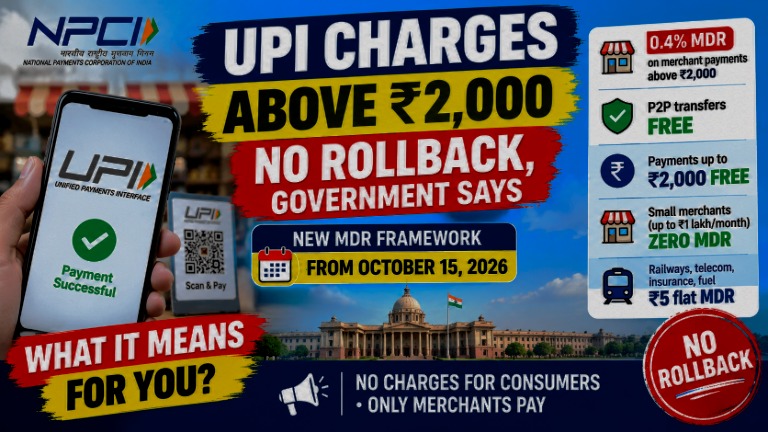
UPI Charges Above ₹2,000: No Rollback, Sources Say; What Users and Merchants Need to Know
India’s new UPI Merchant Discount Rate (MDR) framework will not be rolled back, according to sources cited by NDTV on September 16, 2026, even as the decision has triggered a political debate over the future of digital payments.
The revised framework, announced by the National Payments Corporation of India (NPCI), introduces a 0.4% MDR on specified person-to-merchant (P2M) UPI transactions above ₹2,000 from October 15, 2026.
Importantly, the charge is designed to be paid by merchants and other participants in the payment ecosystem, not consumers. Person-to-person UPI transfers will continue to remain free regardless of the amount.
The government has also said banks should ensure that merchants do not pass the MDR on to customers.
No rollback of new UPI charge framework
According to sources quoted by NDTV, the decision to introduce MDR was considered over several years.
A source said the framework had been contemplated around five years ago, with the intention of introducing merchant charges once the country’s digital-payment infrastructure had developed sufficiently.
The same source said the government does not intend to reconsider or withdraw the decision.
The comments came after opposition parties criticised the new framework and called for its withdrawal.
The government, meanwhile, has maintained that the revised framework is intended to support the long-term sustainability and expansion of the UPI ecosystem.
When will the new UPI charges start?
The revised MDR framework will take effect from October 15, 2026.
The October 15 start date gives banks, payment aggregators, fintech companies and other participants time to update their technology and billing systems.
Until then, the existing payment framework continues to apply.
Will normal UPI users have to pay?
No. Consumers are not being charged an additional UPI transaction fee under the new framework.
This is one of the most important points to understand.
If you send money through UPI to another individual, the transaction remains free regardless of the amount.
For example:
₹5,000 to a friend → No MDR
₹25,000 to a family member → No MDR
₹1,500 payment to a merchant → No MDR
Eligible merchant payment above ₹2,000 → MDR applies to the merchant under the specified framework
The Finance Ministry has said MDR is not a tax collected by the government or NPCI. Instead, it is distributed among participants in the payment ecosystem, including banks and payment application providers.
What happens when you pay a merchant more than ₹2,000?
For specified P2M transactions above ₹2,000, the MDR is 0.4%.
The charge is calculated on the transaction amount.
For example:
UPI merchant payment 0.4% MDR
₹2,001 About ₹8
₹5,000 ₹20
₹10,000 ₹40
₹25,000 ₹100
₹50,000 ₹200
₹75,000 ₹300
For transactions of ₹75,000 or more, the standard 0.4% MDR is capped at ₹300 per transaction.
However, this does not mean the customer is supposed to pay the amount separately. The MDR is applicable to the merchant/payment ecosystem under the framework.
Small merchants remain protected
The new framework also contains an exemption for small merchants.
Merchants receiving up to ₹1 lakh per month through UPI QR payments under the applicable small-merchant category will continue to operate under zero MDR.
This means a small local seller using a UPI QR code may not be affected by the new MDR even when individual payment rules would otherwise appear to cross the ₹2,000 threshold, provided the merchant qualifies under the specified category.
This exemption is particularly relevant for small retailers and street vendors.
Some essential services will have a flat ₹5 MDR
The framework also provides a different structure for specified sectors.
For categories such as railways, telecommunications, insurance and fuel, a flat ₹5 MDR applies to eligible transactions above ₹2,000 rather than the standard 0.4% rate.
This means a ₹10,000 payment in one of the specified categories would not attract a ₹40 MDR under the standard formula; the applicable MDR would instead be ₹5 under the special category.
Other categories have separate provisions as well.
Stock market and mutual fund payments have separate treatment
The revised framework also provides a lower MDR structure for certain financial transactions.
Payments involving mutual funds, securities, stockbrokers and dealers will attract an MDR of 0.02%, subject to a ₹300 cap per transaction, according to the Indian Express explanation of the new framework.
This means users making eligible investment-related payments will not necessarily face the standard 0.4% MDR structure.
Around 96% of merchant UPI transactions remain unaffected
The government has stressed that the change applies only to a relatively small portion of UPI merchant transactions.
According to the Finance Ministry statement cited by NDTV, approximately 96% of P2M transactions will remain unaffected.
The government says payments to merchants up to ₹2,000, along with transactions covered under the zero-MDR framework for small merchants, will remain free. Person-to-person transactions are also outside the MDR framework.
This distinction is important because headlines about “UPI charges” can otherwise give the impression that every UPI payment will become chargeable.
That is not what the new framework says.
Why is MDR being introduced?
For years, UPI has operated with a zero-MDR structure for merchants, helping the payment system expand rapidly across India.
The new framework changes that model for certain merchant transactions.
The Finance Ministry’s explanation is that MDR will help support the continued operation and expansion of the UPI ecosystem by providing revenue to participants such as banks and payment application providers.
Reuters reported that the decision marks a shift after more than six years of largely free UPI payments and could create a new revenue stream for banks and fintech companies.
The government has therefore framed the change as a payment-system sustainability measure rather than a consumer tax.
Opposition criticises the decision
The announcement has also become a political issue.
Congress president Mallikarjun Kharge criticised the decision and described the new MDR framework as a burden on the public. Leader of Opposition Rahul Gandhi also called for the decision to be rolled back.
These are political criticisms of the policy and should be distinguished from the government’s stated position that consumers will not be charged and that the MDR is intended for merchants and the payment ecosystem.
The BJP, meanwhile, rejected the criticism and argued that consumers would continue to pay zero transaction charges under the framework.
BJP spokesperson Pradeep Bhandari said the opposition was spreading misinformation and highlighted the exemptions for consumers, small merchants and person-to-person transfers.
Will merchants pass the cost to customers?
This is one of the key practical questions surrounding the new framework.
The Finance Ministry has advised banks to ensure that merchants do not transfer the MDR cost to UPI users.
Therefore, the official framework is that the customer should not be charged an additional UPI fee simply because the merchant’s transaction exceeds ₹2,000.
However, how individual businesses respond to the new cost structure will remain an important issue to watch once the rules become operational.
UPI continues to remain free for person-to-person payments
The distinction between P2P and P2M transactions is central to understanding the new system.
P2P — Person to Person
Examples include:
Sending ₹10,000 to a friend
Sending ₹50,000 to a family member
Paying another individual
Transferring money between individuals
These transactions remain free under the new MDR framework.
P2M — Person to Merchant
Examples include:
Paying a restaurant
Buying electronics
Paying a retailer
Paying an online merchant
Eligible transactions above ₹2,000 can attract MDR under the new framework.
What changes from October 15?
The key rules at a glance
Transaction type New framework
P2P UPI payment Free
Merchant payment up to ₹2,000 Free
Eligible merchant payment above ₹2,000 0.4% MDR
Standard MDR cap ₹300 per transaction
Railways/telecom/insurance/fuel, eligible payments above ₹2,000 ₹5 MDR
Eligible small merchants up to ₹1 lakh monthly QR receipts Zero MDR
Eligible mutual fund/securities transactions 0.02%, subject to cap
Consumer transaction fee No charge under the framework
The exact application depends on the merchant category and transaction classification.
Why this matters for India’s digital-payment ecosystem
UPI has become a central part of India’s digital-payment infrastructure.
Reuters reported that UPI processed 24.5 billion transactions worth ₹29.823 trillion in August 2026, highlighting the enormous scale of the system.
Introducing MDR on selected merchant payments therefore represents a significant change in the economics of UPI.
Banks, payment applications and payment aggregators are among the participants affected by how MDR revenue is distributed.
For consumers, the immediate framework remains relatively straightforward: sending money to another person remains free, and the government says consumers should not bear the merchant MDR.
Kannada Key Points
UPI Charges: ಅಕ್ಟೋಬರ್ 15ರಿಂದ ಹೊಸ ನಿಯಮ
₹2,000ಕ್ಕಿಂತ ಹೆಚ್ಚಿನ ಕೆಲವು Merchant UPI Payments ಮೇಲೆ 0.4% MDR ಅನ್ವಯವಾಗಲಿದೆ.
ಈ ಹೊಸ ವ್ಯವಸ್ಥೆ ಅಕ್ಟೋಬರ್ 15, 2026ರಿಂದ ಜಾರಿಗೆ ಬರಲಿದೆ.
ಸಾಮಾನ್ಯ ಗ್ರಾಹಕರಿಗೆ UPI ಬಳಸಲು ಪ್ರತ್ಯೇಕ transaction fee ವಿಧಿಸುವುದಿಲ್ಲ.
Person-to-Person (P2P) UPI ಹಣ ವರ್ಗಾವಣೆ ಯಾವುದೇ ಮೊತ್ತವಾಗಿದ್ದರೂ ಉಚಿತವಾಗಿರುತ್ತದೆ.
₹2,000ವರೆಗೆ ಇರುವ ಅರ್ಹ merchant payments ಮೇಲೆ MDR ಇರುವುದಿಲ್ಲ.
₹75,000 ಅಥವಾ ಅದಕ್ಕಿಂತ ಹೆಚ್ಚಿನ ಸಾಮಾನ್ಯ ಅರ್ಹ merchant transactionಗಳಿಗೆ MDR ಗರಿಷ್ಠ ₹300ಕ್ಕೆ ಸೀಮಿತವಾಗಿರುತ್ತದೆ.
ರೈಲ್ವೆ, ಟೆಲಿಕಾಂ, ವಿಮೆ ಮತ್ತು ಇಂಧನದಂತಹ ಕೆಲವು ಕ್ಷೇತ್ರಗಳಿಗೆ ₹5 flat MDR ಅನ್ವಯವಾಗುತ್ತದೆ.
ತಿಂಗಳಿಗೆ UPI QR ಮೂಲಕ ₹1 ಲಕ್ಷದವರೆಗೆ ಪಡೆಯುವ ಅರ್ಹ ಸಣ್ಣ ವ್ಯಾಪಾರಿಗಳಿಗೆ zero-MDR ವ್ಯವಸ್ಥೆ ಮುಂದುವರಿಯಲಿದೆ.
ಸರ್ಕಾರದ ಪ್ರಕಾರ ಸುಮಾರು 96% P2M transactions ಪರಿಣಾಮಕ್ಕೊಳಗಾಗುವುದಿಲ್ಲ.
UPI MDR ನಿರ್ಧಾರವನ್ನು ಹಿಂಪಡೆಯುವ ಯಾವುದೇ ಪ್ರಸ್ತುತ ಯೋಜನೆ ಇಲ್ಲ ಎಂದು ಮೂಲಗಳು ತಿಳಿಸಿವೆ.
Frequently Asked Questions
1. Will UPI become chargeable for everyone from October 15?
No. The revised MDR framework does not impose a consumer transaction fee on all UPI payments. Person-to-person payments remain free, while eligible merchant payments above ₹2,000 can attract MDR.
2. Who pays the 0.4% UPI MDR?
The MDR applies to the merchant/payment ecosystem, not directly to the consumer under the stated framework.
3. Is sending ₹10,000 to a friend through UPI free?
Yes. Person-to-person UPI transactions remain free regardless of the amount.
4. What is the UPI charge on a ₹10,000 eligible merchant payment?
The standard MDR is 0.4%, which equals ₹40. However, the MDR is applicable to the merchant/payment ecosystem rather than being a consumer transaction fee.
5. What is the maximum standard MDR?
For standard eligible transactions of ₹75,000 or more, the MDR is capped at ₹300 per transaction.
6. When will the new UPI MDR rules start?
The new framework is scheduled to take effect from October 15, 2026.
7. Will small merchants be charged?
Eligible small merchants receiving up to ₹1 lakh per month through UPI QR payments will remain under zero MDR.
8. Will the government collect the 0.4% as a tax?
No. The Finance Ministry has said MDR is not a government tax and is distributed among participants in the payment ecosystem.
Final Takeaway
The new UPI MDR framework represents a significant change in India’s digital-payment ecosystem, but it does not mean that every UPI user will start paying a fee.
From October 15, 2026, eligible merchant transactions above ₹2,000 will attract a 0.4% MDR, subject to applicable caps and sector-specific rules. Person-to-person transfers remain free, and eligible small merchants continue to receive protection under the zero-MDR framework.
As of September 16, government sources cited by NDTV and Indian Express say there is no plan to roll back the framework. The policy has drawn criticism from opposition parties, while the government maintains that the change is necessary to support the long-term sustainability of UPI.
Disclaimer:
This article explains the UPI MDR framework based on information available as of September 16, 2026. Specific charges can depend on transaction type, merchant category and applicable NPCI rules. Political statements and criticisms are attributed to the respective parties and individuals and do not represent an independent political assessment.
Do WhatsApp @ https://chat.whatsapp.com/K5POJK9KbpN8egjjOCaOw6
Do Follow For More Info @ http://roydailyupdate.in
About the Author — Ravi H Irannanavar
Ravi H Irannanavar is a blogger and digital content creator who covers breaking news, government updates, jobs, education, business, stock-market developments and trending stories. His focus is on delivering clear, informative and reader-friendly content with useful updates for Indian audiences.
thank you for the information
You are welcome sir