

India’s 3-0 Sweep Over Afghanistan

Introduction
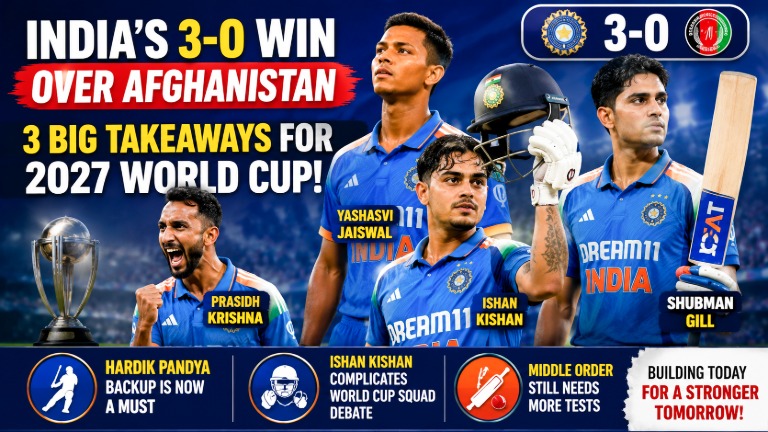
India completed a convincing 3-0 ODI series sweep against Afghanistan, but the real significance of the series extends far beyond the scoreline. While fans celebrated dominant performances from Shubman Gill, Ishan Kishan, Yashasvi Jaiswal and Prasidh Krishna, the Indian team management quietly gained crucial insights into its long-term planning for the ICC ODI World Cup 2027.
The victories showcased India’s strength, depth and talent pool. However, they also highlighted a few unresolved issues that could influence team selection and strategy over the next two years. The search for a reliable backup to Hardik Pandya, the growing case for Ishan Kishan’s inclusion, and the lack of pressure situations for the middle order emerged as the biggest talking points.
As India begins preparing for the next World Cup, expected to be played primarily in South Africa, these lessons could prove far more valuable than the series result itself.
Hardik Pandya’s Backup Has Become India’s Biggest Priority
One of the clearest messages from the Afghanistan series was the importance of finding a reliable backup for Hardik Pandya.
Modern ODI cricket demands players who can contribute with both bat and ball. Hardik’s ability to finish innings, accelerate scoring, and provide valuable seam-bowling overs makes him one of the most important players in India’s setup.
The problem is that players with a similar skill set are extremely rare.
India possesses an abundance of batting talent and a strong pool of fast bowlers and spinners. However, replacing Hardik’s unique balance remains one of the biggest challenges facing the selectors.
This is why players such as Nitish Kumar Reddy, Harshit Rana and other pace-bowling all-rounders are receiving increased attention. The team management appears determined to develop alternatives before the 2027 World Cup rather than waiting for a natural successor to emerge.
South African conditions are expected to favour pace bowling, making team balance even more critical. India may need three specialist fast bowlers regularly, and without a seam-bowling all-rounder, the side could be forced into uncomfortable compromises.
The Afghanistan series reinforced the belief that India needs long-term insurance for Hardik Pandya if they hope to maintain flexibility in their World Cup squad.
Ishan Kishan Has Created a Selection Headache
Few players improved their World Cup prospects more than Ishan Kishan during the series.
His explosive century in the second ODI was not just another impressive innings—it was a powerful reminder of the unique qualities he brings to the team.
India’s batting order is already crowded with established stars and emerging talents. Shubman Gill remains a central figure in India’s future plans. Rohit Sharma continues to lead from the front. Yashasvi Jaiswal is making a strong case for permanent inclusion. Virat Kohli, KL Rahul and Shreyas Iyer remain major contenders.
Yet Kishan offers something different.
As a left-handed batter and wicketkeeper who can attack from the first ball, he provides tactical flexibility. He can open the innings, keep wickets and change the momentum of a match within a few overs.
This versatility increases his value significantly.
For selectors, the decision is becoming increasingly difficult. Leaving out Kishan may require India to use separate squad spots for a reserve wicketkeeper and an aggressive backup opener.
His performances against Afghanistan may not guarantee a place in the playing XI, but they certainly ensure he remains firmly in the conversation for the 2027 World Cup squad.
Shubman Gill Continues to Strengthen His Position
Another major positive for India was the consistency of Shubman Gill.
The young opener once again demonstrated why he is viewed as the future leader of India’s batting lineup. His ability to build innings while maintaining a healthy scoring rate continues to impress selectors and cricket experts alike.
Gill has successfully transformed from a promising youngster into one of the most dependable ODI batters in world cricket.
With the 2027 World Cup still two years away, India can confidently build their batting strategy around him.
His performances against Afghanistan further confirmed that he is likely to be one of the first names on the team sheet for major ICC tournaments in the coming years.
Yashasvi Jaiswal Makes a Strong Statement
Yashasvi Jaiswal’s unbeaten century in Chennai was another significant outcome of the series.
The left-handed batter continues to impress across formats and appears increasingly comfortable at the international level.
His aggressive style and fearless approach make him an attractive option for modern ODI cricket. More importantly, he provides valuable left-right balance at the top of the order.
India’s selectors now face an enviable challenge: finding room for multiple talented top-order batters while maintaining overall squad balance.
Jaiswal’s performance ensured that he remains firmly in contention for future ODI assignments.
India’s Biggest Concern Remains Unanswered

Despite the comprehensive 3-0 series victory, one major question remains unresolved.
What happens when India’s top order fails?
Against Afghanistan, the openers and top-order batters dominated most matches. As a result, the middle order rarely found itself under genuine pressure.
While this may seem positive, it actually deprived the team management of valuable information.
World Cups are often decided by how teams respond in difficult situations. Successful teams recover from 50 for 3, rebuild after collapses and finish strongly under pressure.
India did not face enough such scenarios during this series.
Questions still remain regarding:
- Who anchors the innings if early wickets fall?
- Who attacks spin during the middle overs?
- Who finishes matches if Hardik Pandya is unavailable?
- What is the ideal No. 6 and No. 7 combination?
- Can the lower-middle order handle pressure situations consistently?
These questions are likely to dominate discussions over the next two years.
Why the Series Matters for the 2027 World Cup
At first glance, the Afghanistan series looked like a routine victory.
However, for India’s selectors and coaching staff, it served as an important checkpoint in the journey towards the 2027 ODI World Cup.
The series helped identify emerging contenders, reinforced the importance of key players and highlighted areas requiring further development.
The focus is no longer just on finding talented cricketers. India now needs role clarity, squad balance and pressure-tested combinations.
The road to the World Cup is long, but this series has already provided valuable clues regarding how India’s squad could evolve.
Conclusion
India’s clean sweep over Afghanistan delivered much more than three victories.
It reinforced Shubman Gill’s status as a future batting leader, strengthened Yashasvi Jaiswal’s case, and brought Ishan Kishan firmly back into World Cup discussions. At the same time, it highlighted India’s urgent need to develop a reliable backup for Hardik Pandya and exposed the lack of middle-order examination under pressure.
The results were impressive, but the lessons were even more important.
As preparations for the 2027 ODI World Cup gather pace, India’s biggest challenge will not be finding talent. It will be transforming that talent into a balanced, adaptable and championship-winning squad.
FAQs
Why is Hardik Pandya so important to India’s ODI team?
Hardik provides crucial balance by contributing as both a middle-order batter and seam-bowling all-rounder, allowing India to play an extra specialist bowler.
How did Ishan Kishan improve his World Cup chances?
His explosive century against Afghanistan highlighted his versatility as a left-handed batter, wicketkeeper and aggressive top-order option.
What was India’s biggest concern from the series?
The middle order remained largely untested because the top-order batters dominated throughout the series.
Is Yashasvi Jaiswal a contender for the 2027 World Cup?
Yes. His unbeaten century and consistent performances have strengthened his case significantly.
What are India’s priorities before the 2027 World Cup?
Developing an all-rounder backup, testing middle-order combinations and establishing role clarity across the squad.
Disclaimer
This article is based on publicly available match reports, player performances and expert analysis. Team selection decisions for future tournaments remain subject to the discretion of the BCCI, team management and selectors. Opinions regarding squad composition are analytical in nature and not official confirmations.
Do follow for more info @http://roydailyupdate.in
Connect with Whatsapp @ https://chat.whatsapp.com/K5POJK9KbpN8egjjOCaOw6
1 thought on “India’s 3-0 Sweep Over Afghanistan Reveals Bigger Truths About India’s 2027 World Cup Plans”