

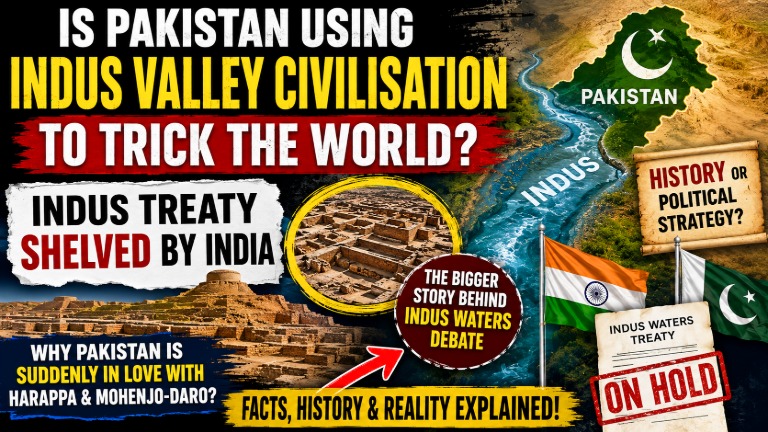
Why Pakistan Is Suddenly Highlighting the Indus Valley Civilisation Amid the Indus Waters Debate
The Indus Valley Civilisation, one of the world’s oldest urban cultures, has once again become a major topic of discussion in South Asia. However, this time the debate is not only about archaeology or ancient history. It is also linked to modern geopolitics, national identity, and the increasingly tense dispute over the Indus Waters Treaty between India and Pakistan.
Over the past year, Pakistan has significantly increased its focus on Mohenjo-daro, Harappa, Gandhara, Taxila and other pre-Islamic heritage sites. Government-backed projects, cultural campaigns, academic discussions and political speeches have placed the Indus Valley Civilisation at the center of Pakistan’s historical narrative.
This shift has attracted attention because for decades Pakistan’s official narrative largely emphasized Islamic history, particularly the arrival of Muhammad bin Qasim in Sindh in 712 CE as a defining historical moment.
Today, however, a different story appears to be emerging.
Pakistan’s Renewed Interest in Mohenjo-daro and Harappa
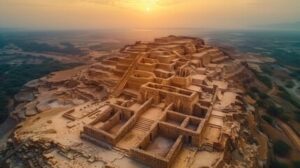
The renewed focus became more noticeable when fresh excavations began at Mohenjo-daro in 2025. The ancient city, which is among the most significant archaeological sites of the Indus Valley Civilisation, had seen limited major excavation activity for decades.
At the same time, Pakistan increased efforts to promote Mohenjo-daro and Harappa internationally through cultural events, documentaries, tourism campaigns and academic collaborations.
Political leaders also started referencing these ancient sites more frequently.
Supporters of this approach argue that Pakistan is simply recognizing an important part of its heritage that had previously received insufficient attention.
Critics, however, believe there is a deeper political objective behind the growing emphasis.
The Indus Waters Treaty Factor
The timing of this renewed focus has drawn significant attention.
India placed the Indus Waters Treaty in abeyance following heightened tensions after the Pahalgam terror attack and subsequent security developments.
New Delhi argued that changing realities, security concerns and evolving water requirements required a reassessment of existing arrangements.
Pakistan strongly opposed the move and described it as a violation of international commitments.
Since then, the water-sharing agreement has become a major diplomatic issue between the two countries.
It is within this context that Pakistan’s increasing references to the Indus Valley Civilisation have gained additional significance.
Bilawal Bhutto’s Civilisational Argument
Among the most prominent voices linking ancient history with the modern water dispute has been Bilawal Bhutto-Zardari.
In several public statements, he has referred to Pakistan as a custodian of the Indus civilisation and highlighted the country’s connection to Mohenjo-daro and other ancient sites.
The argument presented by some Pakistani political leaders suggests that because much of the Indus River system flows through Pakistan and because important Indus Valley sites are located within its borders, Pakistan possesses a unique historical relationship with the river.
Such statements have generated considerable debate among historians, archaeologists and political observers.
Pakistan’s Broader Historical Rebranding
The focus is not limited to Mohenjo-daro alone.
Pakistan has increasingly promoted:
- Taxila (Takshashila)
- Gandhara civilisation
- Buddhist heritage sites
- Mehrgarh archaeological site
- Ancient trade routes
- Pre-Islamic cultural traditions
Museums, tourism campaigns and cultural diplomacy initiatives have highlighted these locations as evidence of a rich and diverse historical legacy.
Supporters say this broader approach allows Pakistan to present itself as a civilization with roots extending thousands of years before the creation of the modern state.
Why the Narrative Matters Internationally
In modern diplomacy, narratives are often as important as legal arguments.
By emphasizing a 5,000-year-old connection to the Indus River, Pakistan may be attempting to strengthen international sympathy for its position regarding water rights.
Historical storytelling can influence public opinion, attract international attention and shape diplomatic conversations.
For many observers, this appears to be an effort to frame the water dispute not merely as a technical issue but as a civilisational concern connected to heritage and identity.
Such framing can be powerful in international forums where cultural and historical narratives often influence perceptions.
The Archaeological Debate
Archaeology presents a far more complex picture than political speeches often suggest.
While globally famous sites such as Mohenjo-daro and Harappa are located in present-day Pakistan, a large number of Indus-related archaeological sites have also been discovered in India.
Many researchers note that the civilization extended across a vast region covering parts of present-day India, Pakistan and Afghanistan.
Several Indian scholars prefer the term “Indus-Sarasvati Civilisation” because many archaeological sites are located along the Ghaggar-Hakra river system, which some researchers associate with the ancient Sarasvati River mentioned in historical texts.
As a result, the civilisation is generally viewed by academics as a shared heritage of the broader region rather than the exclusive inheritance of any single modern nation-state.
Can Ancient History Determine Water Rights?
One of the most important questions emerging from the debate is whether ancient civilisations can determine modern water rights.
Most international experts argue that contemporary water disputes are governed by treaties, international law, hydrological realities and present-day needs rather than archaeological claims.
The Indus Waters Treaty was signed in 1960 and established a framework for managing water resources between India and Pakistan.
Any future discussions regarding the treaty are likely to focus on:
- Water availability
- Population growth
- Climate change
- Agricultural requirements
- Hydropower projects
- Environmental sustainability
Ancient history may influence public narratives, but legal agreements remain the primary mechanism for resolving water-sharing issues.
Climate Change Adds a New Dimension
The water debate has become even more important because climate change is affecting river systems across South Asia.
Glacial retreat, changing rainfall patterns and increasing demand for freshwater resources are creating new challenges for both India and Pakistan.
Experts believe that future discussions on water management will require cooperation, scientific planning and updated policy frameworks.
In this context, focusing solely on historical claims may not address the practical challenges both countries face.
Why the Story Has Global Attention
The Indus River supports millions of people across the region.
Any dispute involving the river naturally attracts international attention because it affects:
- Food security
- Agriculture
- Energy production
- Regional stability
- Environmental sustainability
As a result, statements linking ancient civilisation with modern water disputes often receive significant coverage from international media and policy analysts.
Conclusion
Pakistan’s growing emphasis on the Indus Valley Civilisation marks a notable shift in how the country presents its historical identity. Mohenjo-daro, Harappa, Taxila and Gandhara are increasingly being showcased as central elements of Pakistan’s national narrative.
Whether this represents a genuine effort to reconnect with a broader historical heritage or a strategic attempt to strengthen diplomatic messaging during the Indus Waters Treaty dispute remains a subject of debate.
What is clear, however, is that the conversation has expanded beyond archaeology and entered the realm of geopolitics, diplomacy and national identity.
As discussions surrounding the Indus Waters Treaty continue, the role of history in shaping modern political narratives is likely to remain an important and closely watched issue across South Asia.
FAQ
Q: Why is Pakistan promoting the Indus Valley Civilisation?
A: Pakistan has increasingly highlighted ancient heritage sites as part of its broader national identity and cultural diplomacy efforts.
Q: What is the Indus Waters Treaty?
A: It is a water-sharing agreement signed between India and Pakistan in 1960 governing the use of the Indus River system.
Q: Is the Indus Valley Civilisation located only in Pakistan?
A: No. Archaeological sites associated with the civilisation are found in both India and Pakistan, with some extending into Afghanistan.
Q: Can ancient history determine water rights?
A: Modern water disputes are generally governed by treaties, international law and current resource needs rather than historical claims.
Q: Why has this issue gained attention recently?
A: The debate intensified after tensions surrounding the Indus Waters Treaty and subsequent political statements linking ancient heritage with modern water disputes.
DISCLAIMER:
This article is based on publicly available reports, statements, historical records, and ongoing political developments. The topic involves competing historical and political interpretations. Readers are encouraged to consult multiple sources for a broader understanding.
Do Follow for more info @ http://roydailyupdate.in
Do Connect WhatsApp @ https://chat.whatsapp.com/K5POJK9KbpN8egjjOCaOw6 
Bengaluru PG Owner Murdered After Water Dispute; Two College Students Arrested
1 thought on “Pakistan’s Indus Valley Civilisation Narrative and the Indus Waters Treaty: What It Means”