India’s High-Speed Rail Dream Takes Shape as NHSRCL Plans Seven New Bullet Train Corridors
India’s ambitious high-speed rail mission has entered an exciting new phase. After years of work on the country’s first Mumbai-Ahmedabad Bullet Train project, the National High Speed Rail Corporation Limited (NHSRCL) has now initiated the process of developing the next generation of indigenous high-speed trains called B35.
These advanced trainsets are expected to become the backbone of India’s future Bullet Train network and will operate across seven proposed high-speed rail corridors, connecting some of the country’s busiest economic and industrial cities.
If completed as planned, these new corridors will dramatically reduce travel time, boost economic growth, improve regional connectivity, create thousands of jobs, and position India among the world’s leading nations in high-speed railway technology.
What is the B35 Bullet Train?
The B35 is India’s proposed next-generation high-speed Bullet Train being developed under the “Make in India” initiative.
Unlike the first Mumbai-Ahmedabad Bullet Train, which uses Japanese Shinkansen technology, the B35 trains are expected to be designed and manufactured largely within India with participation from global technology partners.
According to NHSRCL, companies are currently being evaluated to design, manufacture, supply and maintain these advanced trainsets.
Expected Specifications
- Maximum Speed: 350 kmph
- Operational Speed: 320 kmph
- Designed for Indian climate
- Energy-efficient technology
- Advanced passenger safety systems
- Modern signaling integration
- High passenger comfort
- Indigenous manufacturing focus
The B35 project represents one of India’s largest transportation technology initiatives.
Why India Needs More Bullet Trains 

India currently has one of the world’s largest railway networks but also one of the busiest.
Every day millions of passengers travel between major metropolitan cities.
Conventional rail routes are increasingly congested, making faster transportation essential.
High-speed rail can significantly reduce travel time while offering:
- Faster business travel
- Better tourism
- Lower airline dependency
- Reduced carbon emissions
- Higher economic productivity
- Improved regional development
Countries such as Japan, China, France, Spain, Italy and South Korea have already demonstrated the economic benefits of extensive Bullet Train networks.
India now aims to join that league.
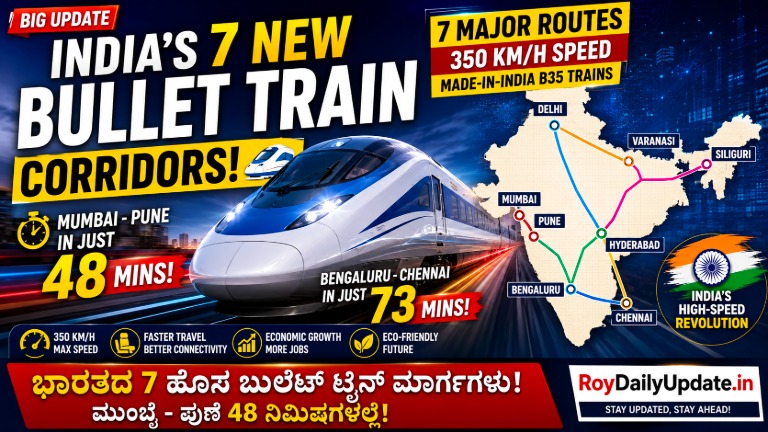
Complete List of India’s Seven Proposed Bullet Train Corridors

According to NHSRCL, the new B35 trains are expected to operate across the following proposed high-speed routes.
1. Mumbai – Pune
Expected Travel Time:
Just 48 Minutes
Current travel by road often exceeds 3–5 hours depending on traffic.
The Bullet Train could revolutionize commuting between Maharashtra’s two largest economic hubs.
2. Pune – Hyderabad
Expected Travel Time:
Around 2 Hours 8 Minutes
This route will connect Maharashtra and Telangana’s growing IT and manufacturing sectors.
3. Hyderabad – Bengaluru
Expected Travel Time:
Around 2 Hours 10 Minutes
This corridor could become one of India’s busiest technology routes, connecting two major IT capitals.
4. Hyderabad – Chennai
The proposed corridor aims to strengthen southern India’s industrial and technology connectivity.
Expected travel time details will be finalized after route planning.
5. Bengaluru – Chennai
Expected Travel Time:
Just 73 Minutes
Currently this journey takes around 5–7 hours by road and 5–6 hours by conventional rail.
The Bullet Train could reduce travel time by nearly 75%.
6. Delhi – Varanasi
Expected Travel Time:
Around 3 Hours 15 Minutes
Intermediate connectivity is expected to include major cities in Uttar Pradesh.
Delhi-Lucknow travel could reduce to just 2 hours.
7. Varanasi – Siliguri
This corridor would significantly improve connectivity across eastern India and support tourism, trade and regional development.
Planning studies are currently underway.
Expected Travel Time Comparison
| Route | Current Time | Bullet Train Time |
|---|---|---|
| Mumbai – Ahmedabad | 7–8 Hours | 1 Hour 57 Minutes |
| Mumbai – Pune | 3–5 Hours | 48 Minutes |
| Bengaluru – Chennai | 5–6 Hours | 73 Minutes |
| Hyderabad – Bengaluru | 8–9 Hours | 2 Hours 10 Minutes |
| Pune – Hyderabad | 10–12 Hours | 2 Hours 8 Minutes |
| Delhi – Lucknow | 7–8 Hours | 2 Hours |
| Delhi – Varanasi | 10–12 Hours | 3 Hours 15 Minutes |
The reduction in travel time is expected to transform intercity transportation in India.
Mumbai-Ahmedabad Bullet Train Project Nears Major Milestone
India’s first Bullet Train project between Mumbai and Ahmedabad continues to make steady progress.
The 508-kilometre corridor remains India’s flagship high-speed rail project.
According to NHSRCL:
- Civil construction is progressing rapidly.
- Bridges, viaducts and stations are under development.
- Track installation is underway in several sections.
- The Surat-Vapi stretch is targeted to become the first operational section by August 2027.
This project is expected to serve as the foundation for India’s future Bullet Train expansion.
Economic Benefits of India’s Bullet Train Network
Experts believe high-speed rail will generate significant long-term economic benefits.
These include:
- Higher investment
- Faster logistics
- Employment generation
- Tourism growth
- Better airport decongestion
- Industrial corridor development
- Smart city expansion
- Improved real estate around stations
Countries like Japan and China have experienced major economic transformation following Bullet Train expansion.
India hopes to achieve similar results over the coming decades.
How Will the Bullet Train Benefit India?

India’s proposed high-speed rail network is much more than a transportation project. It is expected to become a major driver of economic growth, urban development, and technological advancement.
1. Faster Business Travel
Business professionals will be able to travel between major cities in a matter of hours instead of spending an entire day on the journey. This is expected to improve productivity and encourage greater business collaboration across states.
For example:
- Mumbai to Pune in just 48 minutes
- Bengaluru to Chennai in only 73 minutes
- Delhi to Lucknow in approximately 2 hours
This dramatic reduction in travel time could significantly boost commercial activity.
2. Employment Generation
Construction of India’s Bullet Train network is expected to generate lakhs of direct and indirect employment opportunities.
Jobs will be created in:
- Civil engineering
- Railway construction
- Manufacturing
- Signalling systems
- Electrical works
- Station development
- Hospitality
- Maintenance services
- Security operations
The “Make in India” initiative for B35 trainsets is also expected to strengthen domestic manufacturing capabilities.
3. Tourism Growth
Many of the proposed corridors connect popular tourist destinations.
For instance:
- Delhi–Varanasi
- Mumbai–Ahmedabad
- Bengaluru–Chennai
Faster connectivity will encourage weekend tourism, religious travel, and business tourism while reducing travel fatigue.
4. Reduced Pressure on Roads and Airports
India’s highways and airports are becoming increasingly congested.
High-speed rail offers a practical alternative by shifting millions of passengers from:
- Domestic flights
- Private vehicles
- Long-distance buses
This could help reduce traffic congestion and lower carbon emissions.
Technology Behind the B35 Bullet Train
The proposed B35 trainsets are expected to feature several cutting-edge technologies, including:
- Maximum design speed of 350 kmph
- Operational speed of 320 kmph
- Advanced automatic train control systems
- Aerodynamic nose design for lower air resistance
- Enhanced passenger safety features
- Earthquake detection compatibility
- Energy-efficient regenerative braking
- Modern passenger information systems
- Comfortable reclining seats
- Improved accessibility for differently-abled passengers
The trains are also expected to be designed for Indian climatic conditions, including high temperatures and monsoon weather.
Comparison: India B35 vs Japan Shinkansen
| Feature | B35 Bullet Train | Japanese Shinkansen |
|---|---|---|
| Maximum Speed | 350 kmph | 320–360 kmph |
| Operational Speed | 320 kmph | 285–320 kmph |
| Manufacturing | Make in India | Japan |
| Safety System | Advanced Automatic Control | Automatic Train Control |
| Target | Future Indian Corridors | Japan’s High-Speed Network |
India aims to incorporate global best practices while developing an indigenous high-speed rail ecosystem.
Expected Ticket Prices
Although NHSRCL has not officially announced ticket prices for future B35 services, experts estimate fares may be competitive with economy-class domestic flights.
Possible pricing factors include:
- Distance traveled
- Operational costs
- Passenger demand
- Government subsidies
- Route category
Affordable pricing will be important to ensure widespread adoption of high-speed rail.
Challenges Facing the Bullet Train Project
Despite its transformative potential, the project faces several challenges:
Land Acquisition
Acquiring land across multiple states remains one of the biggest hurdles.
High Construction Costs
Bullet train infrastructure requires significant investment in elevated tracks, tunnels, bridges, and stations.
Technical Expertise
Developing indigenous high-speed train technology requires advanced engineering capabilities.
Environmental Clearances
Projects must comply with environmental regulations and minimize ecological impact.
Funding
Large-scale financing from government and international partners is essential.
Mumbai-Ahmedabad Project: A Model for Future Corridors
India’s first high-speed rail project between Mumbai and Ahmedabad is expected to serve as the blueprint for future Bullet Train routes.
Key milestones include:
- 508 km corridor
- Modern stations under construction
- Viaducts and bridges progressing rapidly
- Track laying underway in several sections
- Surat–Vapi section targeted for operations by August 2027
Lessons learned from this project will help accelerate future corridor development.
Why the B35 Project Matters
The B35 initiative is not just about building faster trains—it represents India’s ambition to become a global leader in transportation technology.
Key objectives include:
- Strengthening the “Make in India” initiative
- Reducing dependence on imported technology
- Promoting sustainable transportation
- Enhancing regional connectivity
- Supporting long-term economic growth
If implemented successfully, the B35 trains could redefine long-distance travel in India.
Frequently Asked Questions (FAQs)
Q1. What is the maximum speed of the B35 Bullet Train?
The B35 trainsets are designed for a maximum speed of 350 kmph, with an operational speed of 320 kmph.
Q2. Which cities will be connected by the new Bullet Train corridors?
The proposed corridors include:
- Mumbai–Pune
- Pune–Hyderabad
- Hyderabad–Bengaluru
- Hyderabad–Chennai
- Bengaluru–Chennai
- Delhi–Varanasi
- Varanasi–Siliguri
Q3. When will the Mumbai–Ahmedabad Bullet Train start?
NHSRCL plans to begin operations on the Surat–Vapi section by August 2027, with the full corridor to follow in phases.
Q4. Will the B35 trains be manufactured in India?
Yes. The B35 project is expected to be developed under the Make in India initiative with participation from domestic and global technology partners.
Q5. Will Bullet Train tickets be expensive?
Official fares have not been announced. Pricing is expected to be competitive with domestic air travel on similar routes.
Key Highlights
- India plans 7 new Bullet Train corridors.
- Indigenous B35 high-speed trainsets to be developed.
- Maximum design speed: 350 kmph.
- Operational speed: 320 kmph.
- Mumbai–Pune journey may take 48 minutes.
- Bengaluru–Chennai travel expected in 73 minutes.
- Delhi–Lucknow journey could reduce to 2 hours.
- Mumbai–Ahmedabad project progressing rapidly.
- First operational Surat–Vapi section targeted for August 2027.
- High-speed rail expected to boost connectivity, tourism, jobs, and economic growth.
Conclusion
India’s ambitious high-speed rail expansion marks a significant step toward modernizing the country’s transportation infrastructure. With seven proposed Bullet Train corridors and the development of the indigenous B35 trainsets, the nation is laying the foundation for a faster, safer, and more connected future.
If completed on schedule, these projects could transform intercity travel, reduce journey times dramatically, stimulate regional economies, and establish India as a major player in global high-speed rail technology.
Disclaimer
This article is based on publicly available information, official announcements by the National High Speed Rail Corporation Limited (NHSRCL), and media reports available at the time of writing. Project timelines, routes, travel times, train specifications, and implementation schedules are subject to change based on future government decisions, technical evaluations, environmental clearances, and funding approvals. Readers are advised to refer to official NHSRCL and Ministry of Railways notifications for the latest updates.
Do follow for more info @ http://roydailyupdate.in
Do Connect WhatsApp @https://chat.whatsapp.com/K5POJK9KbpN8egjjOCaOw6