

Pakistan Karachi Terror Attack 2026:

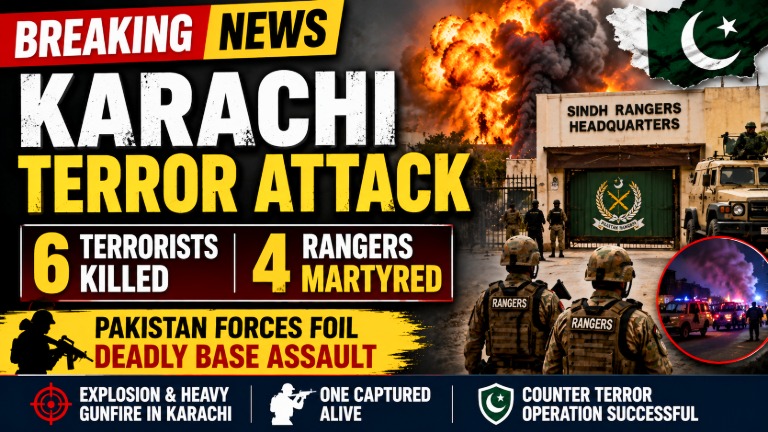
Pakistan has once again been shaken by a major terrorist attack after heavily armed militants stormed the Sindh Rangers headquarters in Karachi on Saturday night. The assault resulted in the deaths of four Rangers personnel before Pakistan’s security forces successfully neutralized six terrorists and captured another attacker alive following an intense operation.
The incident marks one of the most significant terror attacks in Karachi since October 2024 and has once again highlighted the growing security challenges facing Pakistan amid increasing militant activities across the country.
Attack Began With Massive Explosion
According to initial reports, the attack started around 8:30 PM local time when an explosive-laden vehicle rammed into the provincial headquarters of the Sindh Rangers located in the densely populated Gulistan-e-Jauhar area of Karachi.
The powerful explosion was immediately followed by heavy gunfire as multiple terrorists attempted to breach the security compound.
Residents living near Mosamiat Chowrangi and University Road reported hearing loud explosions followed by continuous firing for several minutes. Panic spread across nearby residential areas as security forces rushed to the location.
Authorities quickly sealed all major roads leading to the Rangers headquarters to prevent civilians from entering the danger zone.
Pakistan Security Forces Launch Counter Operation
Soon after the explosion, Pakistan Rangers, police commandos, and Rapid Response Force personnel launched a coordinated counter-terror operation.
Security officials confirmed that the militants attempted to enter the Rangers facility but encountered strong resistance from security personnel stationed inside.
After an intense gun battle lasting several hours:
- Six terrorists were killed.
- One militant was captured alive.
- Four Sindh Rangers personnel lost their lives while defending the headquarters.
- Several security personnel sustained injuries.
Officials stated that the captured terrorist is expected to provide valuable intelligence regarding the planning and execution of the attack.
Jamaat-ul-Ahrar Claims Responsibility
The attack has been claimed by Jamaat-ul-Ahrar (JuA), an extremist militant organization that is considered a splinter faction of the banned Tehrik-e-Taliban Pakistan (TTP).
According to statements released through militant channels, the assault was allegedly carried out by the group’s suicide unit known as the Khulafa-e-Rashideen Ishtishhadi Brigade.
Security experts note that Jamaat-ul-Ahrar has historically operated mainly in Pakistan’s Khyber Pakhtunkhwa province near the Afghanistan border. However, this latest attack indicates that the organization may be expanding its operational reach into Pakistan’s largest city.
Heavy Security Across Karachi
Immediately after the attack, law enforcement agencies imposed strict security measures throughout Karachi.
Major roads around:
- Gulistan-e-Jauhar
- Mosamiat Chowrangi
- University Road
- Meteorological Chowrangi
were heavily guarded.
Bomb disposal units and forensic investigation teams examined the damaged Rangers facility and surrounding area to determine the exact nature of the explosives used.
Authorities also launched search operations in several nearby neighborhoods to identify possible facilitators who may have assisted the attackers.
Sindh Government Orders Immediate Investigation
Sindh Chief Minister Syed Murad Ali Shah took immediate notice of the incident.
He instructed police and intelligence agencies to submit a comprehensive report detailing:
- Timeline of the attack
- Security response
- Casualties
- Intelligence failures
- Future preventive measures
The Chief Minister also directed hospitals to provide the best possible medical treatment to injured security personnel.
Why Karachi Attack Is Significant
Security analysts believe the Karachi attack is particularly concerning because:
- Karachi is Pakistan’s financial capital.
- It hosts several strategic military and security installations.
- Successful attacks in Karachi receive international attention.
- It demonstrates that militant groups continue to possess operational capabilities despite ongoing counter-terror operations.
Experts warn that such attacks are designed not only to inflict casualties but also to undermine public confidence in national security institutions.
Rising Terrorism in Pakistan
Pakistan has experienced a noticeable increase in extremist violence over the past two years.
Security agencies have reported:
- More attacks on military installations.
- Increased assaults on police stations.
- Suicide bombings targeting security forces.
- Cross-border infiltration attempts.
- Growing activity by TTP-linked factions.
Many of these attacks have occurred in Khyber Pakhtunkhwa and Balochistan. However, the Karachi incident suggests that militant networks continue to pose threats even in Pakistan’s largest metropolitan areas.
Counter-Terror Measures Intensified
Following the Karachi attack, Pakistan’s security agencies are expected to strengthen nationwide counter-terror operations.
Possible measures include:
- Enhanced intelligence surveillance.
- Increased security around military installations.
- More checkpoints in major cities.
- Expanded anti-terror raids.
- Improved coordination among intelligence agencies.
Officials have assured citizens that every effort is being made to prevent similar incidents in the future.
International Concern Over Regional Security
The latest terrorist attack comes at a time when South Asia is already witnessing heightened geopolitical tensions.
Security experts believe continued instability inside Pakistan could have broader regional implications, particularly regarding border security, counter-terror cooperation, and intelligence sharing among neighboring countries.
International observers are closely monitoring Pakistan’s response to the resurgence of extremist violence.
Investigation Continues
Forensic teams continue collecting evidence from the blast site while intelligence agencies interrogate the captured militant.
Authorities are attempting to determine:
- Who financed the attack.
- Whether local facilitators were involved.
- How the explosives were transported.
- Whether additional attacks were planned.
The investigation is expected to continue over the coming days.
Frequently Asked Questions (FAQs)
Q1. Where did the Karachi terror attack happen?
The attack targeted the Sindh Rangers headquarters in Gulistan-e-Jauhar, Karachi.
Q2. How many terrorists were killed?
Six terrorists were killed by Pakistani security forces.
Q3. Was anyone captured alive?
Yes. One militant was captured alive during the operation.
Q4. How many Rangers personnel died?
Four Sindh Rangers personnel lost their lives.
Q5. Which group claimed responsibility?
Jamaat-ul-Ahrar, a splinter faction of the banned Tehrik-e-Taliban Pakistan (TTP), claimed responsibility.
Q6. Is the investigation still ongoing?
Yes. Police, forensic teams, and intelligence agencies continue their investigation.
Disclaimer
This article is based on publicly available reports and official statements available at the time of publication. Information regarding casualties, investigations, and responsibility for the attack may change as authorities release further updates. Readers are advised to follow official government announcements for the latest developments.
Do follow for more info @http://roydailyupdate.in
Do Connect WhatsApp @ https://chat.whatsapp.com/K5POJK9KbpN8egjjOCaOw6