

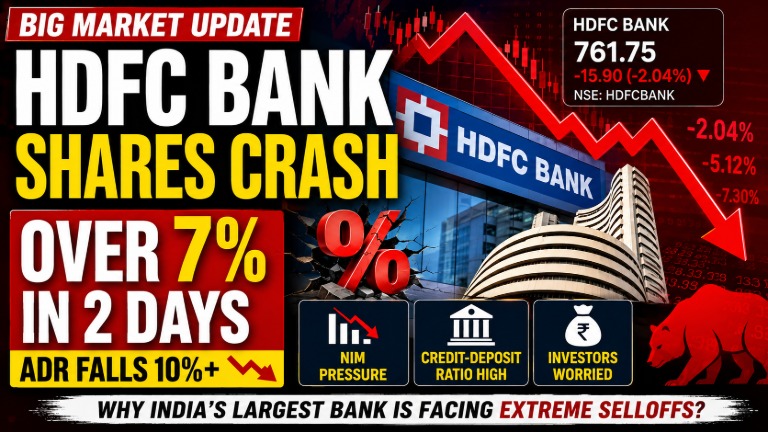

HDFC Bank Shares Crash Over 7% in Two Days:
India’s largest private sector lender, HDFC Bank, witnessed one of its sharpest market corrections in recent months after announcing its Q1 FY27 financial results. The stock declined by more than 7% in just two trading sessions, while its American Depositary Receipts (ADR) listed on the New York Stock Exchange plunged over 10% overnight, reflecting negative global investor sentiment.
Although the bank reported higher profits, improved deposits, and healthy loan growth, investors were disappointed by weaker-than-expected profitability metrics, particularly the decline in Net Interest Margin (NIM) and concerns over liquidity and credit-deposit ratios.
The sharp correction has raised an important question among investors: Is this merely a short-term market reaction, or does it signal deeper concerns for HDFC Bank?
HDFC Bank Stock Falls Sharply After Q1 Results
Following the announcement of its June quarter earnings, HDFC Bank’s shares came under heavy selling pressure.
On July 21, 2026, the stock traded around ₹761.75 on the BSE, extending losses after falling more than 5% in the previous trading session.
Stock Performance
- Share Price: ₹761.75
- Two-day decline: More than 7%
- Single-day fall: Around 2%
- Previous trading session loss: Over 5%
- Market Capitalisation: Around ₹11.7 lakh crore
The sharp decline erased significant investor wealth within just two trading sessions and made HDFC Bank one of the biggest losers in the banking sector during the week.
ADR Also Witnesses Heavy Selling
The negative sentiment was not limited to Indian markets.
HDFC Bank’s American Depositary Receipts (ADR) listed on the New York Stock Exchange (NYSE) also witnessed a steep correction.
The ADR fell by more than 10%, closing around $23.60, indicating that overseas investors were equally disappointed by the quarterly performance.
The sharp decline in ADRs often reflects how global institutional investors interpret a company’s earnings outlook.
Q1 FY27 Financial Performance at a Glance
Despite the market reaction, HDFC Bank reported growth across several important financial parameters.
Key Financial Highlights
- Net Profit: ₹19,060 crore (up 5% YoY)
- Net Interest Income (NII): ₹33,530 crore (up 7% YoY)
- Average Deposits: ₹30.1 lakh crore (up 13.3% YoY)
- CASA Deposits: ₹9.57 lakh crore (up 11.2% YoY)
- Gross Advances: ₹30.6 lakh crore (up 15.4% YoY)
These numbers indicate that HDFC Bank continues to maintain strong business growth despite challenging market conditions.
However, the market focused less on headline numbers and more on profitability concerns.
Net Interest Margin Becomes the Biggest Concern
The biggest reason behind the stock correction was the decline in the bank’s Net Interest Margin (NIM).
NIM measures the difference between interest earned on loans and the interest paid on deposits.
During Q1 FY27:
- NIM declined to around 3.40%
- Margin contracted sequentially by approximately 13 basis points
A lower NIM indicates that the bank’s profitability from lending operations has come under pressure.
Analysts attributed this decline to:
- Higher funding costs
- Increased competition for deposits
- Lower asset yields
- Higher reliance on wholesale lending
For banks, even a small decline in NIM can significantly affect future earnings expectations, which explains the strong market reaction.
Asset Quality Remains Strong
One positive aspect of the quarterly results was HDFC Bank’s asset quality.
The bank reported:
- Gross NPA: 1.17%
Although this was marginally higher than the previous quarter, it remained significantly lower than the corresponding quarter last year.
Stable asset quality indicates that loan defaults remain under control, reducing the risk of large credit losses in the future.
Why Did Investors React So Negatively?

Although HDFC Bank reported growth in net profit, deposits, and loan advances, investors focused on several underlying concerns that could affect the bank’s earnings over the next few quarters.
Market participants were particularly worried about:
- Declining Net Interest Margin (NIM)
- Lower Liquidity Coverage Ratio (LCR)
- High Credit-Deposit (CD) Ratio
- Continued pressure on funding costs
- Slower margin expansion despite strong business growth
These concerns overshadowed the otherwise healthy financial performance, leading to heavy selling across both domestic and international markets.
What Is the Liquidity Coverage Ratio (LCR)?
One of the biggest concerns highlighted by analysts was HDFC Bank’s Liquidity Coverage Ratio (LCR).
The bank reported an LCR of around 115%.
What does LCR mean?
Liquidity Coverage Ratio measures whether a bank has enough high-quality liquid assets to survive short-term financial stress.
Although HDFC Bank remains comfortably above the RBI’s regulatory requirement, analysts believe the current level leaves limited flexibility for aggressive loan growth.
A lower LCR may force banks to depend more on costly funding sources, which can reduce profitability.
High Credit-Deposit Ratio Raises Questions
Another factor that worried investors was HDFC Bank’s Credit-Deposit (CD) Ratio, which stood close to 96%.
Why is this important?
The CD Ratio compares the amount of loans issued by a bank with the deposits it has collected.
A very high ratio suggests:
- Most deposits have already been utilized for lending.
- Limited room remains for fresh credit expansion.
- The bank may need to raise additional deposits before accelerating loan growth.
Analysts believe maintaining such a high ratio may keep pressure on margins in the near term.
Analysts Explain the Weak Net Interest Margin
Brokerage firm Systematix Institutional Equities observed that HDFC Bank experienced a sharper-than-expected compression in Net Interest Margin during the quarter.
According to analysts:
- Funding costs remain elevated.
- Asset yields have softened.
- Higher wholesale lending has diluted profitability.
- Deposit competition remains intense across the banking sector.
These factors collectively reduced the bank’s lending margins despite healthy business growth.
Despite the Correction, Analysts Remain Optimistic
Interestingly, most leading brokerage firms have not turned negative on HDFC Bank.
Instead, many believe the recent correction presents a medium- to long-term opportunity.
JM Financial’s View
JM Financial expects:
- Loan growth of around 15%
- Earnings per Share (EPS) CAGR of approximately 14% between FY26 and FY28
- Stable return on assets (RoA)
- Controlled credit costs due to strong asset quality
The brokerage has maintained an “ADD” rating and revised its target price to around ₹900 per share.
According to the brokerage, profitability should improve gradually as expensive borrowings decline over time.
Yes Securities Continues to Recommend “BUY”
Analysts at Yes Securities remain even more optimistic.
The brokerage has maintained a BUY recommendation with a revised target price of approximately ₹1,100.
According to their analysis:
- Loan demand remains healthy.
- Deposit franchise continues to strengthen.
- Asset quality remains among the best in the industry.
- Earnings growth is expected to improve over the next two to three years.
They also believe HDFC Bank’s subsidiaries continue to add significant value to the overall business.
Is This a Buying Opportunity?
The sharp correction has divided investor opinion.
Reasons Supporting Long-Term Investment
✅ India’s largest private bank
✅ Strong brand and customer trust
✅ Consistent profit growth
✅ Healthy deposit franchise
✅ Improving asset quality
✅ Long-term digital banking opportunities
Risks Investors Should Monitor
⚠ Continued pressure on Net Interest Margin
⚠ Higher funding costs
⚠ Elevated Credit-Deposit Ratio
⚠ Slower earnings upgrades
⚠ Market volatility after earnings
For long-term investors, analysts suggest focusing on the bank’s fundamentals rather than short-term price movements.
What Should Existing Investors Do?
Most brokerage houses currently advise holding existing investments rather than reacting to short-term volatility.
Long-term investors may consider monitoring:
- Future margin improvement
- Deposit growth
- Loan expansion
- RBI interest-rate decisions
- Management commentary in upcoming quarters
The next few quarterly results will play a crucial role in determining whether HDFC Bank can regain investor confidence.
Stock Sell-Off Timeline
HDFC Bank’s sharp correction unfolded immediately after the announcement of its Q1 FY27 financial results, despite the bank posting growth in profit and net interest income.
Timeline of Events
- Q1 FY27 Results Announced: HDFC Bank reported a 5% YoY increase in net profit to ₹19,060 crore and a 7% rise in Net Interest Income (NII).
- Investors Analyze Earnings: Markets focused on the decline in Net Interest Margin (NIM), elevated Credit-Deposit Ratio (CD Ratio), and relatively lower Liquidity Coverage Ratio (LCR).
- Heavy Selling Begins: The stock plunged over 5% immediately after the earnings announcement.
- Second Consecutive Decline: Selling pressure continued the next day, taking the two-day fall to more than 7%.
- ADR Slides Sharply: HDFC Bank’s American Depositary Receipts (ADR) on the NYSE fell by more than 10%, reflecting weak global investor sentiment.
- Brokerages React: While acknowledging near-term pressure, most leading brokerages retained positive ratings and maintained bullish long-term targets.
Why the Market Punished HDFC Bank
Although the headline numbers appeared healthy, investors were more concerned about the bank’s future profitability than its current earnings.
Key Reasons Behind the Sell-Off
- 📉 Decline in Net Interest Margin (NIM)
- 💰 Higher funding costs impacting profitability
- 🏦 Credit-Deposit Ratio close to 96%
- 💧 Liquidity Coverage Ratio (LCR) around 115%
- 📊 Slower margin expansion than expected
- 🌍 Sharp decline in ADR increased negative sentiment
The correction reflects concerns about future earnings growth rather than deterioration in the bank’s overall business fundamentals.
Long-Term Outlook Remains Positive
Despite the sharp fall, most analysts believe HDFC Bank remains one of India’s strongest private sector banks.
Positive factors include:
- Strong retail banking franchise
- Consistent deposit growth
- Healthy loan expansion
- Excellent asset quality
- Robust digital banking ecosystem
- Strong capital position
- Market leadership
Brokerages expect margins to improve gradually as high-cost borrowings reduce over the coming quarters.
Should Investors Buy, Hold or Sell?
Existing Investors
Most analysts recommend holding existing investments rather than reacting to short-term market volatility.
Long-Term Investors
For investors with a 3–5 year investment horizon, the recent correction may offer an opportunity to accumulate gradually, provided they are comfortable with short-term fluctuations.
Short-Term Traders
Traders should remain cautious until the stock stabilizes and market sentiment improves after the earnings-driven sell-off.
Note: Investment decisions should be based on your financial goals, risk tolerance, and advice from a qualified financial advisor. Market movements are uncertain, and no outcome is guaranteed.
Key Highlights
| Particular | Details |
|---|---|
| Company | HDFC Bank Ltd. |
| Sector | Private Banking |
| Stock Fall | More than 7% in 2 Days |
| ADR Movement | Down over 10% |
| Q1 FY27 Net Profit | ₹19,060 Crore (+5% YoY) |
| Net Interest Income | ₹33,530 Crore (+7% YoY) |
| Gross Advances | ₹30.6 Lakh Crore (+15.4% YoY) |
| Gross NPA | 1.17% |
| Major Concern | NIM Compression |
| Analyst View | Mostly Positive for Long Term |
Frequently Asked Questions (FAQs)
1. Why did HDFC Bank shares fall over 7%?
The decline was mainly driven by concerns over Net Interest Margin (NIM) compression, elevated funding costs, and a high Credit-Deposit Ratio, despite the bank reporting growth in profit and deposits.
2. Why did HDFC Bank ADR fall more than 10%?
The ADR reflected negative sentiment among overseas investors following the quarterly earnings announcement and concerns about future profitability.
3. Did HDFC Bank report weak financial results?
Not entirely. The bank reported higher net profit, deposits, and loan growth, but investors were disappointed by weaker margins and profitability indicators.
4. What is the biggest concern in Q1 FY27?
The biggest concern was the decline in Net Interest Margin (NIM), which indicates pressure on the bank’s lending profitability.
5. What are brokerages saying?
Several brokerages continue to maintain positive long-term ratings, with target prices ranging around ₹900–₹1,100, though these are analyst estimates and not guarantees.
6. Is HDFC Bank still a fundamentally strong company?
Many analysts continue to view HDFC Bank as one of India’s strongest private sector banks due to its diversified business, strong deposit franchise, and stable asset quality, while noting that near-term profitability pressures remain.
Final Conclusion
HDFC Bank’s 7% correction in just two trading sessions highlights how strongly markets react to expectations rather than headline earnings. Although the bank posted steady growth in profit, deposits, and advances, investors were disappointed by pressure on margins and liquidity metrics.
The sharp fall in both domestic shares and ADRs reflects short-term concerns, but many brokerage firms continue to maintain constructive long-term views on the bank’s fundamentals. Investors should monitor upcoming quarterly performance, margin trends, deposit growth, and management commentary before making investment decisions.
English Highlight Points
- 📉 HDFC Bank Shares Crash Over 7% in 2 Days
- 🌍 ADR Falls More Than 10%
- 💰 Q1 Net Profit Rises 5% YoY
- 📊 NII Grows 7% to ₹33,530 Crore
- ⚠️ NIM Compression Worries Investors
- 🏦 Credit-Deposit Ratio Near 96%
- 💧 LCR Around 115%
- 📈 Brokerages Remain Positive Long Term
- 🎯 Target Prices Up to ₹1,100 by Some Analysts
- 📉 Market Reacts to Margin Pressure Rather Than Profit Growth
ಕನ್ನಡ ಪ್ರಮುಖ ಅಂಶಗಳು
- 📉 ಎರಡು ದಿನಗಳಲ್ಲಿ HDFC ಬ್ಯಾಂಕ್ ಷೇರುಗಳು 7%ಕ್ಕೂ ಹೆಚ್ಚು ಕುಸಿತ
- 🌍 ADR ನಲ್ಲಿ 10%ಕ್ಕೂ ಹೆಚ್ಚು ಭಾರಿ ಇಳಿಕೆ
- 💰 Q1 ನಿವ್ವಳ ಲಾಭ 5% ಏರಿಕೆ
- 📊 NII ₹33,530 ಕೋಟಿಗೆ ಏರಿಕೆ
- ⚠️ NIM ಇಳಿಕೆಯಿಂದ ಹೂಡಿಕೆದಾರರ ಆತಂಕ
- 🏦 ಕ್ರೆಡಿಟ್-ಡಿಪಾಸಿಟ್ ಅನುಪಾತ ಸುಮಾರು 96%
- 💧 LCR ಸುಮಾರು 115%
- 📈 ದೀರ್ಘಾವಧಿಗೆ ಬ್ರೋಕರೇಜ್ ಸಂಸ್ಥೆಗಳ ಸಕಾರಾತ್ಮಕ ಅಭಿಪ್ರಾಯ
- 🎯 ಕೆಲವು ವಿಶ್ಲೇಷಕರ ಗುರಿ ಬೆಲೆ ₹1,100 ವರೆಗೆ
- 📉 ಲಾಭಕ್ಕಿಂತ ಮಾರ್ಜಿನ್ ಒತ್ತಡದ ಬಗ್ಗೆ ಮಾರುಕಟ್ಟೆಯ ಹೆಚ್ಚು ಗಮನ
Disclaimer
Disclaimer: This article is intended for informational and educational purposes only. It summarizes publicly available financial results and analyst commentary and should not be considered investment advice. Stock markets involve risk, and share prices can be volatile. Always conduct your own research and consult a SEBI-registered financial advisor before making any investment decisions.
Do follow For More Info @ http://roydailyupdate.in
Do Connect WhatsApp @ https://chat.whatsapp.com/K5POJK9KbpN8egjjOCaOw6