


CJP Rejects PM Modi’s Fast-Track Court Plan, Repeats Demand for Dharmendra Pradhan’s Resignation
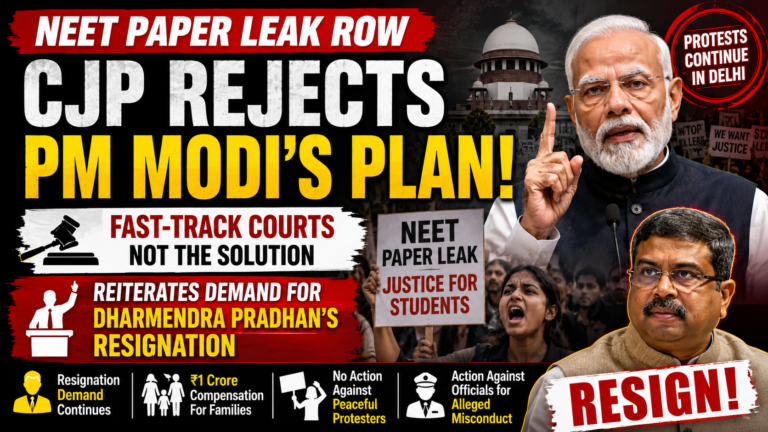
The political and public debate surrounding the alleged NEET paper leak controversy intensified on Thursday, after the Cockroach Janta Party (CJP) rejected Prime Minister Narendra Modi’s announcement regarding the establishment of fast-track courts to deal with examination paper leak cases.
The Prime Minister, in his first public statement addressing the controversy, said the Union Government had decided to create fast-track courts to ensure speedy investigations and strict punishment for those involved in examination paper leaks. He emphasized that protecting the future of students remained one of the government’s highest priorities.
However, the CJP dismissed the announcement as insufficient, arguing that judicial reforms alone would not solve what it described as deeper structural problems within the country’s examination system. The organization reiterated that its principal demand continues to be the resignation of Union Education Minister Dharmendra Pradhan, whom it holds politically responsible for the alleged failures.
The exchange has added a fresh political dimension to the ongoing protests that have drawn thousands of students and supporters in several parts of the country, particularly in the national capital.
Prime Minister Announces Fast-Track Courts for Paper Leak Cases
Responding publicly to the controversy for the first time, Prime Minister Narendra Modi stated that safeguarding the future of students is a national priority.
In a message shared on social media, the Prime Minister announced that the government would establish fast-track courts to ensure that individuals involved in examination paper leaks face swift trials and stringent punishment.
He also directed concerned authorities to take all necessary measures to strengthen action against those attempting to compromise examination integrity.
The Prime Minister further asserted that those responsible for harming the future of India’s youth would not be spared under the law.
The announcement was presented as part of the government’s broader efforts to improve examination security and maintain public confidence in the country’s education system.
CJP Says Announcement Does Not Address Root Cause
Shortly after the Prime Minister’s announcement, the CJP issued its response through social media.
The organization maintained that its position remains unchanged and once again demanded the resignation of Education Minister Dharmendra Pradhan.
In its response, the group argued that creating fast-track courts addresses only the legal process after an alleged offence occurs and does not prevent examination irregularities from taking place in the first place.
According to the organization, the primary issue lies in ensuring a secure, transparent and reliable examination system capable of preventing leaks before they occur.
The CJP maintained that accountability must begin at the highest administrative level within the Education Ministry.
Spokesperson Calls Proposal a ‘Distraction’
Speaking on behalf of the organization, CJP spokesperson Ashutosh Ranka criticized the government’s proposal.
According to his statement, the announcement of fast-track courts does not represent a comprehensive solution to the concerns raised by students protesting across the country.
He argued that repeated examination controversies point toward systemic weaknesses that require administrative reforms rather than only legal action after alleged irregularities occur.
Ranka further stated that many students are seeking immediate accountability and institutional reforms aimed at restoring trust in the examination process.
The organization emphasized that improving examination security, transparency, and accountability should remain the government’s highest priority.
Political Exchanges Intensify
The issue has now developed into a larger political debate.
While the Central Government has maintained that strict legal action will be taken against anyone involved in examination paper leaks, opposition voices and protest organizers continue to question whether administrative accountability should accompany criminal investigations.
The controversy has triggered widespread discussions regarding:
- Examination security
- Student welfare
- Government accountability
- Recruitment transparency
- Education reforms
- Public confidence in competitive examinations
The debate has also dominated discussions across social media platforms, where students, educators and political leaders continue to express differing opinions on the government’s response.
Nationwide Student Protests Continue
The Prime Minister’s announcement comes against the backdrop of continuing protests led by the CJP and student groups in Delhi.
Large numbers of demonstrators have gathered near Jantar Mantar and surrounding areas over the past several days, demanding action over the alleged examination irregularities.
Authorities have increased security arrangements in parts of the national capital to maintain law and order as demonstrations continue.
Protest organizers have stated that their movement will continue until their principal demands receive an official response from the government.
Government Maintains Its Stand
The Union Government has defended its handling of the situation.
Senior BJP leaders, including Union Education Minister Dharmendra Pradhan, have maintained that the government is committed to protecting students’ interests and ensuring strict action against those responsible for any examination-related wrongdoing.
The government has argued that stronger legal mechanisms, including fast-track courts, will help ensure quicker justice and deter future offences.
Officials have also reiterated that safeguarding the credibility of India’s examination system remains an important priority.
CJP Reiterates Its Key Demands
Despite the Prime Minister’s announcement regarding fast-track courts, the CJP stated that its core demands remain unchanged. According to the organisation, meaningful reforms require both accountability and systemic changes to restore confidence in the examination process.
The organisation said it would continue its nationwide protests until its primary demands are addressed.
Key Demands Raised by CJP
- Resignation of Union Education Minister Dharmendra Pradhan.
- Compensation of ₹1 crore for the families of students who allegedly died by suicide in connection with the controversy.
- No legal action against peaceful protesters.
- Action against officials found responsible for alleged misconduct during protests.
These demands continue to form the central agenda of the ongoing demonstrations.
Protests Continue Across Delhi
The demonstrations led by the CJP have entered another phase, with protesters continuing to gather in Delhi, particularly around Jantar Mantar and nearby areas.
Thousands of students and supporters have participated in rallies demanding greater transparency in the country’s examination system. The protests have also intensified political exchanges between the ruling BJP and opposition parties.
Security has been tightened across parts of the national capital, and authorities remain on alert to maintain law and order.
Debate Over Examination Reforms
The controversy has sparked a broader national discussion about the integrity of competitive examinations.
Education experts have highlighted the importance of:
- Stronger cybersecurity measures
- Better encryption of question papers
- Enhanced monitoring of examination centres
- Faster investigation into alleged irregularities
- Greater institutional accountability
- Transparent recruitment and admission processes
The government’s proposal to establish fast-track courts has been welcomed by some as a step toward quicker justice, while others argue that long-term reforms are equally necessary to prevent future incidents.
Political Reactions
The issue has become a major political talking point.
The BJP has defended the government’s response, stating that strict legal action will be taken against anyone found guilty of examination-related offences.
Meanwhile, the CJP and several opposition voices have argued that administrative accountability should accompany legal action.
The differing responses have intensified the political debate surrounding education reforms and examination security.
Key Highlights
| Particular | Details |
|---|---|
| Issue | Alleged NEET Paper Leak |
| Prime Minister’s Announcement | Fast-track courts for paper leak cases |
| Government Objective | Speedy trials and strict punishment |
| CJP’s Response | Rejected proposal as insufficient |
| Main Demand | Resignation of Union Education Minister Dharmendra Pradhan |
| Protest Location | Jantar Mantar, New Delhi |
| Protest Status | Continuing |
| Government Position | Strong legal action against offenders |
| Main Concern | Examination security and accountability |
Frequently Asked Questions (FAQs)
1. Why did the CJP reject the Prime Minister’s proposal?
The organisation stated that fast-track courts alone would not address what it describes as deeper systemic issues in the examination process and reiterated its demand for administrative accountability.
2. What did Prime Minister Narendra Modi announce?
The Prime Minister announced that the government would establish fast-track courts to ensure quicker trials and stricter punishment in paper leak cases, emphasizing the protection of students’ futures.
3. What is the CJP’s main demand?
The CJP has reiterated its demand for the resignation of Union Education Minister Dharmendra Pradhan, along with other measures related to accountability and support for affected families.
4. Where are the protests taking place?
The demonstrations have primarily been held in and around Jantar Mantar in New Delhi, with supporters gathering to press for their demands.
5. What is the government’s stand?
The government has stated that it is committed to protecting the interests of students, strengthening examination security, and taking strict legal action against those responsible for paper leaks.
Conclusion
The ongoing debate over the alleged NEET paper leak continues to shape national discussions on education policy, examination integrity, and accountability. While the Centre has announced fast-track courts as part of its response, the CJP maintains that broader institutional reforms and accountability are necessary.
As protests continue and political exchanges intensify, attention will remain on how the government implements its announced measures and whether further reforms are introduced to strengthen confidence in India’s examination system.
English Highlights
- 🚨 PM Modi announces fast-track courts for paper leak cases
- 📚 Government says protecting students is the top priority
- ✋ CJP rejects proposal as inadequate
- 🏛️ CJP reiterates demand for Dharmendra Pradhan’s resignation
- 🎓 Debate continues over examination reforms
- 📍 Protests continue at Jantar Mantar
- 👮 Security tightened across parts of Delhi
- ⚖️ Political debate over accountability intensifies
ಕನ್ನಡ ಪ್ರಮುಖ ಅಂಶಗಳು
- 🚨 ಪ್ರಶ್ನೆಪತ್ರಿಕೆ ಸೋರಿಕೆ ಪ್ರಕರಣಗಳಿಗೆ ಫಾಸ್ಟ್ ಟ್ರ್ಯಾಕ್ ನ್ಯಾಯಾಲಯಗಳ ಘೋಷಣೆ
- 📚 ವಿದ್ಯಾರ್ಥಿಗಳ ಭವಿಷ್ಯ ಸರ್ಕಾರದ ಮೊದಲ ಆದ್ಯತೆ ಎಂದು ಪ್ರಧಾನಿ ಮೋದಿ
- ✋ CJP ಸರ್ಕಾರದ ಕ್ರಮವನ್ನು ಅಪರ್ಯಾಪ್ತ ಎಂದು ಟೀಕೆ
- 🏛️ ಧರ್ಮೇಂದ್ರ ಪ್ರಧಾನ ರಾಜೀನಾಮೆಗೆ CJP ಮತ್ತೆ ಒತ್ತಾಯ
- 🎓 ಪರೀಕ್ಷಾ ವ್ಯವಸ್ಥೆಯ ಸುಧಾರಣೆ ಕುರಿತು ದೇಶವ್ಯಾಪಿ ಚರ್ಚೆ
- 📍 ಜಂತರ್ ಮಂತರ್ನಲ್ಲಿ ಪ್ರತಿಭಟನೆ ಮುಂದುವರಿಕೆ
- 👮 ದೆಹಲಿಯ ಹಲವು ಭಾಗಗಳಲ್ಲಿ ಭದ್ರತೆ ಹೆಚ್ಚಳ
- ⚖️ ಹೊಣೆಗಾರಿಕೆ ಕುರಿತು ರಾಜಕೀಯ ಚರ್ಚೆ ತೀವ್ರ
Disclaimer
Disclaimer: This article is based on publicly reported statements made by government officials and the Cockroach Janta Party (CJP) at the time of publication. The reported paper leak allegations, political responses, and protest-related claims remain subject to official investigations and ongoing developments. This article is intended solely for informational purposes and does not endorse or verify the claims made by any individual or organisation.
Do Follow For More Info @ http://roydailyupdate.in
Do Connect WhatsApp @ https://chat.whatsapp.com/K5POJK9KbpN8egjjOCaOw6