

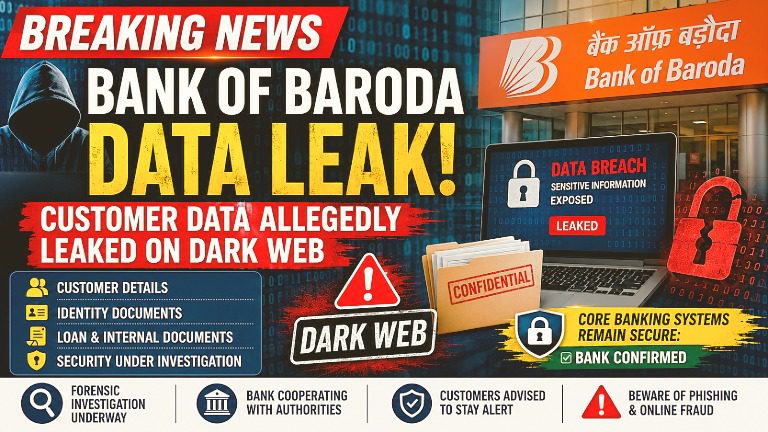
Bank of Baroda Data Leak:
India’s banking sector is once again under the spotlight after reports emerged that sensitive customer information and internal documents linked to Bank of Baroda (BoB) were allegedly leaked on the dark web. The state-owned lender has confirmed that it has initiated a forensic investigation following the detection of unauthorized access involving one of its employee email accounts.
Although the bank has assured customers that its core banking systems remain secure, the incident has sparked widespread concern about cybersecurity, data privacy, and the increasing sophistication of cybercriminals targeting financial institutions.
With digital banking becoming the backbone of India’s financial ecosystem, the alleged breach highlights why protecting customer information has become more critical than ever.
What Happened?
According to multiple reports, including Reuters, a large cache of data allegedly connected to Bank of Baroda surfaced on a dark web marketplace over the weekend.
Cybersecurity researcher Srikanth L, founder of Cashless Consumer, stated that the dataset was advertised as containing more than 700 GB of information based on metadata available on the dark web listing.
The leaked material reportedly includes:
- Customer information
- Identification documents
- Loan-related paperwork
- Internal audit records
- Other confidential institutional documents
At the time of writing, the total number of affected customers has not been officially disclosed.
Authorities are continuing to verify the authenticity, scope, and impact of the alleged breach.
Bank of Baroda’s Official Response
Bank of Baroda acknowledged the cybersecurity incident through an official statement issued on Monday.
According to the bank, preliminary investigations indicate that the breach originated from a compromised employee email account, allowing unauthorized individuals to access certain internal data.
However, the bank emphasized an important reassurance for customers:
Core banking infrastructure remains unaffected.
Customer deposits and banking operations continue normally.
Immediate containment measures have already been implemented.
A comprehensive forensic investigation is underway.
Relevant government agencies and cybersecurity authorities have been informed.
The bank also stated that it is cooperating with investigators to determine the complete extent of the incident and strengthen its cybersecurity systems.
What Data Was Allegedly Exposed?
While investigators continue their forensic examination, cybersecurity experts suggest that the leaked files may include several categories of sensitive information.
These reportedly include:
* Customer names
* Identity verification documents
* Loan application records
* Financial paperwork
* Internal compliance reports
* Audit-related documentation
It is important to note that Bank of Baroda has not officially confirmed the complete contents of the leaked dataset, and investigators are still verifying exactly what information may have been accessed.
The bank has also not confirmed whether customer passwords, debit card information, internet banking credentials, or transaction data were compromised.
Core Banking Systems Remain Secure
One of the biggest concerns during any banking cyber incident is whether customer money is immediately at risk.
Bank of Baroda has clarified that its core banking systems were not accessed during the incident.
This distinction is significant because core banking systems handle:
Customer deposits
Fund transfers
Account balances
Payment processing
Transaction records
According to the bank’s preliminary assessment, these systems remain fully operational and secure.
However, cybersecurity experts caution that exposure of customer identity documents could still create risks such as phishing attacks, identity theft attempts, or social engineering scams if criminals misuse the information.
Authorities Yet to Issue Detailed Statement
Following reports of the alleged data breach, attention has also shifted toward India’s financial and cybersecurity regulators.
As of the latest updates:
The Reserve Bank of India (RBI) has not released a detailed public statement regarding the incident.
India’s national cybersecurity response agency CERT-In has also not publicly commented on the investigation.
Experts expect regulatory authorities to closely monitor the forensic findings before determining whether additional compliance measures or advisories are required for the banking sector.
The incident comes at a time when cybersecurity has become a major focus for banks, financial institutions, and regulators as digital transactions continue to grow rapidly across India.
Why the Dark Web Listing Matters
Cybersecurity researchers believe the alleged Bank of Baroda dataset was advertised on a dark web platform over the weekend. According to researcher Srikanth L., the listing appeared to contain more than 700 GB of data, making it one of the larger publicly reported banking-related data exposures in recent months.
The dark web refers to a hidden part of the internet that is not indexed by traditional search engines. Cybercriminals often use these platforms to trade stolen credentials, financial information, confidential documents, and hacking tools.
If verified, such leaks can expose customers and institutions to risks including:
- Identity theft
- Phishing attacks
- Financial fraud
- Social engineering scams
- Unauthorized account access attempts
Even when banking systems remain secure, leaked personal information can still be exploited by cybercriminals to deceive customers through fake emails, SMS messages, or phone calls.
Growing Cybersecurity Threats to Indian Companies
The Bank of Baroda incident comes amid a growing number of cybersecurity attacks targeting major Indian organizations.
In recent months:
Tata Electronics reportedly experienced a cyberattack that allegedly exposed component design documents linked to global technology companies.
Multiple ransomware groups have increasingly targeted manufacturing, healthcare, financial services, and government organizations.
Financial institutions continue to face sophisticated phishing campaigns, malware attacks, credential theft, and email compromises.
Cybersecurity experts say attackers are increasingly focusing on employee email accounts because they often provide an entry point into corporate systems.
This latest incident serves as another reminder that even organizations with advanced security infrastructure remain vulnerable to human-targeted cyberattacks.
What Should Bank of Baroda Customers Do?
Although the bank has stated that its core banking infrastructure remains secure, customers should remain cautious until the investigation concludes.
Experts recommend taking the following precautions:
1. Monitor Bank Accounts Regularly
Review account statements and transaction history frequently for any unauthorized activity.
2. Never Share OTPs or Banking Passwords
Bank officials never ask customers to disclose:
OTPs
Debit card PINs
CVV numbers
Internet banking passwords
UPI PINs
Ignore anyone requesting such information.
3. Beware of Phishing Messages
Cybercriminals often exploit publicized breaches by sending fake:
Emails
SMS messages
WhatsApp links
Phone calls pretending to be bank representatives
Always verify communications through official Bank of Baroda channels.
4. Change Passwords if Necessary
Customers using similar passwords across multiple services should consider updating them and enabling multi-factor authentication wherever available.
5. Stay Updated Through Official Sources
Avoid relying on rumors circulating on social media. Instead, follow updates issued by:
Bank of Baroda
RBI
CERT-In
Investigation Continues
The forensic investigation is expected to determine:
How the employee email account was compromised.
Whether additional systems were accessed.
The exact volume of data exposed.
The number of affected customers.
Whether any financial information was compromised.
Depending on the findings, additional security measures or customer advisories may be issued by the bank or regulatory authorities.
Why This Incident Is Important
India has rapidly become one of the world’s largest digital banking markets, with millions of customers relying on online banking, UPI, mobile apps, and internet banking services every day.
As financial institutions continue expanding digital services, cybersecurity has become one of the most important operational priorities.
The Bank of Baroda incident demonstrates that while banks continue investing heavily in security infrastructure, attackers are also becoming increasingly sophisticated. Protecting customer information now requires continuous monitoring, employee awareness, advanced threat detection, and rapid incident response.
For customers, staying alert and following basic cybersecurity practices remains one of the best defenses against fraud.
Frequently Asked Questions (FAQs)
Was Bank of Baroda hacked?
The bank has confirmed unauthorized access involving a compromised employee email account. A forensic investigation is underway to determine the full scope of the incident.
Is customer money safe?
According to Bank of Baroda, its core banking systems were not accessed and continue to remain secure.
What information may have been leaked?
Reports suggest customer information, identity documents, loan-related paperwork, and internal audit records may have been exposed. The complete scope has not yet been officially confirmed.
How many customers were affected?
The bank has not disclosed the number of potentially affected customers.
What should customers do now?
Customers should monitor their accounts, avoid sharing OTPs or passwords, remain cautious of phishing attempts, and follow updates issued through official Bank of Baroda channels.
Conclusion
The alleged Bank of Baroda data leak highlights the increasing cybersecurity challenges facing financial institutions worldwide. While the bank has reassured customers that its core banking systems remain secure, the incident underscores the importance of strong cybersecurity practices and customer vigilance.
As investigators continue examining the breach, customers are advised to rely only on official updates and remain cautious of fraud attempts that often follow widely reported cyber incidents.
Disclaimer
Disclaimer: This article is intended solely for informational purposes based on publicly available reports and official statements available at the time of publication. The investigation into the alleged Bank of Baroda data leak is ongoing, and facts may evolve as authorities release additional information. Readers should refer to official communications from Bank of Baroda, the Reserve Bank of India (RBI), and CERT-In for the latest updates. RoyDailyUpdate does not provide financial, legal, or cybersecurity advice.
Do Follow For More Info @ http://roydailyupdate.in
Do WhatsApp @ https://chat.whatsapp.com/K5POJK9KbpN8egjjOCaOw6