

Japan Earthquake 2026:
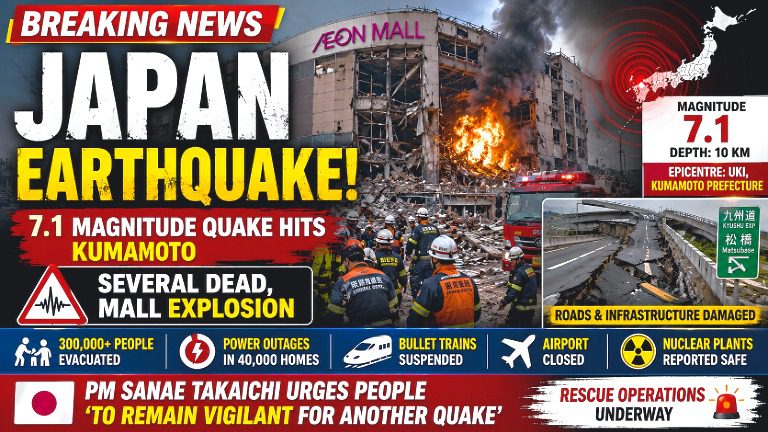
A powerful 7.1 magnitude earthquake struck Japan’s southern Kumamoto Prefecture on Tuesday, triggering widespread destruction, power outages, transportation disruptions and a devastating explosion at a shopping mall where authorities fear multiple fatalities.
The earthquake, which struck at a relatively shallow depth of 10 kilometres, sent strong tremors across several prefectures in southern Japan, forcing hundreds of thousands of residents to evacuate while emergency services launched large-scale rescue operations.
Officials have warned residents to remain alert as strong aftershocks continue to shake the region.
7.1 Magnitude Earthquake Jolts Southern Japan
According to Japan’s Meteorological Agency, the earthquake’s epicentre was located near the city of Uki in Kumamoto Prefecture.
The tremor was powerful enough to be felt across several neighbouring prefectures including:
- Kumamoto
- Nagasaki
- Kagoshima
- Fukuoka
- Saga
- Miyazaki
The shallow depth of the earthquake intensified ground shaking, causing severe structural damage in multiple areas.
Initially, authorities issued a tsunami warning, but it was later withdrawn after further assessment.
Shopping Mall Explosion Raises Casualties
One of the most serious incidents following the earthquake occurred at an Aeon Mall in Kumamoto.
According to police, an explosion occurred shortly after the earthquake, leaving several people feared dead while others remain trapped beneath damaged sections of the building.
Eyewitnesses described hearing a massive blast followed by thick clouds of smoke rising into the sky.
A nearby restaurant owner told local media that the explosion was so powerful that dust and debris spread across surrounding streets, creating conditions similar to volcanic ash.
Emergency rescue teams immediately rushed to the scene and continue searching for survivors trapped inside the damaged complex.
Authorities have not yet confirmed the exact cause of the explosion, and investigations remain ongoing.
Hundreds of Thousands Asked to Evacuate
Japan’s Disaster Management Agency instructed approximately 300,000 residents to move to designated evacuation centres as aftershocks continued throughout the afternoon.
Prime Minister Sanae Takaichi confirmed that nearly 3,600 members of Japan’s Self-Defense Forces had been mobilised to support rescue and relief operations.
Emergency teams have been deployed across affected districts to:
Rescue trapped residents
Provide emergency medical assistance
Restore damaged infrastructure
Assess collapsed buildings
Support evacuation shelters
Officials continue to monitor landslide risks as heavy aftershocks increase the possibility of additional structural collapses.
More Than 50 Injured
Public broadcaster NHK reported that one hospital alone received more than 50 injured people shortly after the earthquake.
Several additional injuries occurred when a Shinkansen bullet train derailed due to the powerful shaking.
Although no major fatalities have been reported from the train incident itself, railway authorities immediately suspended services across Kyushu to inspect tracks and ensure passenger safety.
Medical facilities throughout Kumamoto remain on high alert as rescue operations continue.
Power Outages and Infrastructure Damage
The earthquake caused significant damage to public infrastructure across southern Japan.
Officials reported:
Around 40,000 homes lost electricity
Roads were cracked or collapsed
Bridges suffered structural damage
Buildings partially collapsed
Railway services were suspended
Airport operations were disrupted
The runway at Aso Kumamoto Airport was closed indefinitely pending safety inspections.
Rail operator JR Kyushu also suspended both local rail services and high-speed bullet trains until engineers complete structural assessments.
Prime Minister Sanae Takaichi Appeals for Vigilance
Addressing the nation shortly after the disaster, Prime Minister Sanae Takaichi urged residents to prioritise their safety and prepare for additional aftershocks.
According to the Prime Minister:
Authorities have received reports of injuries.
Fires and power outages have occurred in multiple locations.
Roads, bridges and buildings have sustained damage.
Rescue operations are continuing around the clock.
She appealed to residents to immediately move to safer locations whenever instructed by local authorities and remain prepared for another earthquake of similar intensity.
Later, she reiterated through social media that government agencies were working continuously to assess the full extent of the disaster and coordinate emergency response efforts.
Nuclear Facilities Reported Safe
Following the earthquake, attention quickly turned toward nearby nuclear power facilities.
Japan’s Nuclear Regulation Authority stated that inspections conducted at three nearby nuclear plants found no abnormalities.
Officials confirmed that:
Reactor safety systems remain normal.
No radiation leaks have been detected.
Nuclear facilities continue operating safely.
This announcement provided reassurance after initial concerns that the powerful earthquake could have affected critical energy infrastructure.
Nevertheless, authorities continue monitoring all facilities as aftershocks persist throughout the region.
Major Companies Assess Damage
The earthquake also disrupted operations at several major industrial facilities located in southern Japan.
According to local reports:
Sony temporarily evacuated employees from manufacturing facilities in the affected region.
Fujifilm also moved staff to safer locations as a precaution.
TSMC (Taiwan Semiconductor Manufacturing Company), which operates a semiconductor facility in Kumamoto, began assessing its infrastructure for possible damage.
At the time of publication, no company had reported significant structural damage to its production facilities, although detailed inspections remain underway.
Given Japan’s critical role in the global semiconductor and electronics supply chain, experts are closely monitoring whether the disaster could temporarily affect manufacturing operations.
Rescue Operations Continue
Emergency responders continued working through the night to rescue people trapped beneath collapsed structures and damaged commercial buildings.
Japan’s Fire and Disaster Management Agency, local police, firefighters and the Self-Defense Forces have deployed specialized rescue teams equipped with:
Search-and-rescue dogs
Thermal imaging equipment
Heavy excavation machinery
Medical emergency units
Urban search-and-rescue specialists
Authorities have warned residents to avoid entering damaged buildings because repeated aftershocks could trigger further collapses.
Kumamoto Castle Suffers Fresh Damage
Officials confirmed that sections of the historic Kumamoto Castle, one of Japan’s most famous cultural landmarks, suffered additional structural damage.
Some portions of the castle’s stone walls reportedly collapsed following Tuesday’s earthquake.
The castle had already undergone years of restoration after suffering severe damage during the devastating Kumamoto earthquakes of 2016.
Engineers are expected to conduct a detailed assessment before restoration work resumes.
Why Japan Experiences So Many Earthquakes
Japan is among the world’s most earthquake-prone nations due to its unique geographical location.
The country lies along the Pacific Ring of Fire, a region where several major tectonic plates meet.
Japan sits near the convergence of:
Pacific Plate
Philippine Sea Plate
Eurasian Plate
North American Plate
As these plates continuously shift beneath one another, stress builds over time before being released in the form of earthquakes.
According to geological studies:
Japan experiences thousands of earthquakes every year.
Around 20% of the world’s earthquakes measuring magnitude 6.0 or higher occur in or around Japan.
Strict building codes and advanced early-warning systems have significantly reduced casualties from many recent earthquakes.
Despite these preparations, shallow earthquakes like Tuesday’s event can still cause extensive damage because of the intense ground shaking they generate.
Memories of the 2016 Kumamoto Earthquake
Tuesday’s disaster has revived memories of the catastrophic Kumamoto earthquakes that struck the same region a decade ago.
The twin earthquakes in April 2016 claimed:
275 lives
More than 2,700 injuries
Widespread destruction of homes, roads and public infrastructure
Those earthquakes also caused major damage to Kumamoto Castle and triggered landslides across mountainous regions.
Although Japan has strengthened disaster preparedness since then, the latest earthquake demonstrates that the region remains highly vulnerable to powerful seismic activity.
Safety Tips During an Earthquake
Disaster management experts advise residents to follow these precautions during earthquakes:
Drop, cover and hold on during shaking.
Stay away from windows, glass panels and heavy furniture.
Avoid elevators and use stairs after the shaking stops.
Prepare an emergency kit with water, food, medicines and important documents.
Follow official evacuation orders immediately.
Beware of aftershocks, which can sometimes be as dangerous as the main earthquake.
Preparedness remains one of the most effective ways to reduce injuries during major seismic events.
Conclusion
The powerful 7.1 magnitude earthquake in Kumamoto has once again demonstrated Japan’s vulnerability to natural disasters despite having some of the world’s most advanced earthquake preparedness systems.
With several people feared dead, dozens injured, hundreds of thousands evacuated and critical infrastructure affected, rescue efforts remain the government’s top priority.
Authorities continue assessing the full extent of the destruction while warning residents to remain alert for additional aftershocks. As emergency teams work around the clock, Japan’s resilience and rapid disaster response will once again play a crucial role in helping affected communities recover from this devastating event.
Frequently Asked Questions (FAQs)
Where did the Japan earthquake occur?
The earthquake struck near the city of Uki in Kumamoto Prefecture on Japan’s southern island of Kyushu.
How strong was the earthquake?
The Japan Meteorological Agency reported the earthquake measured 7.1 on the Richter scale.
Was a tsunami generated?
A tsunami warning was initially issued but was later lifted after further assessment.
Were nuclear power plants affected?
Japan’s Nuclear Regulation Authority stated that inspections found no abnormalities at nearby nuclear facilities.
Why does Japan experience so many earthquakes?
Japan lies on the Pacific Ring of Fire, where several tectonic plates converge, making it one of the world’s most seismically active countries.
Disclaimer
Disclaimer: This article is based on publicly available reports from official agencies and international news organizations available at the time of publication. Casualty figures, damage assessments and rescue operations may change as authorities continue their investigation and relief efforts. Readers are encouraged to follow official updates from the Government of Japan and disaster management agencies for the latest information.
Do Follow For More Info @ http://roydailyupdate.in
Do WhatsApp @ https://chat.whatsapp.com/K5POJK9KbpN8egjjOCaOw6