

Namma Metro Yellow Line Completes One Year
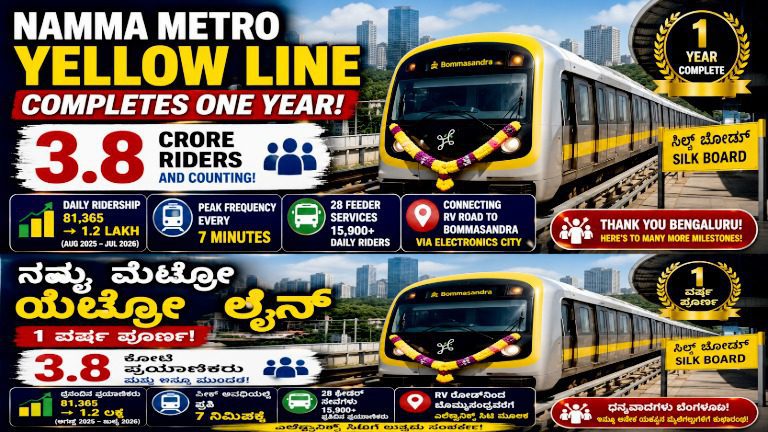
Bengaluru’s Namma Metro Yellow Line has completed its first year of commercial operations with more than 3.8 crore passenger journeys, underlining the growing importance of the corridor connecting RV Road and Bommasandra through Electronics City.
The 19-km corridor has quickly become an important public transport option for thousands of employees, students and residents travelling between south Bengaluru and the city’s major IT and industrial hubs. Passenger numbers have continued to rise despite operational constraints during the line’s initial months, particularly the shortage of trainsets.
According to the latest figures reported by The Times of India, average daily ridership increased from around 81,365 passengers in August 2025 to approximately 1.2 lakh in July 2026.
Yellow Line connects Bengaluru’s key IT corridor
The Yellow Line runs between Rashtreeya Vidyalaya Road (RV Road) and Delta Electronics Bommasandra, covering roughly 19 kilometres and serving 16 stations.
The corridor is particularly significant because it provides direct Metro connectivity towards Electronics City, one of Bengaluru’s biggest employment hubs.
The Yellow Line was inaugurated on August 10, 2025, with Prime Minister Narendra Modi flagging off the corridor. The project was built as part of Namma Metro Phase II and had an estimated project cost of around ₹7,160 crore at the time of inauguration.
Commercial passenger services subsequently began in August 2025.
The route has since become an important alternative for commuters who previously depended heavily on private vehicles, buses, cabs and two-wheelers to travel along the busy Hosur Road–Electronics City corridor.
3.8 crore passengers in the first year
The biggest milestone for the Yellow Line is its passenger growth.
More than 3.8 crore passengers have used the corridor during its first year of commercial operations, according to the latest report.
The daily average has also climbed considerably.
In August 2025, the Yellow Line recorded average daily ridership of around 81,365 passengers. By July 2026, that figure had increased to around 1.2 lakh passengers a day.
That growth is significant because the corridor did not initially have its complete planned train fleet.
The increasing passenger numbers suggest that demand for Metro connectivity to Electronics City is strong and that ridership could rise further if waiting times are reduced and additional trains are deployed.
Train shortage affected the Yellow Line’s early growth
One of the major challenges faced by the Yellow Line after its opening was the shortage of trainsets.
BMRCL had planned a fleet of 15 trainsets for the corridor. However, the delivery and commissioning of the trains took considerably longer than expected.
The final trainset reached Bengaluru in July 2026, completing the planned initial fleet. Moneycontrol reported that the final trainset was unloaded at the Hebbagodi depot on July 27.
The delays meant that the Yellow Line had to begin operations with fewer trains than originally planned.
As more trainsets were gradually inducted, BMRCL was able to improve the frequency of services.
Yellow Line trains now run every seven minutes during peak hours
The availability of additional trains has already improved services.
At present, BMRCL operates around 10 trains on the Yellow Line, with services running approximately every seven minutes during peak hours and around 10 minutes during non-peak periods, according to the report.
The corporation is monitoring passenger demand before deciding whether more trains should be deployed.
Earlier reports indicated that once the complete fleet becomes operational, the waiting time could potentially fall further.
For regular commuters, even a reduction of a few minutes in train frequency can make a significant difference, particularly during the morning and evening office rush.
Electronics City stations see heavy passenger traffic
The strongest demand is being recorded at stations serving the Electronics City and Hosur Road stretches.
According to the reported figures, Infosys Konappana Agrahara recorded around 22,284 passengers, while Silk Board recorded approximately 21,300 and Delta Electronics Bommasandra around 19,368.
The figures highlight the importance of the Yellow Line for Bengaluru’s large technology workforce.
Electronics City hosts several major technology companies and industrial establishments, resulting in substantial daily commuter movement.
The Metro has therefore become an important component of the area’s public transport network.
Yellow Line helped Namma Metro cross 10 lakh daily passengers
The impact of the Yellow Line extends beyond its own ridership numbers.
Its opening has contributed to the overall growth of Namma Metro’s passenger base, with the city’s Metro network crossing the 10-lakh daily passenger mark on several occasions.
This comes as Bengaluru continues to struggle with traffic congestion and longer road travel times.
For many commuters, Metro travel offers a more predictable journey compared with travelling by road during peak hours.
The Yellow Line’s growing usage also demonstrates how new Metro corridors can influence travel behaviour when they connect residential areas with major employment centres.
Feeder buses strengthen last-mile connectivity
Metro connectivity alone does not solve the complete commuting problem because passengers still need to travel between their homes, workplaces and Metro stations.
To address this issue, BMTC has been operating feeder services around Yellow Line stations.
According to the figures provided in the report, there are 28 scheduled feeder services, making nearly 300 trips every day and carrying more than 15,900 passengers daily.
The Electronics City–Tin Factory feeder route reportedly has the highest patronage, with more than 3,400 passengers a day.
The feeder network is particularly important in areas where residential layouts and workplaces are located several kilometres away from Metro stations.
Better last-mile connectivity could help increase Yellow Line ridership further by making the entire journey more convenient.
Companies are encouraging employees to use the Metro
The Yellow Line is also influencing how companies in Electronics City approach employee transportation.
Several companies and industry organisations are encouraging workers to shift from private vehicles to public transport.
One example highlighted in the report is Biocon’s Corporate Commute Nudge programme.
More than 1,300 employees reportedly completed over 77,000 Metro rides in three months through the initiative. The programme is estimated to have helped avoid around 99 tonnes of carbon emissions.
Other organisations, including Hical Technologies and ELCITA, have also taken steps to encourage public transport and improve last-mile connectivity.
This indicates that the Yellow Line’s impact could extend beyond passenger numbers to areas such as traffic reduction, fuel consumption and emissions.
What the Yellow Line could mean for Bengaluru’s future
The Yellow Line is only one part of Bengaluru’s expanding Metro network.
The city is planning and developing additional corridors that are expected to improve connectivity between major residential, commercial and technology hubs.
Future Blue and Pink Line connections are expected to strengthen the wider Metro network and create additional options for passengers travelling between Bengaluru’s major IT corridors.
The state budget for 2026-27 also noted that Namma Metro’s operational network had reached around 96 km and was serving approximately 10 lakh commuters daily, while additional Metro expansion was planned.
For the Yellow Line, the immediate focus is likely to remain on improving train frequency, accommodating growing ridership and strengthening last-mile connectivity.
A strong first year, but demand is still growing
The first year of the Yellow Line shows a clear trend: Bengaluru commuters are using the Metro when reliable connectivity is available to major employment centres.
The jump from around 81,000 average daily passengers in August 2025 to approximately 1.2 lakh by July 2026 is particularly notable.
The corridor also managed to build a substantial passenger base despite operating with a limited train fleet during its early months.
With the planned fleet now arriving and service frequency improving, passenger numbers could increase further.
The bigger challenge will be ensuring that rising demand does not result in overcrowding and long waiting times.
For Bengaluru, the Yellow Line’s first year is therefore more than just a ridership milestone. It represents a shift in how thousands of people travel to one of the city’s most important employment zones.
From 3.8 crore passenger journeys in its first year to potentially even higher numbers ahead, the Yellow Line is emerging as one of the key pillars of Bengaluru’s public transport system.
Key Yellow Line numbers at a glance
Particular Details
Corridor RV Road – Bommasandra
Length About 19 km
First year ridership 3.8+ crore
Daily average, Aug 2025 81,365
Daily average, July 2026 ~1.2 lakh
Planned initial trainsets 15
Current peak frequency ~7 minutes
Non-peak frequency ~10 minutes
Feeder services 28
Feeder trips per day ~300
Feeder passengers per day 15,900+
FAQs
Q1. When did the Namma Metro Yellow Line begin commercial operations?
The Namma Metro Yellow Line began commercial operations in August 2025.
Q2. How many passengers used the Yellow Line in its first year?
The Yellow Line recorded more than 3.8 crore passenger journeys during its first year of commercial operations.
Q3. How much has the Yellow Line’s daily ridership increased?
Average daily ridership increased from around 81,365 passengers in August 2025 to approximately 1.2 lakh passengers in July 2026.
Q4. Which areas does the Yellow Line connect?
The Yellow Line connects RV Road and Bommasandra, passing through important areas including BTM Layout, Silk Board and Electronics City.
Q5. How frequently do Yellow Line trains operate during peak hours?
According to the supplied report, Yellow Line services currently operate at approximately seven-minute intervals during peak hours.
Q6. How frequently do trains operate during non-peak hours?
During non-peak periods, trains operate at approximately 10-minute intervals.
Q7. Which Yellow Line stations have recorded high passenger footfall?
The supplied figures identify Infosys Konappana Agrahara, Silk Board and Delta Electronics Bommasandra among stations recording high passenger numbers.
Q8. How many feeder services support the Yellow Line?
BMTC is operating 28 scheduled feeder services, making nearly 300 trips every day and carrying more than 15,900 passengers daily, according to the supplied information.
Q9. Why is the Yellow Line important for Bengaluru?
The corridor provides Metro connectivity to Electronics City and the wider IT corridor, giving commuters an alternative to private vehicles and road-based transport.
Q10. Are companies encouraging employees to use the Yellow Line?
Yes. The supplied report highlights initiatives by companies including Biocon, Hical Technologies and ELCITA to encourage employees to use public transport and improve last-mile connectivity.
Disclaimer
Disclaimer: This article has been prepared using information provided in the source report and available reports related to Namma Metro’s Yellow Line. Passenger numbers, operational statistics, train frequencies and other figures may change as BMRCL and other authorities release updated information. Readers are advised to verify the latest operational details, schedules and announcements through official sources before making travel decisions. Roy Daily Update does not guarantee the completeness or accuracy of information that may subsequently change.
Do Follow For More Info @ http://roydailyupdate.in
Do WhatsApp @ https://chat.whatsapp.com/K5POJK9KbpN8egjjOCaOw6
About the Author
Ravi is a digital content writer and blogger at Roy Daily Update, covering trending news, Bengaluru and Karnataka updates, business, jobs, technology, entertainment, transport and important developments from India and around the world.
Ravi focuses on presenting news in a simple, clear and reader-friendly format, while highlighting the key facts readers need to know. His content is created with an emphasis on timely updates, useful information and easy-to-understand explanations.