

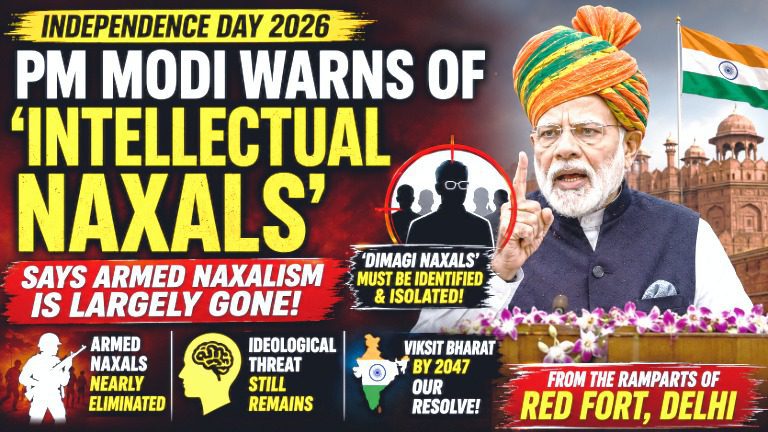
Modi Warns of ‘Dimagi Naxals’ in Independence Day Speech
Prime Minister Narendra Modi used his Independence Day address from the Red Fort on August 15, 2026, to declare that India has made significant progress in eliminating the armed Naxalite-Maoist insurgency, while warning that what he described as an ideological threat from “dimagi Naxals” — or “intellectual Naxals” — remains.
Modi said the country had succeeded in getting rid of “armed Naxals” but argued that ideological supporters of the movement continue to pose a challenge. He called for such elements to be “identified and isolated.”
The remarks have already triggered political debate, with critics arguing that labels such as “urban Naxal” and now “dimagi Naxal” can be used broadly against activists, academics, intellectuals and government critics.
What did PM Modi say about ‘Dimagi Naxals’?
Speaking from the Red Fort on India’s 80th Independence Day, Modi drew a distinction between armed Maoist insurgents and what he characterised as their ideological supporters.
He said the armed Naxal movement had been substantially weakened but warned that ideological elements remained capable of influencing society and institutions.
The term “dimagi Naxal”, literally referring to an ideological or intellectual Naxal, became one of the most politically significant phrases in the speech. Modi said these elements need to be identified and isolated.
According to reports on the speech, Modi also alleged that people with a Maoist mindset had found influence within parts of the system and could attempt to create unrest.
From armed insurgency to ideological confrontation
The Naxalite movement traces its origins to the 1967 uprising in Naxalbari, West Bengal.
Over subsequent decades, Maoist groups developed an armed insurgency across parts of central and eastern India. The conflict affected areas across what came to be known as the “Red Corridor.”
Thousands of civilians, security personnel and insurgents were killed during the decades-long conflict.
Modi said his government’s security and development policies since 2014 had helped sharply reduce Maoist violence and argued that the movement had damaged the prospects of generations of young Indians.
The government has increasingly presented the reduction in Maoist violence and the shrinking geographical influence of armed groups as a major security achievement.
Why the phrase ‘intellectual Naxal’ is controversial
The phrase “dimagi Naxal” has drawn attention because it echoes the previously used expression “urban Naxal.”
The latter has been used in Indian political discourse to describe people alleged to sympathise with or support Maoist ideology from outside the traditional armed insurgency zones.
Critics have argued that the term can be applied too broadly to activists, academics, journalists, civil-society organisations and political opponents who disagree with government policies.
The distinction between supporting an armed insurgency and merely expressing dissent or criticism is therefore central to the debate surrounding the terminology.
The Indian Express reported that opposition leaders accused Modi of using politically charged labels to target dissent.
At the same time, Modi’s supporters and government-aligned voices have framed the warning as a continuation of the fight against Maoist ideology rather than a general attack on intellectual or political disagreement.
Modi says armed Naxalism is nearing its end
A central message in the Prime Minister’s speech was that India’s armed Maoist insurgency is now approaching its end.
Modi credited security operations as well as development initiatives in affected regions for the decline in violence.
He also referred to the sacrifices of security personnel involved in anti-Naxal operations.
The government has for years combined security operations with infrastructure, welfare and development programmes in areas affected by Maoist activity.
The decline of armed violence has therefore been presented as the result of both military and policing pressure and efforts to improve state presence and economic opportunities.
Independence Day speech also focused heavily on youth
While the “dimagi Naxal” warning attracted considerable attention, it was only one component of Modi’s wider Independence Day address.
The Prime Minister also focused on India’s young population and technology-driven opportunities.
He highlighted initiatives involving artificial intelligence training and free online coaching for competitive examinations, presenting them as measures intended to expand opportunities for young Indians.
The speech also reiterated the government’s ambition to make India a developed nation by 2047, the centenary year of independence.
Modi’s broader message centred on self-reliance, economic development, technology, national security and youth participation.
Political debate intensifies after the speech
The “dimagi Naxal” comments have generated an immediate political response.
Opposition figures criticised the language, arguing that repeatedly applying labels such as “urban Naxal” or “dimagi Naxal” risks branding government critics as security threats.
The Indian Express reported that opposition leaders accused the Prime Minister of being concerned about dissent and attempting to politically frame critics through such terminology.
Meanwhile, reports from other outlets presented Modi’s comments primarily as a warning about ideological support for Maoism.
This difference in interpretation is likely to keep the phrase at the centre of political debate beyond Independence Day.
What is the Naxalite movement?
The Naxalite movement began in Naxalbari in 1967, when an uprising involving landless farmers and agricultural workers became associated with a broader revolutionary communist movement.
Over the decades, several Maoist organisations operated in different parts of India.
The insurgency was particularly active in forested and tribal regions of central and eastern India, where groups opposed state authority and sought revolutionary political change.
The conflict resulted in significant loss of life and displaced communities in affected areas.
The Indian government responded through security operations alongside development programmes intended to address infrastructure and economic disadvantages.
Why the government considers Maoist ideology a continuing threat
The government’s position is that defeating armed insurgents does not necessarily eliminate the ideology that supports them.
From this perspective, ideological networks, recruitment and political influence could potentially create conditions for a revival of violent extremism.
That appears to be the reasoning behind Modi’s warning about “dimagi Naxals.”
However, the use of such terminology raises a separate question: where should the line be drawn between legitimate political dissent and support for violent extremism?
That distinction is likely to remain an important part of the public debate.
Rights groups raise concerns over dissent
Rights organisations have for years criticised aspects of India’s approach to national security and counterterrorism, arguing that laws relating to national security, terrorism, sedition and foreign funding have sometimes been used against civil-society groups, activists and critics.
These concerns form part of the broader context in which Modi’s latest comments are being interpreted.
Supporters of the government’s position argue that national security agencies must be able to act against genuine extremist networks and attempts to support violent insurgencies.
Critics counter that counterinsurgency measures should not be allowed to blur the distinction between violent extremism and peaceful political disagreement.
Modi’s larger message: Developed India by 2047
Beyond the political controversy, Modi’s Independence Day address focused on his longer-term vision for India.
The Prime Minister reiterated the goal of making India a developed nation by 2047.
His speech highlighted areas including technology, artificial intelligence, manufacturing, defence self-reliance, energy security and youth development.
The government is positioning these areas as key components of India’s transformation over the next two decades.
What happens next?
The political debate over “dimagi Naxals” is likely to continue, particularly because the term has similarities with the already contentious “urban Naxal” label.
For the government, the issue is framed as part of the continuing battle against Maoist ideology after the decline of armed insurgency.
For critics, the concern is whether such language could be used to characterise legitimate dissent as an ideological security threat.
The key issue going forward will therefore be how authorities distinguish actual support for violent extremism from peaceful criticism, activism, academic debate and political opposition.
Key Takeaways
PM Modi raised the issue of “dimagi Naxals” during his August 15, 2026 Independence Day speech.
He said India’s armed Naxal insurgency has largely been eliminated.
Modi called for ideological Naxals to be “identified and isolated.”
The phrase echoes the politically controversial term “urban Naxal.”
Opposition leaders criticised the language and its potential implications for dissent.
Modi also focused on AI training, youth opportunities and his 2047 developed-India vision.
The speech has reignited debate over the boundary between national security concerns and legitimate political dissent.
FAQs
Q1. What did PM Modi say about ‘intellectual Naxals’?
During his Independence Day speech on August 15, 2026, PM Modi said India had largely succeeded in getting rid of armed Naxals, but warned about what he called “dimagi Naxals”, or intellectual/ideological Naxals.
Q2. What does ‘dimagi Naxal’ mean?
“Dimagi Naxal” literally refers to an intellectual or ideological Naxal. The phrase was used by PM Modi in the context of his warning about ideological support for the Maoist movement.
Q3. What did Modi say should be done about ‘dimagi Naxals’?
Modi said such elements should be “identified and isolated”, according to reports of his Independence Day address.
Q4. What is the Naxalite movement?
The Naxalite movement began with the 1967 uprising in Naxalbari, West Bengal. It later developed into a wider Maoist armed insurgency across parts of central and eastern India.
Q5. Did PM Modi say the armed Naxal movement has ended?
Modi said India had largely succeeded in getting rid of armed Naxals, while warning that an ideological threat remained.
Q6. What is the connection between ‘dimagi Naxal’ and ‘urban Naxal’?
The expression “dimagi Naxal” echoes the politically contentious term “urban Naxal,” which has previously been used in Indian political discourse to describe alleged ideological supporters of Maoism outside traditional insurgency areas.
Q7. Why has Modi’s ‘dimagi Naxal’ remark become controversial?
The remark has triggered political debate because critics argue that terms such as “urban Naxal” or “dimagi Naxal” could potentially be applied broadly to activists, academics, intellectuals or government critics. Supporters of Modi’s position frame the warning as being directed at ideological support for Maoist violence.
Q8. What else did PM Modi discuss in his Independence Day speech?
Modi also highlighted youth opportunities, artificial intelligence skills, online coaching and India’s ambition to become a developed nation by 2047.
Q9. When did the Naxalite movement begin?
The movement traces its origins to the Naxalbari uprising of 1967 in West Bengal.
Q10. Why is the Naxal issue important in India?
The Maoist insurgency has resulted in deaths of civilians, security personnel and insurgents over several decades. The Indian government has pursued security operations alongside development initiatives in affected regions.
Disclaimer
Disclaimer: This article is based on the source material and reports available regarding Prime Minister Narendra Modi’s Independence Day speech on August 15, 2026. Political statements, allegations and characterizations mentioned in the article are attributed to the respective speakers or reports and should not automatically be treated as independently established facts. Political developments and official statements may change after publication. Roy Daily Update does not endorse any political party, ideology or individual and aims to present news for informational purposes.
Do Follow For More Info @ http://roydailyupdate.in
Do WhatsApp @ https://chat.whatsapp.com/K5POJK9KbpN8egjjOCaOw6
About the Author
Ravi is a digital content writer and blogger at Roy Daily Update, covering breaking news, Indian politics, Karnataka and Bengaluru updates, business, jobs, technology, entertainment and major developments from India and around the world.
Ravi focuses on presenting important developments in a clear, simple and reader-friendly format, while separating reported statements and claims from established facts wherever necessary.