

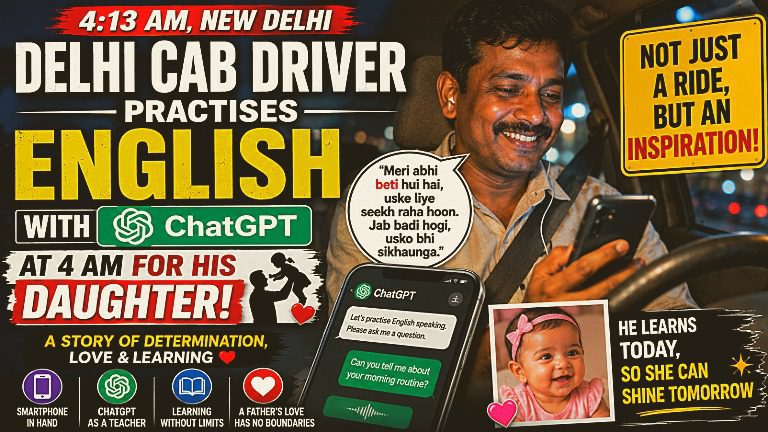
Delhi Cab Driver Uses ChatGPT at 4 AM to Learn English for His Newborn Daughter: A Story of AI, Ambition and Hope
A routine early-morning cab ride in Delhi turned into an unexpectedly inspiring story about artificial intelligence, education and a father’s determination to create better opportunities for his child.
Management consultant Tushar Jejani recently shared a LinkedIn post describing how he discovered that his cab driver was using ChatGPT to practise spoken English during the early hours of the morning.
What initially made Jejani curious — and even slightly uncomfortable — eventually became a conversation about learning, parenthood and the growing accessibility of AI-powered tools.
The driver’s motivation was particularly touching: he had recently become a father and wanted to learn English so he could eventually teach his daughter.
A 4:13 AM cab ride takes an unexpected turn
Delhi Cab Driver Uses ChatGPT at 4 AM to Learn English for His Newborn Daughter: A Story of AI, Ambition and Hope
According to Jejani’s account, the incident took place at around 4:13 AM in New Delhi.
During the journey, Jejani noticed that the driver appeared to be speaking English on his phone while describing his morning routine and information related to the ride.
At first, Jejani was unsure about what was happening. He wondered whether the driver might be speaking to another person and sharing details about the journey.
The situation became clearer when the driver noticed Jejani’s discomfort and began speaking directly with him.
The two continued talking for roughly 10 minutes.
Interestingly, the driver spoke in English while Jejani responded in Hindi.
The driver asked Jejani where he was travelling. Jejani replied that he was going to Bengaluru.
The driver then asked whether the journey was related to work or personal reasons.
Jejani answered with a smile that it was always for work.
Delhi Cab Driver Uses ChatGPT at 4 AM
But the conversation left one question unanswered: Who had the driver been speaking English with on his phone?
The surprising answer: ChatGPT
Eventually, Jejani asked the driver directly.
The answer surprised him.
The driver explained that he had not been talking to another person at all.
He had been using ChatGPT to practise speaking English.
According to Jejani’s account, the driver admitted that he was not yet fluent in English but was actively working on improving his speaking ability.
What made the explanation particularly meaningful was the reason behind his efforts.
The driver had recently become a father.
He wanted to learn English not simply for his own career or personal benefit, but because he hoped to teach the language to his daughter when she grew older.
That simple goal transformed an ordinary cab ride into a much more powerful story.
A father learning today for his daughter’s tomorrow
Learning a new language can be difficult, particularly for adults who may not have easy access to formal education, coaching classes or regular opportunities to practise speaking.
The driver’s approach was different.
He had a smartphone, access to an AI tool and the determination to learn.
Instead of waiting for the perfect circumstances, he was using the time available to him — even at 4 in the morning — to practise.
His motivation was also bigger than himself.
He wanted his daughter to grow up with an additional skill and hoped that his own learning could eventually help her.
The story therefore highlights how education can sometimes begin with a very simple decision: a person deciding that they want to learn something and taking the first step.
AI learning beyond offices and classrooms
Artificial intelligence is often discussed in the context of technology companies, software development, automation and corporate workplaces.
But stories like this demonstrate another possible dimension of AI: personal learning.
ChatGPT and similar AI tools can potentially provide people with opportunities to practise, ask questions and receive explanations without necessarily needing access to a traditional classroom.
In this case, the driver was using the technology as a conversational practice partner.
For someone trying to improve spoken English, having an interactive system available on a smartphone can provide an opportunity to practise repeatedly without the pressure of speaking in front of other people.
The driver could practise whenever he had time — even during the early hours of the morning.
“No coaching class. No gatekeeper.”
Reflecting on the encounter, Jejani focused on the accessibility of AI.
His broader observation was that modern technology can potentially put learning tools into the hands of people from very different social and economic backgrounds.
Traditional learning opportunities can sometimes involve tuition fees, travel, fixed schedules or access barriers.
AI-based tools can offer a different model.
A smartphone and an internet connection can potentially provide access to language practice, explanations, writing assistance and educational conversations.
That does not mean AI replaces teachers or formal education.
Instead, the incident illustrates how AI can become an additional learning resource for people who may otherwise have limited opportunities to practise.
Why the story resonated with LinkedIn users
Jejani’s post attracted attention from other LinkedIn users who saw the incident as an example of technology being used in an unexpected and deeply personal way.
Some commenters highlighted the importance of curiosity and intent.
The driver’s circumstances did not stop him from trying to improve his communication skills.
Instead, he found a tool that was available to him and started practising.
Others argued that some of AI’s most important applications may not necessarily happen inside technology companies or corporate offices.
They may happen in everyday situations — such as a worker learning a language, a student understanding a difficult subject or someone developing a new skill from their phone.
Another recurring theme in the reactions was accessibility.
AI can potentially reduce some of the barriers between people and information by making certain learning resources available directly through digital devices.
The bigger lesson behind a simple cab ride
The story is ultimately less about English and more about aspiration.
The driver was not described as someone chasing a viral moment or trying to impress a passenger.
He was simply trying to learn.
His reason was equally straightforward: he wanted to be better prepared for his daughter’s future.
That makes the incident an example of how personal ambitions and technology can intersect.
For one person, ChatGPT may be a tool for writing emails.
For another, it may be used to understand a complex topic.
For this Delhi cab driver, it became a way to practise English and prepare himself to teach his daughter one day.
AI as a tool for everyday people
The story also contributes to a much larger discussion about the changing role of artificial intelligence in everyday life.
As AI tools become increasingly accessible through smartphones and other devices, their use is moving beyond traditional technology audiences.
People can potentially use AI for language learning, interview preparation, writing, translation, study assistance and skill development.
The Delhi driver’s experience demonstrates this shift in a particularly relatable way.
He was not using AI to build a startup or automate a corporate process.
He was using it to learn a language at 4 AM.
That is a reminder that technological progress is not only about sophisticated machines or large companies.
Sometimes its impact can be measured by something much smaller: one person gaining the confidence to learn something new.
A lesson in determination
Perhaps the most memorable part of the story is the driver’s willingness to practise despite not being fluent.
Many people avoid speaking a new language because they are afraid of making mistakes.
The driver instead chose to practise with an AI system.
There was no audience judging his pronunciation and no classroom where he had to worry about making an error.
He could practise, make mistakes and try again.
And his ultimate motivation was his daughter.
That makes his effort a reminder that learning does not necessarily have to begin with perfect conditions.
It can begin with whatever resources are available.
The human side of artificial intelligence
AI discussions often focus on jobs, automation and the possibility of machines replacing human workers.
Jejani’s encounter offers a different perspective.
Here, AI was not being used to replace the cab driver.
It was being used by the driver as a learning assistant.
That distinction is important.
Technology can create disruption, but it can also provide new ways for people to acquire knowledge and improve their skills.
The driver’s story shows one such possibility in a remarkably simple setting.
A father’s message for the future
The Delhi cab driver’s early-morning English practice may appear to be a small event, but the motivation behind it gives the story its emotional impact.
He was learning today because he hoped to give his daughter something tomorrow.
He was using a modern AI tool to pursue a very traditional parental dream: to help the next generation have better opportunities.
The story also offers a broader message for anyone trying to learn something new.
You do not necessarily need an expensive course, a prestigious institution or a perfect schedule to begin.
Sometimes, you need curiosity, consistency and the willingness to start.
In this case, that beginning happened at 4:13 AM, inside a Delhi cab, with a smartphone and ChatGPT.
And perhaps the most powerful takeaway is exactly what Jejani concluded after the encounter:
FAQs
Q1. Why was the Delhi cab driver using ChatGPT?
According to the passenger’s account, the driver was using ChatGPT to practise speaking English and improve his fluency.
Q2. Why did the cab driver want to learn English?
The driver reportedly said he had recently become a father and wanted to learn English so that he could eventually teach his daughter.
Q3. At what time was the driver practising English?
The incident reportedly happened at around 4:13 AM, when the driver was using ChatGPT during the early-morning period.
Q4. Who shared the story?
Management consultant Tushar Jejani shared his experience in a LinkedIn post titled “4:13 am, New Delhi. A cab ride I will never forget.”
Q5. Was the cab driver speaking to another person?
No. According to Jejani’s account, the driver explained that he was not speaking with another person but was using ChatGPT to practise English.
Q6. How can ChatGPT help people learn English?
ChatGPT can be used as an interactive practice tool for conversations, vocabulary, sentence formation, explanations and other language-learning exercises.
Q7. Why did the story attract attention?
The story resonated with people because the driver was using AI not for a corporate task but for personal learning, with the goal of helping his newborn daughter in the future.
Q8. What is the broader lesson from the story?
The incident highlights how AI tools can potentially make learning resources more accessible to people who may not have access to traditional coaching or formal language classes.
Disclaimer
Disclaimer: This article is based on the account shared by management consultant Tushar Jejani regarding his interaction with a Delhi cab driver and the subsequent discussion around the driver’s use of ChatGPT. Details of the conversation are based on the reported LinkedIn account and may not independently verify every statement attributed to the driver. Roy Daily Update presents the story for informational purposes and does not guarantee that circumstances may not have changed after the original report.
Do Follow For More Info @ http://roydailyupdate.in
Do WhatsApp @ https://chat.whatsapp.com/K5POJK9KbpN8egjjOCaOw6
About the Author
Ravi is a digital content writer and blogger at Roy Daily Update, covering trending news, technology, artificial intelligence, jobs, business, Karnataka and Bengaluru updates, entertainment and important developments from India and around the world.
Ravi focuses on presenting stories in a simple, informative and reader-friendly format, highlighting the facts and human-interest elements that matter most to readers.