

Ebola Death Toll in Congo Reaches 600 as Virus Spreads to New Areas
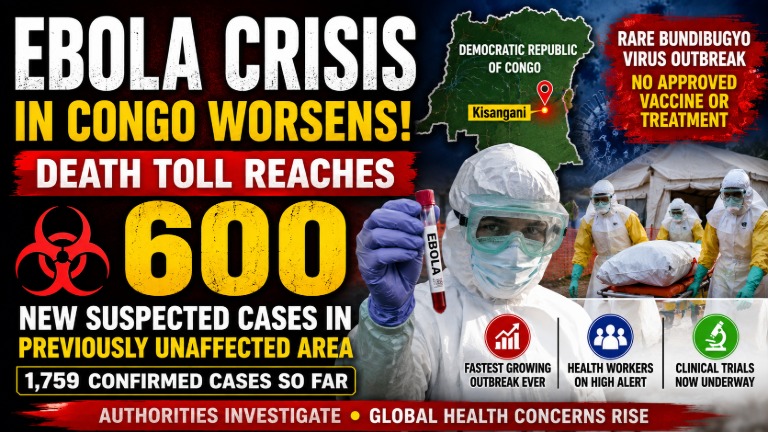
The Democratic Republic of Congo (DRC) is facing an increasingly serious public health emergency after the country’s latest Ebola outbreak claimed 600 lives, while health officials confirmed new suspected infections in areas that had previously remained untouched by the virus.
According to the latest government health report, authorities are investigating two suspected Ebola cases in Kisangani, located in Tshopo Province, marking the first possible infections reported outside the outbreak’s original epicenter.
The development has heightened concerns among health experts, who fear the virus could be expanding into new regions despite ongoing containment efforts.
Death Toll Continues to Rise
The Congolese government reported that the total number of confirmed Ebola infections has now increased to 1,759 cases, while the death toll has reached 600.
Health authorities continue intensive surveillance across affected provinces, tracing contacts and isolating suspected patients to prevent further transmission.
However, the appearance of possible cases in previously unaffected areas has raised fresh concerns about community transmission.
New Suspected Cases Detected in Kisangani
One of the most significant developments involves two suspected Ebola infections identified in Kisangani, one of the country’s major cities.
According to officials:
- One patient has been linked to the Nia-Nia Health Zone in Ituri Province, where the outbreak originally began.
- The second suspected patient has no known epidemiological connection to previously identified outbreak clusters.
Health investigators are now attempting to determine whether this represents an isolated incident or evidence that the virus has begun spreading through previously undetected transmission chains.
Outbreak Began Weeks Before Official Detection
The World Health Organization (WHO) confirmed that the outbreak was officially declared on May 15, 2026.
However, investigations later revealed that the virus had already been circulating within communities for several weeks before health authorities officially recognized the outbreak.
The delayed detection allowed additional infections to occur before emergency response teams were mobilized.
Public health experts say early detection remains one of the most important factors in controlling Ebola outbreaks.
Bundibugyo Ebola Virus Behind Current Outbreak
Unlike previous Ebola outbreaks in Africa, the current emergency is being caused by the Bundibugyo strain of the Ebola virus.
This particular strain is relatively rare compared to the more commonly known Zaire Ebola virus.
One major challenge facing health authorities is that:
- There is currently no fully approved vaccine specifically designed for the Bundibugyo strain.
- No licensed treatment exists exclusively for this virus variant.
As a result, healthcare workers must rely on supportive care, patient isolation, and experimental therapies while researchers continue clinical investigations.
Clinical Trials Offer Hope
Despite the worsening outbreak, there is cautious optimism among scientists.
Last week, international researchers officially launched clinical trials evaluating potential treatments against the Bundibugyo Ebola virus.
Medical experts hope the study will help identify therapies capable of reducing severe illness and lowering mortality rates.
Although the trials are still in the early stages, they represent one of the most significant scientific efforts launched during the current outbreak.
Researchers believe successful treatment options could dramatically improve future outbreak responses.
Why Containing Ebola Has Become Difficult
Health officials acknowledge that several factors have complicated containment efforts.
These include:
- Ongoing armed conflict in eastern Congo.
- Attacks on healthcare facilities.
- Limited healthcare infrastructure.
- Delayed detection of infections.
- Funding shortages affecting emergency operations.
- Population movement between affected regions.
Together, these challenges have allowed the virus to spread more rapidly than expected, making this one of Congo’s most difficult Ebola responses in recent years.
Why the Ebola Outbreak Is Raising Global Concern
Although the current Ebola outbreak is centered in the Democratic Republic of Congo (DRC), global health organizations are closely monitoring the situation because Ebola is one of the world’s deadliest infectious diseases.
The emergence of suspected cases in Kisangani, a region that had previously remained unaffected, has increased concerns that the virus could spread beyond its original hotspot if transmission chains are not quickly interrupted.
The World Health Organization (WHO) and international health partners continue supporting the Congolese government through surveillance, laboratory testing, contact tracing, and emergency medical response.
What Is Ebola?
Ebola Virus Disease (EVD) is a severe viral illness that affects humans and certain animals.
The virus is transmitted through direct contact with:
- Blood
- Body fluids
- Contaminated medical equipment
- Infected animals
Unlike airborne viruses, Ebola does not spread through casual contact or through the air.
However, once symptoms develop, infected individuals become highly contagious through bodily fluids, making rapid isolation extremely important.
Common Symptoms of Ebola
Symptoms generally appear between 2 and 21 days after exposure.
Early symptoms include:
- High fever
- Severe headache
- Muscle pain
- Fatigue
- Weakness
- Sore throat
As the disease progresses, patients may develop:
- Vomiting
- Diarrhea
- Abdominal pain
- Internal bleeding
- External bleeding in severe cases
- Organ failure
Without prompt medical treatment, Ebola can be fatal.
Why the Bundibugyo Virus Is Challenging
The current outbreak is caused by the Bundibugyo strain of the Ebola virus, one of the less common Ebola variants.
Unlike the Zaire Ebola strain—which has approved vaccines and treatment options—the Bundibugyo strain currently has:
- No licensed vaccine
- No approved targeted treatment
This makes outbreak control considerably more difficult and increases the importance of early detection, patient isolation, and supportive medical care.
Researchers are now conducting clinical trials in hopes of identifying effective therapies against this rare strain.
Conflict and Funding Shortages Slow Response
Health officials have repeatedly warned that the outbreak response is being complicated by multiple challenges.
These include:
- Armed conflict in eastern Congo.
- Attacks on healthcare workers and medical facilities.
- Difficult access to remote communities.
- Population displacement.
- Limited financial resources.
Several treatment centers have faced operational difficulties due to security concerns, making surveillance and patient care more challenging.
International humanitarian organizations continue to call for increased financial support to strengthen the response.
Can the Virus Be Contained?
Public health experts believe Ebola outbreaks can be controlled if response measures are implemented quickly.
The most effective containment strategies include:
- Early detection of cases.
- Immediate isolation of infected individuals.
- Contact tracing.
- Community awareness campaigns.
- Safe burial practices.
- Strong infection prevention measures.
The appearance of suspected infections in a previously unaffected province highlights the need for continued vigilance.
WHO Continues to Monitor the Situation
The World Health Organization continues working with Congolese authorities to:
- Monitor new infections.
- Expand laboratory testing.
- Strengthen surveillance systems.
- Support healthcare workers.
- Improve outbreak preparedness.
International health agencies have also increased monitoring at border crossings to reduce the risk of cross-border transmission.
At present, there is no indication of widespread international spread, but authorities remain alert due to the evolving situation.
Expert Analysis
The latest Ebola outbreak in the Democratic Republic of Congo demonstrates how quickly infectious diseases can escalate when early transmission goes undetected.
The detection of suspected cases in Kisangani is particularly significant because it may indicate that the virus has moved beyond previously identified outbreak zones.
Combined with the absence of an approved vaccine for the Bundibugyo strain, ongoing armed conflict, attacks on health facilities, and limited funding, the outbreak presents a complex humanitarian and public health challenge.
The launch of clinical treatment trials offers hope, but controlling the outbreak will depend largely on rapid surveillance, community cooperation, adequate funding, and sustained international support.
For now, global health experts emphasize that early intervention remains the most effective tool for preventing further spread.
Key Highlights
- 🦠 Congo’s Ebola outbreak has claimed 600 lives.
- 📍 New suspected Ebola cases have been detected in Kisangani, a previously unaffected area.
- 📊 Confirmed infections have reached 1,759 cases.
- 🧬 The outbreak is caused by the rare Bundibugyo Ebola virus.
- 💉 No approved vaccine currently exists for this strain.
- 🔬 Clinical trials for potential treatments have officially begun.
- 🌍 WHO and international health agencies continue supporting outbreak response efforts.
Frequently Asked Questions (FAQs)
How many people have died in the current Congo Ebola outbreak?
According to the latest official figures, the outbreak has resulted in 600 deaths.
Where were the new suspected Ebola cases found?
The latest suspected cases were reported in Kisangani, Tshopo Province, an area previously unaffected by the outbreak.
Which Ebola strain is causing the outbreak?
The outbreak is caused by the Bundibugyo strain of the Ebola virus.
Is there a vaccine for the Bundibugyo Ebola virus?
Currently, there is no approved vaccine or targeted treatment specifically for the Bundibugyo strain.
Why is the outbreak difficult to control?
Conflict, attacks on healthcare facilities, delayed detection, funding shortages, and the absence of a licensed vaccine have complicated response efforts.
Conclusion
The Ebola outbreak in the Democratic Republic of Congo has entered a critical phase, with the death toll reaching 600 and suspected infections emerging in regions previously untouched by the virus.
While ongoing clinical trials provide hope for future treatments, health authorities continue to face significant obstacles, including insecurity, limited healthcare resources, and the absence of an approved vaccine for the Bundibugyo strain.
The coming weeks will be crucial in determining whether intensified surveillance, international support, and public health interventions can successfully contain one of the most challenging Ebola outbreaks in recent years.
Disclaimer
This article is based on official updates from Congolese health authorities, the World Health Organization (WHO), and publicly available reports at the time of publication. The outbreak situation is evolving, and official figures may change as new cases are confirmed and investigations continue.
Do Follow For more Info @ http://roydailyupdate.in
Do Connect WhatsApp @ https://chat.whatsapp.com/K5POJK9KbpN8egjjOCaOw6