

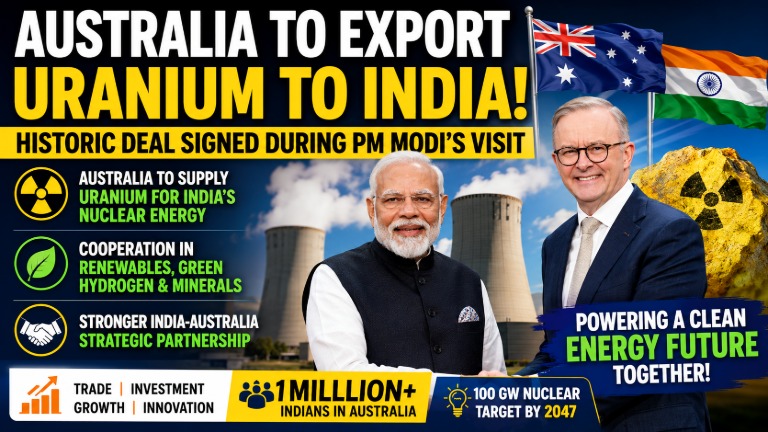

Australia to Export Uranium to India:
India and Australia have taken their strategic partnership to a new level after signing a landmark agreement that will allow Australia to export uranium to India for peaceful nuclear energy generation.
The agreement was finalised during Prime Minister Narendra Modi’s official visit to Melbourne, where he held bilateral talks with Australian Prime Minister Anthony Albanese. Apart from uranium exports, both nations agreed to deepen cooperation in renewable energy, green hydrogen, critical minerals, infrastructure development, and long-term investment.
The agreement is being viewed as one of the most significant milestones in India-Australia relations over the past decade and is expected to strengthen India’s energy security while opening new economic opportunities for Australia.
A Landmark Deal for India’s Energy Future
Australia possesses one of the world’s largest uranium reserves, while India has ambitious plans to significantly expand its nuclear energy capacity over the next two decades.
Under the new agreement, Australia will export uranium exclusively for India’s civilian nuclear energy programme.
The fuel will be used only for electricity generation and other peaceful purposes under internationally accepted safeguards.
The deal supports India’s long-term objective of achieving 100 Gigawatts (GW) of nuclear power capacity by 2047, forming an important part of the country’s clean energy transition strategy.
Why India Needs Australian Uranium
India’s electricity demand continues to rise rapidly due to:
- Population growth
- Industrial expansion
- Urbanisation
- Electric vehicle adoption
- Digital infrastructure
To reduce dependence on fossil fuels while ensuring reliable power generation, India has been aggressively expanding renewable energy sources such as solar and wind.
However, renewable energy alone cannot meet round-the-clock electricity demand.
Nuclear energy offers several advantages:
- Continuous power generation
- Low carbon emissions
- Energy security
- Reduced dependence on imported fossil fuels
Australia’s abundant uranium reserves make it a reliable long-term partner for India’s clean energy ambitions.
Australia Looks Beyond China
The agreement is equally important for Australia.
Although China remains Australia’s largest trading partner, Canberra has increasingly focused on diversifying its export markets amid changing geopolitical dynamics.
India, now one of the world’s fastest-growing major economies, represents a significant opportunity for Australian exports in sectors including:
- Critical minerals
- Energy resources
- Education
- Agriculture
- Infrastructure
- Technology
The uranium agreement provides Australia with an additional high-value export market while strengthening economic ties with one of the Indo-Pacific’s most influential nations.
Nuclear Cooperation Built on Earlier Agreements
India and Australia signed a Civil Nuclear Cooperation Agreement in 2014, laying the legal framework for uranium exports.
However, actual exports remained limited for several years because of concerns regarding the possible diversion of nuclear material.
The newly signed arrangement includes stronger safeguards to ensure Australian uranium is used exclusively for peaceful civilian nuclear applications.
Officials from both countries emphasised that the agreement fully complies with international nuclear safety and non-proliferation commitments.
PM Modi Highlights Historic Opportunities
Speaking after the bilateral meeting, Prime Minister Narendra Modi described the India-Australia partnership as entering a new era.
He said the relationship now presents “historic opportunities” across multiple sectors.
According to the Prime Minister, Australia’s strengths in:
- Technology
- Natural resources
- Capital investment
- Research
can significantly contribute to India’s economic transformation.
He also invited Australian businesses to participate in India’s rapidly expanding infrastructure projects, including highways, ports, railways, logistics corridors, smart cities, and urban development.
Modi assured investors that India offers a stable, transparent, and long-term growth environment backed by policy reforms and strong economic fundamentals.
Cooperation Beyond Uranium
While the uranium agreement attracted the most attention, both leaders also announced broader cooperation in several future-focused sectors.
The partnership will expand collaboration in:
Green Hydrogen
Both countries aim to accelerate the production and adoption of green hydrogen to reduce industrial carbon emissions.
Critical Minerals
Australia is one of the world’s leading producers of lithium and other minerals essential for electric vehicles, batteries, and renewable energy technologies.
India plans to strengthen supply chains by increasing imports and joint investments in these strategic minerals.
Renewable Energy
The two countries agreed to deepen cooperation in solar energy, wind power, battery storage, and emerging clean-energy technologies.
Low-Carbon Manufacturing
Prime Minister Modi also indicated that India and Australia could collaborate on producing low-carbon aluminium and other environmentally sustainable industrial products.
AustralianSuper Announces Fresh Investment
One of the major announcements accompanying the visit came from AustralianSuper, Australia’s largest pension fund.
The fund announced an additional investment of A$500 million in India’s National Investment and Infrastructure Fund (NIIF).
This investment is expected to support projects in:
- Roads
- Airports
- Renewable energy
- Urban infrastructure
- Logistics
Anthony Albanese Calls PM Modi a “Living Bridge” Between India and Australia

Australian Prime Minister Anthony Albanese described Prime Minister Narendra Modi as a “living bridge” connecting India and Australia, highlighting the Indian leader’s role in strengthening bilateral relations over the past decade.
Speaking after the bilateral talks in Melbourne, Albanese said India’s rise as a global economic power presents enormous opportunities for Australian businesses, investors, universities, and technology companies.
He noted that Modi’s leadership has helped transform the India-Australia relationship from a traditional diplomatic partnership into a comprehensive strategic alliance spanning trade, defence, education, clean energy, and innovation.
According to Albanese, both democracies share common values, support a free and open Indo-Pacific, and are committed to building resilient supply chains in an increasingly uncertain global environment.
PM Modi Addresses Thousands of Indians in Melbourne
Following the official meetings, Prime Minister Modi addressed nearly 30,000 members of the Indian diaspora at a community event in Melbourne.
The gathering reflected the growing strength of the Indian community in Australia, with thousands waving Indian flags and chanting “Modi, Modi” as the Prime Minister arrived.
During his address, Modi thanked the Indian community for acting as the strongest link between both nations.
He said the Indian diaspora has played a major role in enhancing cultural, educational, and economic ties between India and Australia.
Recalling his previous visits, Modi said this was his third visit to Australia as Prime Minister, following earlier visits in 2014 and 2023.
He described the occasion as a “hat-trick” visit, saying it demonstrated how rapidly India-Australia relations have grown over the past decade.
Victoria Government Reaffirms Support for India
Victoria Premier Jacinta Allan also addressed the gathering and praised the deep relationship between Victoria and India.
She said the state welcomes:
- Indian students
- Indian entrepreneurs
- Skilled professionals
- Families
- Investors
According to Allan, India is not merely a trading partner but a trusted long-term strategic partner.
She emphasized that Victoria remains committed to strengthening educational exchanges, business collaboration, and technological partnerships with India.
Large Indian Community Strengthens Bilateral Relations
Australia is home to nearly one million people of Indian origin, making it one of the country’s fastest-growing communities.
The Indian diaspora contributes significantly to:
- Healthcare
- Information Technology
- Engineering
- Education
- Small businesses
- Scientific research
Analysts believe the growing Indian community has become an important pillar of bilateral diplomacy, helping deepen people-to-people connections beyond government-level cooperation.
Trade Between India and Australia Continues to Expand
Economic ties between the two countries have grown steadily in recent years.
According to official data:
- Bilateral trade reached approximately $28.15 billion during 2024–25.
- India is Australia’s fifth-largest trading partner.
- Australia remains an important supplier of minerals, coal, education services, and agricultural products to India.
The new uranium agreement is expected to further diversify bilateral trade and create additional opportunities in energy, manufacturing, and infrastructure.
Why the Uranium Agreement Is Strategically Important
Experts believe the agreement carries significance beyond energy cooperation.
1. Energy Security
Reliable uranium supplies will help India diversify its energy sources while reducing dependence on fossil fuels.
2. Climate Goals
Nuclear energy produces low-carbon electricity, supporting India’s commitment to reducing emissions and expanding clean energy capacity.
3. Indo-Pacific Cooperation
The agreement strengthens cooperation between two major Indo-Pacific democracies amid evolving regional geopolitical dynamics.
4. Economic Benefits
Australian mining companies gain access to one of the world’s fastest-growing energy markets, while India secures a stable source of nuclear fuel.
5. Supply Chain Diversification
The partnership complements ongoing cooperation in critical minerals required for batteries, electric vehicles, semiconductors, and renewable energy technologies.
Challenges Ahead
While the agreement marks a significant breakthrough, several implementation details remain to be finalised.
Both governments have yet to announce:
- Export timelines
- Annual uranium supply volumes
- Commercial pricing
- Long-term delivery schedules
Industry experts also expect detailed regulatory frameworks and technical protocols to be established before large-scale shipments begin.
Expert Analysis
The India-Australia uranium agreement represents one of the most strategically significant outcomes of Prime Minister Narendra Modi’s Australia visit.
Rather than being limited to uranium exports, the agreement reflects a broader shift toward comprehensive cooperation in clean energy, advanced manufacturing, infrastructure, critical minerals, and investment.
For India, the partnership supports its ambitious target of achieving 100 GW of nuclear power capacity by 2047, helping strengthen long-term energy security while advancing climate commitments.
For Australia, the deal opens a valuable export market and reduces overdependence on traditional trading partners by expanding economic engagement with one of the world’s fastest-growing major economies.
Combined with growing investment flows, expanding diaspora connections, and increasing strategic cooperation in the Indo-Pacific, the agreement marks another milestone in the rapidly evolving India-Australia Comprehensive Strategic Partnership.
Key Highlights
- 🇮🇳 India and Australia signed a landmark uranium export agreement.
- ☢️ Australian uranium will be used exclusively for India’s peaceful nuclear energy programme.
- ⚡ The deal supports India’s target of 100 GW nuclear power capacity by 2047.
- 🌱 Both nations agreed to strengthen cooperation in renewable energy, green hydrogen, and critical minerals.
- 💰 AustralianSuper announced an additional A$500 million investment in India’s infrastructure fund.
- 🤝 PM Albanese described Narendra Modi as a “living bridge” between the two nations.
- 🌏 The agreement further strengthens Indo-Pacific strategic cooperation.
Frequently Asked Questions (FAQs)
Why is Australia exporting uranium to India?
Australia will export uranium to support India’s civilian nuclear energy programme under a peaceful-use agreement.
Will the uranium be used for military purposes?
No. The agreement specifies that Australian uranium will be used exclusively for peaceful civilian nuclear energy generation.
What is India’s nuclear energy target?
India aims to achieve 100 GW of nuclear power capacity by 2047 as part of its clean energy strategy.
What other agreements were signed?
Both countries expanded cooperation in renewable energy, green hydrogen, critical minerals, infrastructure investment, and low-carbon manufacturing.
Why is this agreement important?
The partnership strengthens India’s energy security, supports climate goals, boosts bilateral trade, and enhances strategic cooperation in the Indo-Pacific region.
Conclusion
The landmark uranium export agreement between India and Australia marks a new chapter in bilateral relations, reflecting shared ambitions for sustainable development, energy security, and economic growth.
As India accelerates its transition toward cleaner energy and Australia seeks to diversify its export markets, the partnership offers long-term benefits for both nations. Beyond uranium, cooperation in green hydrogen, critical minerals, infrastructure, and technology is expected to deepen further, reinforcing the Comprehensive Strategic Partnership and contributing to a stable, prosperous Indo-Pacific region.
Disclaimer
This article is based on publicly available reports and official statements available at the time of publication. Details regarding commercial arrangements, export schedules, and implementation may evolve as both governments finalize operational agreements. Readers should refer to official government announcements for the latest updates.
Do Follow For More Info @ http://roydailyupdate.in
Do Connect WhatsApp @ https://chat.whatsapp.com/K5POJK9KbpN8egjjOCaOw6