

Bengaluru Voter List SIR 2026: Nearly Half of Electors Flagged Under ASDDO Category;
Bengaluru, August 7, 2026: Nearly half of Bengaluru’s electors have been flagged under the ASDDO/uncollected category during Karnataka’s ongoing Special Intensive Revision (SIR) of electoral rolls, putting the city at the centre of attention as election officials work to verify voter records ahead of the revised electoral-roll publication schedule.
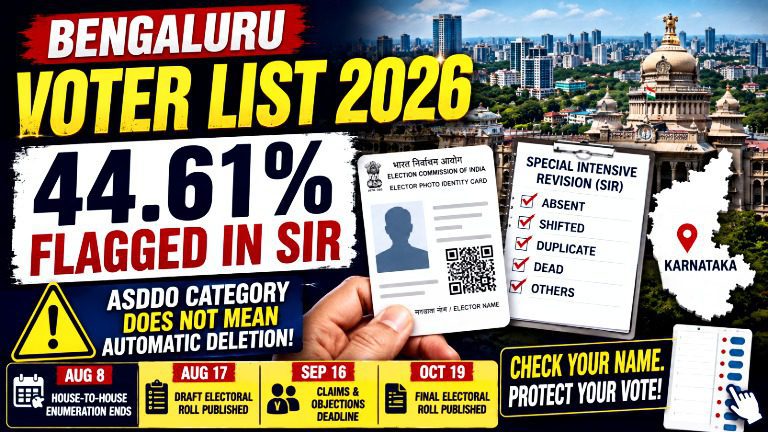
According to the latest figures cited by NDTV from the Chief Electoral Officer’s data, Bangalore Urban district has around 40.21 lakh electors, of whom enumeration forms for 55.39% have been digitised. The remaining 44.61%, or about 17.93 lakh electors, have been classified under the ASDDO or uncollected category.
The situation is even more pronounced across the three BBMP zones. BBMP South has the highest proportion of electors in the flagged category, followed by BBMP Central and BBMP North.
However, voters should not interpret the ASDDO classification as an immediate deletion notice.
Election officials have specifically clarified that being categorised as Absent, Shifted, Duplicate, Dead or Others does not automatically mean that a person’s name will disappear from the electoral roll.
The ongoing process is intended to identify records that require verification, correction or further action.
What Is SIR and Why Is It Being Conducted?
SIR stands for Special Intensive Revision of electoral rolls.
Unlike a routine electoral-roll update, the exercise involves a more extensive verification process, including house-to-house enumeration by Booth Level Officers (BLOs).
The purpose is to identify inaccuracies and ensure that electoral rolls contain eligible voters while removing records that may no longer be valid.
During the process, officials collect and digitise enumeration forms and identify records requiring additional verification.
The exercise is particularly important in a rapidly growing city such as Bengaluru, where large numbers of residents move between neighbourhoods, constituencies and even states for employment, education and other reasons.
Migration can create difficulties in maintaining accurate electoral records.
A voter may have shifted permanently but remained registered at an earlier address. Another voter may have been enrolled in more than one location. Records may also remain in electoral rolls after a person’s death if the information has not been updated.
The SIR process is designed to address these issues.
Why Bengaluru Has Such a High Number of Flagged Voters
Bengaluru’s unusually high ASDDO/uncollected numbers have attracted attention because the city has a highly mobile population.
People regularly move into the city for jobs, education and business.
At the same time, many residents retain links to their hometowns and may continue to have voter registration at an earlier address.
This can create discrepancies between where a person currently lives and where their name appears on an electoral roll.
The city’s rapid urban expansion also adds another layer of complexity.
Administrative boundaries, polling stations and residential patterns have changed over time, while many people have changed addresses without immediately updating their electoral information.
Therefore, a high number of flagged records does not automatically indicate that all those voters are ineligible.
Instead, it shows that a significant number of records require verification or could not be conclusively processed during the enumeration stage.
BBMP South Records the Highest Proportion
The latest figures show significant differences across Bengaluru’s three BBMP zones.
BBMP South has recorded the highest proportion of electors under the ASDDO or uncollected category, at approximately 51.18%.
That represents around 10.97 lakh electors.
BBMP Central has approximately 47.85% of its electors in the category, equivalent to around 9.04 lakh voters.
BBMP North has approximately 46.95%, representing around 10.95 lakh electors.
These figures are substantially higher than Karnataka’s overall ASDDO/uncollected share of around 19.93%, according to the latest figures reported by NDTV.
The gap between Bengaluru and the statewide average is one reason the city has emerged as a major focus of the SIR exercise.
ASDDO Does Not Mean Automatic Deletion
This is the most important point for Bengaluru voters.
Being marked under ASDDO does not itself constitute a final decision to remove a person’s name from the electoral roll.
The category is used during the verification exercise to identify records associated with circumstances such as a voter being absent, having shifted permanently, appearing to be deceased, already being enrolled elsewhere or falling into another category requiring examination.
Election authorities have said incorrect markings can be corrected.
BLOs and Electoral Registration Officers have been given an opportunity to rectify erroneous ASDDO classifications during the ongoing enumeration stage. The current house-to-house exercise is scheduled to conclude on August 8.
This means voters who believe their records have been incorrectly flagged should not panic.
Instead, they should verify their electoral details and contact the appropriate election officials if corrections are required.
What Does ASDDO Stand For?
The term can appear confusing to voters.
ASDDO broadly refers to categories involving:
A — Absent: The voter could not be found or contacted during the enumeration process.
S — Shifted: The voter appears to have permanently moved from the registered address.
D — Duplicate: The voter may already be registered at another location.
D — Dead: The record is associated with a person reported to be deceased.
O — Others: Records that do not fit neatly into the primary categories but require further attention.
The classification is therefore primarily a tool used during electoral-roll verification.
It should not be interpreted as a final judgement on a person’s eligibility to vote.
Karnataka’s Overall SIR Numbers
Bengaluru’s numbers need to be viewed against the statewide picture.
Karnataka has approximately 5.54 crore electors.
The latest data cited in the report indicates that nearly all enumeration forms have been digitised or otherwise accounted for during the ongoing exercise, while about 19.93%, or approximately 1.1 crore electors, are currently classified under the ASDDO/uncollected category.
The largest category among the flagged records is permanently shifted voters.
According to the reported figures, approximately:
66.43 lakh voters are classified as permanently shifted
16.32 lakh records are associated with deceased electors
16.12 lakh are untraceable or absent
6.93 lakh are already enrolled elsewhere
4.67 lakh fall under other categories
These figures show that voter movement is a major factor behind the large number of records requiring verification.
Why Permanently Shifted Voters Matter
Migration is one of the biggest challenges for electoral-roll management in rapidly developing urban centres.
A person may have moved from one district to another or from another state to Bengaluru but may not have transferred their electoral registration.
Similarly, people who leave Bengaluru permanently may continue to appear on the city’s electoral roll.
If such records remain unchanged for long periods, electoral rolls can become outdated.
SIR attempts to identify these cases so that the rolls can be corrected.
However, the process must also protect genuine voters who are temporarily away from their registered residence.
For example, students, employees working in another city and people travelling for extended periods should not automatically lose their electoral registration simply because they were unavailable during a house visit.
That is why verification and correction opportunities are important.
What Should Bengaluru Voters Do?
Voters should first verify their electoral information rather than assuming their name has been deleted.
If the voter has completed the enumeration process correctly, they should retain any acknowledgement or confirmation available to them.
If the voter believes their record has been incorrectly marked, they should contact their BLO or the relevant Electoral Registration Officer.
The voter should also ensure that their name, address and other electoral details are correct.
People who have permanently moved may need to follow the appropriate procedure for updating their electoral registration rather than maintaining registrations at multiple addresses.
Election Commission Provides Form 6 for Fresh Enrolment
The Election Commission has also taken steps to facilitate fresh voter enrolment in Bengaluru.
According to the report, around 10 lakh copies of Form 6 have been supplied to Electoral Registration Officers across BBMP and the Greater Bengaluru area.
Form 6 is used for applying for inclusion of a person’s name in the electoral roll.
This is particularly relevant for eligible citizens who are not currently registered as voters.
The availability of Form 6 is also important in the context of the SIR exercise because the revision process is not solely about identifying potentially invalid records.
It also provides an opportunity to ensure that eligible citizens are included in the electoral roll.
Large Number of Applications Received
The scale of voter-related activity can also be seen in the number of applications submitted during the SIR period.
Between June 16 and August 5, the Election Commission received approximately 12.32 lakh applications under Forms 6, 6A, 7 and 8 across Karnataka for inclusion, deletion and correction of electoral records, according to the latest report.
The different forms serve different purposes in the electoral-roll system.
This level of activity demonstrates that many voters are actively seeking to update their records while the revision exercise is underway.
Karnataka SIR Deadline: August 8
The current stage of the SIR exercise has an important deadline.
The Election Commission extended Karnataka’s house-to-house enumeration phase, with BLO visits now scheduled to continue until August 8, 2026. The earlier deadline had been July 29.
The extension was intended to give voters and BLOs additional time to complete the exercise.
For voters who have not yet completed the required process or who need to resolve a discrepancy, the deadline is therefore particularly important.
When Will the Draft Electoral Roll Be Published?
The revised schedule provides several important dates for voters.
The draft electoral roll is scheduled to be published on August 17, 2026.
After publication of the draft roll, voters will have an opportunity to submit claims and objections.
The claims-and-objections period is scheduled to continue until September 16.
Following scrutiny and disposal of claims and objections, the final electoral roll is scheduled for publication on October 19, 2026.
These dates are important because the current ASDDO figures should not be confused with the final electoral roll.
The process is still underway.
What If Your Name Is Missing From the Draft Roll?
If a voter’s name does not appear in the draft electoral roll when it is published, the voter should not assume that there is no remedy.
The claims-and-objections stage is specifically designed to allow citizens and stakeholders to raise concerns about electoral-roll entries.
A voter whose name has been incorrectly omitted should follow the official process for seeking inclusion or restoration.
This makes it particularly important for voters to check the draft roll after its publication.
Why the Final Roll Matters
The final electoral roll will be the outcome of the verification, correction and claims process.
Until that stage is completed, the numbers being reported under ASDDO should be viewed as part of an ongoing administrative exercise rather than a final list of voters who will be removed.
This distinction is critical.
Headlines suggesting that nearly half of Bengaluru voters are definitely going to lose their voting rights would be misleading.
The available data shows that nearly half of the city’s electors have been placed in an ASDDO/uncollected category during the current exercise—not that half of Bengaluru’s voters have been finally deleted.
Bengaluru’s Voter Verification Challenge
The unusually high figures underline a broader challenge for Bengaluru.
The city is one of India’s fastest-growing metropolitan regions and has a highly mobile workforce.
People frequently change rental homes, move between neighbourhoods and relocate between Bengaluru and their hometowns.
Keeping electoral records accurate in such an environment requires continuous updating.
SIR is therefore not simply a one-time deletion exercise.
Ideally, it should help create cleaner electoral rolls while ensuring that eligible voters are not wrongly excluded.
What Voters Should Remember
For Bengaluru residents, the most important points are straightforward.
ASDDO does not automatically mean deletion.
The current enumeration phase continues until August 8.
The draft electoral roll is scheduled for August 17.
Claims and objections can be submitted after the draft roll is published.
The final electoral roll is scheduled for October 19.
Voters should verify their names and details rather than relying solely on social-media messages or headlines.
Bengaluru SIR 2026: Key Numbers at a Glance
Area Electors/Flagged Data
Bangalore Urban electors 40.21 lakh
Bangalore Urban ASDDO/uncollected 17.93 lakh
Bangalore Urban share 44.61%
BBMP South flagged 51.18%
BBMP Central flagged 47.85%
BBMP North flagged 46.95%
Karnataka total electors 5.54 crore
Karnataka ASDDO/uncollected About 1.1 crore
Karnataka share 19.93%
House-to-house SIR deadline August 8, 2026
Draft electoral roll August 17, 2026
Claims/objections deadline September 16, 2026
Final electoral roll October 19, 2026
The figures above are based on the latest data reported in connection with the ongoing SIR exercise and the revised electoral-roll schedule.
Conclusion
The latest SIR data has placed Bengaluru under the spotlight, with nearly half of the city’s electors currently appearing under the ASDDO or uncollected classification.
But the headline number requires important context.
Being placed in the ASDDO category does not automatically mean that a voter will be removed from the electoral roll.
The classification is part of an ongoing verification process designed to identify voters who may have shifted, may be duplicated, may be deceased, may be absent or whose records require further examination.
With the house-to-house phase continuing until August 8, voters still have an opportunity to ensure their records are correctly represented.
The next major milestone will be the publication of the draft electoral roll on August 17. Citizens should then carefully check whether their names and details appear correctly and use the claims-and-objections process if necessary.
For Bengaluru, the challenge is particularly significant because of the city’s enormous population mobility. The success of the SIR exercise will ultimately depend on striking the right balance: removing genuinely invalid records while ensuring that no eligible voter is wrongly excluded.
For now, Bengaluru voters should verify rather than panic.
The ASDDO figure is significant, but it is not the final electoral-roll outcome.
What Bengaluru’s SIR Numbers Actually Mean
The headline figure — nearly half of Bengaluru’s electors falling under ASDDO/uncollected categories — is significant, but it needs to be understood carefully. The latest data does not mean that 44%–51% of Bengaluru voters have already been removed from the electoral roll. The classification is part of an ongoing verification exercise, and officials have explicitly said incorrect ASDDO markings can be corrected.
1. Why Bengaluru’s Numbers Are Much Higher Than Karnataka’s Average
Bengaluru’s ASDDO/uncollected share is substantially above Karnataka’s statewide figure of about 19.93%. Bangalore Urban has around 40.21 lakh electors, with 17.93 lakh currently in the ASDDO/uncollected category.
There are several practical reasons why a large metropolitan area can produce more records requiring verification.
Bengaluru has a highly mobile population. Thousands of people move every year because of employment, education, business, marriage and housing changes. A voter who was registered at one address several years ago may now live somewhere else without having transferred the registration.
The reverse can also happen. Someone may move to Bengaluru temporarily for work while retaining their permanent residence elsewhere.
This creates a challenge for electoral authorities because the voter database has to distinguish between a person who has temporarily moved and someone who has permanently shifted.
That distinction is especially important during a house-to-house exercise.
2. BBMP South Is the Biggest Area of Concern
Among Bengaluru’s three BBMP zones, BBMP South has the highest proportion of electors classified under ASDDO/uncollected — 51.18%, according to the latest figures.
BBMP Central follows at 47.85%, while BBMP North stands at 46.95%.
These percentages naturally attract attention because they are close to or above the halfway mark.
However, the figures should not be interpreted as “half of the voters are fake” or “half of the voters have been deleted.” Such an interpretation goes beyond what the data establishes.
The classification simply indicates that the enumeration form was not successfully processed in the normal manner or that the record has been identified for further categorisation or verification.
3. Permanently Shifted Voters Are the Largest Category
At the Karnataka level, permanently shifted voters represent the largest portion of the ASDDO/uncollected category.
The latest figures cited by NDTV put permanently shifted voters at approximately 66.43 lakh statewide. This is considerably higher than the other individual categories.
This is important because migration is a normal feature of India’s urban economy.
A voter moving from Hubballi to Bengaluru, Bengaluru to Mysuru, or Karnataka to another state does not necessarily update their electoral registration immediately.
Similarly, people who leave Bengaluru after several years may continue to have their names associated with their former polling station.
The SIR exercise is therefore attempting to identify such discrepancies.
4. What Happens After the ASDDO Classification?
The process does not end with the ASDDO classification.
According to the latest reporting, BLOs and Electoral Registration Officers have an opportunity to correct erroneous ASDDO markings until August 8, when the current house-to-house enumeration and digitisation phase concludes.
This is why voters should distinguish between:
ASDDO/uncollected status → verification stage
and
Final deletion from electoral roll → later administrative decision following the prescribed process
The two are not the same.
This distinction should be prominently explained whenever the Bengaluru figures are reported because a misleading interpretation could unnecessarily alarm legitimate voters.
5. The August 8 Deadline Is Important
The current house-to-house stage is scheduled to conclude on August 8, 2026.
The Election Commission had earlier extended Karnataka’s SIR timeline. Under the revised schedule, BLO house-to-house visits were extended from the earlier July 29 deadline to August 8.
That extension is particularly relevant for Bengaluru because the city’s large and mobile population makes door-to-door verification more complicated.
The extension gives officials additional time to complete enumeration and allows voters more opportunity to address problems.
6. What Happens on August 17?
The next major milestone will be the publication of the draft electoral roll on August 17, 2026.
This is the stage when voters should pay close attention.
The draft roll will provide a clearer picture of which names remain on the electoral register after the initial enumeration and verification exercise.
If an eligible voter’s name is missing or information is incorrect, the claims-and-objections process becomes particularly important.
The revised schedule provides a claims-and-objections window running until September 16, while disposal of claims and objections is scheduled to continue through October 15. The final electoral roll is scheduled for October 19, 2026.
7. SIR Is Not Just About Deleting Names
Another important point is that electoral-roll revision has two sides.
One side involves identifying records that may no longer be valid.
The other involves ensuring that eligible citizens who are missing from the electoral roll can be enrolled.
The Election Commission has reportedly supplied 10 lakh Form 6 copies to Electoral Registration Officers across BBMP and the Greater Bengaluru area to facilitate fresh enrolment.
Form 6 is particularly relevant to eligible citizens who have never been registered as voters or who need to seek inclusion in the electoral roll.
This means the SIR process should not be viewed exclusively as a deletion exercise.
It is also an opportunity to update and strengthen the electoral database.
8. More Than 12 Lakh Applications Filed Across Karnataka
The level of public participation is also reflected in the number of applications submitted.
Between June 16 and August 5, approximately 12.32 lakh applications under Forms 6, 6A, 7 and 8 were received across Karnataka for inclusion, deletion and correction of electoral records, according to the latest report.
That figure indicates substantial activity around the electoral rolls.
For voters, the lesson is straightforward: if a record needs to be corrected, the electoral-roll system provides formal mechanisms for making that request.
9. Why Voters Should Not Rely on WhatsApp Messages
The Bengaluru SIR controversy is likely to generate a large amount of social-media discussion because the numbers are unusually high.
But voters should be careful about messages claiming that:
“Half of Bengaluru voters have been deleted.”
“Everyone in the ASDDO list has lost voting rights.”
“ASDDO means your voter ID is cancelled.”
“You cannot restore your name after August 8.”
Such statements can oversimplify the process.
The latest official-position reporting makes clear that an ASDDO classification itself does not automatically result in deletion.
Voters should instead rely on the Election Commission, Karnataka Chief Electoral Officer and authorised electoral officers for information about their individual records.
10. Bengaluru’s High Migration Rate Is a Major Factor
The city’s demographic structure provides useful context.
Bengaluru is home to a large population of people who were born outside the city or who have moved between different parts of Karnataka and India.
Rental housing is also extremely common.
A person might move several times within the same constituency without updating their electoral information.
Others may move between constituencies.
For example, someone who lived in Whitefield may later move to Electronic City, Yelahanka or another part of Bengaluru.
If the electoral registration is not updated, the person’s record can remain linked to an earlier address.
A large-scale verification exercise is therefore likely to identify many such cases.
11. The Bigger Challenge: Protecting Genuine Voters
While maintaining accurate electoral rolls is important, the other side of the exercise is equally important: eligible voters should not be wrongly excluded.
This is particularly relevant in Bengaluru.
A voter may be temporarily absent when a BLO visits.
Students may be away from home.
Employees may be travelling.
People may be working night shifts or living temporarily at another address.
Families may also be away during the enumeration period.
Therefore, a missed house visit should not automatically be interpreted as proof that the person is no longer eligible to vote.
The subsequent verification and claims process is crucial for resolving such cases.
12. Why the Draft Roll Will Be More Important Than Today’s ASDDO Figure
The current ASDDO numbers are attracting attention because they are available before the draft electoral roll is published.
But from a voter’s perspective, the August 17 draft roll will be more important.
That is when citizens can check whether their names and details appear correctly after the enumeration stage.
The current figures should therefore be treated as an indication of the scale of records requiring attention, rather than as a prediction of the final number of deletions.
13. The Final Roll Is Expected on October 19
The entire process is scheduled to culminate in the publication of the final electoral roll on October 19, 2026.
That gives authorities several weeks after the draft publication to process claims and objections.
The Karnataka High Court also recently dealt with a plea seeking a longer SIR timeline. The court did not direct the Election Commission to extend the schedule, noting that the ECI is the specialised authority conducting the exercise.
This means the existing schedule remains especially important for voters.
14. What Bengaluru Voters Should Do Now
For residents of Bengaluru, the practical approach is simple:
First, verify your voter registration.
Do not wait until election day to discover that your details require correction.
Second, check your address.
If you have permanently moved, make sure your electoral registration reflects your current eligible constituency.
Third, respond if contacted by election officials.
If a BLO requires clarification or verification, provide the necessary information through the authorised process.
Fourth, check the draft electoral roll after August 17.
This will be one of the most important steps for voters.
Fifth, use the claims-and-objections mechanism if necessary.
If your name is missing despite being an eligible voter, or if your details are incorrect, use the prescribed process rather than relying on informal complaints.
15. What This Means for Bengaluru Ahead
The Bengaluru SIR figures highlight the difficulty of maintaining electoral databases in rapidly expanding cities.
The challenge is not unique to Bengaluru.
Urbanisation, migration and frequent changes of residence can make electoral-roll management increasingly complex.
But Bengaluru’s unusually high ASDDO/uncollected numbers make the city a particularly important test case for the current exercise.
The ultimate measure of success will not simply be how many records are removed.
It will be whether the final electoral roll is accurate, inclusive and capable of reflecting genuine eligible voters.
For now, the key message for Bengaluru residents is clear:
Do not panic because your record appears under ASDDO/uncollected.
Instead, verify your status, correct any errors through the official process and check the draft electoral roll when it is published.
Bengaluru SIR Timeline
Date What Happens
August 8, 2026 House-to-house enumeration phase ends
August 17, 2026 Draft electoral roll scheduled
August 17–September 16 Claims and objections
August 17–October 15 Disposal of claims and objections
October 19, 2026 Final electoral roll scheduled
The revised Karnataka schedule is supported by reporting from The Indian Express and the Election Commission’s published SIR schedule documents.
Bottom Line
Bengaluru’s SIR numbers are undeniably large, but the phrase “nearly half of Bengaluru voters face deletion” needs qualification.
The available data shows that a large proportion of electors are currently classified under ASDDO/uncollected categories during the enumeration process. It does not establish that all those voters will ultimately be deleted.
The next crucial stage is the draft electoral roll on August 17.
For Bengaluru voters, checking the draft roll and using the official claims-and-objections process, if required, will be far more important than reacting to preliminary ASDDO figures circulating online.
The biggest takeaway: ASDDO is a verification flag, not an automatic deletion order.
Bengaluru SIR 2026 FAQs
What is SIR in Karnataka?
SIR stands for Special Intensive Revision of electoral rolls. It is an extensive verification exercise designed to update electoral records and identify discrepancies in voter lists.
What does ASDDO mean in the voter list?
ASDDO refers to categories including Absent, Shifted, Duplicate, Dead and Others. It is used during the verification process to identify records requiring further examination.
Does ASDDO mean my voter name will be deleted?
No. Being classified under ASDDO or uncollected does not automatically mean that a voter’s name will be deleted from the electoral roll.
How many Bengaluru voters are currently under the ASDDO/uncollected category?
According to the reported latest figures, around 17.93 lakh electors in Bangalore Urban are classified under the ASDDO/uncollected category, representing approximately 44.61% of the district’s electors.
Which Bengaluru zone has the highest ASDDO percentage?
BBMP South has the highest reported proportion, at approximately 51.18%, followed by BBMP Central at 47.85% and BBMP North at 46.95%.
When will the Karnataka draft electoral roll be published?
The draft electoral roll is scheduled to be published on August 17, 2026.
When is the final Karnataka electoral roll expected?
The final electoral roll is scheduled to be published on October 19, 2026.
What should I do if my name is missing from the draft roll?
Check the official claims-and-objections process after publication of the draft roll and contact the appropriate electoral authorities or Booth Level Officer for assistance.
What is Form 6 used for?
Form 6 is used by eligible citizens to apply for inclusion of their name in the electoral roll.
Why are so many Bengaluru voters classified as shifted or uncollected?
Bengaluru has a highly mobile population, with residents frequently moving for employment, education, housing and other reasons. This can result in electoral records remaining associated with previous addresses.
Disclaimer
Disclaimer: This article is intended for informational and educational purposes only. Electoral-roll data, SIR classifications, deadlines and government procedures may change as the revision process progresses. The ASDDO/uncollected classification should not be interpreted as an automatic deletion of a voter’s name. Readers should verify their individual electoral status through official Election Commission or Karnataka election authorities and follow the prescribed procedure for corrections, claims or objections. Roy Daily Update does not guarantee the completeness or accuracy of third-party information reproduced for reporting purposes and is not responsible for decisions taken solely on the basis of this article.
Do Follow For More Info @ http://roydailyupdate.in
Do WhatsApp @ https://chat.whatsapp.com/K5POJK9KbpN8egjjOCaOw6
About the Author
Ravi H Irannanavar is a blogger and digital content creator who covers breaking news, Karnataka updates, government announcements, recruitment news, business developments, stock-market updates, technology, sports and major national and international events.
Through Roy Daily Update, Ravi focuses on presenting important developments in a simple, reader-friendly format while providing relevant background and context. His articles are prepared using information from credible news reports, official announcements and publicly available sources.
The goal is to help readers understand not only what happened, but also why the development matters and what they should know next.