

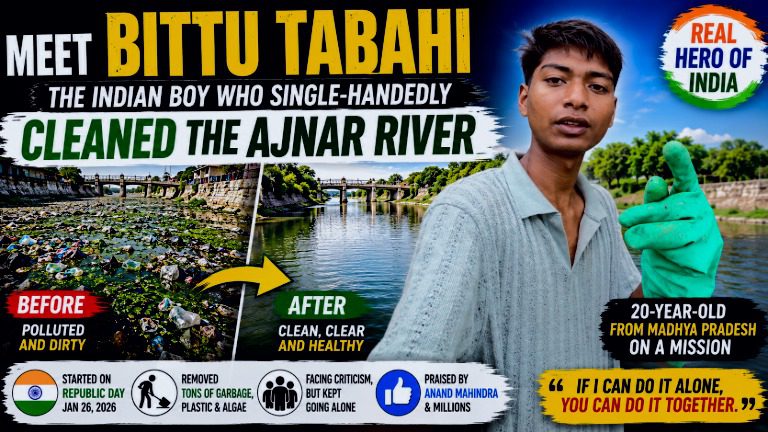
Bittu Tabahi: The 20-Year-Old Cleaning Madhya Pradesh’s Polluted Ajnar River
At a time when polluted rivers often become the subject of complaints, campaigns and social-media debates, one young man from Madhya Pradesh decided to take a different approach.
20-year-old Surendra Singh Choudhary, popularly known online as Bittu Tabahi, began cleaning polluted stretches of the Ajnar River in Biaora, Rajgarh district, using basic tools and his own effort. His work has now attracted widespread attention online, including praise from industrialist Anand Mahindra.
What started on January 26, 2026, has turned into a months-long environmental effort and an increasingly viral story about individual action.
But there is an important distinction: reports describe Bittu as cleaning stretches and ghats of the Ajnar River, rather than literally restoring the entire river from source to mouth.
Who Is Bittu Tabahi?
Bittu Tabahi is the social-media name of Surendra Singh Choudhary, a 20-year-old from Biaora in Madhya Pradesh’s Rajgarh district.
He is also a BSc student and became concerned about the condition of the Ajnar River, which had accumulated plastic, bottles, algae, garbage and other waste.
Rather than simply complaining about the situation, he decided to personally begin removing the waste.
His story stands out because the cleanup was not initially backed by a large organisation or a major campaign. Reports say he used basic equipment and, at least during the early stages, spent his own money on the effort.
How Did Bittu Start Cleaning the Ajnar River?
Bittu’s cleanup mission began on Republic Day, January 26, 2026.
Initially, he was joined by friends. The group started working around the polluted river area, but the scale and difficulty of the task eventually meant that the others stopped participating.
Bittu continued.
He began returning to the river and manually removing accumulated waste and other material from polluted stretches.
According to later reports, one of the first stretches took approximately three months of continuous work before he moved on to another area.
The transformation became more visible through photographs and videos showing the condition of the river before and after his cleanup work.
What Was Bittu Removing From the River?
The work involved dealing with the kind of waste commonly associated with heavily polluted urban and semi-urban water bodies.
Reports have described Bittu removing:
Plastic waste
Discarded bottles
Garbage
Algae
Other accumulated debris
Waste around the river and public areas
Some reports also mention religious offerings among the material accumulating in the river.
The job was physically demanding, particularly because Bittu was working in polluted water rather than simply collecting garbage from dry riverbanks.
From Republic Day Cleanup to a Personal Mission
What began as a Republic Day activity could easily have ended after a single cleanup drive.
For Bittu, however, it became a continuing mission.
Instead of treating the first cleanup as a one-day symbolic activity, he kept returning to the river.
That persistence appears to be one of the main reasons his story attracted attention.
His approach was simple: identify the problem, start working and keep going.
That message resonated with people online, particularly because river pollution is an issue that is often discussed but can be difficult to address at the local level.
Bittu Tabahi Faced Criticism Online
As Bittu began documenting his work on social media, not everyone was convinced.
Some users questioned whether he was cleaning the river primarily to gain followers and views.
Bittu responded to such criticism by continuing to document his work and showing before-and-after footage of the areas he had cleaned.
The debate itself helped bring even more attention to the initiative.
The question became less about whether a person should receive attention for environmental work and more about whether social media could be used to encourage useful action.
Recent reports say Bittu has continued responding to people who questioned whether he was actually carrying out the cleanup.
Anand Mahindra Notices Bittu’s Work
The story received a major boost when industrialist Anand Mahindra highlighted Bittu’s efforts on X.
Mahindra defended the young man’s use of social media, arguing that if the desire for attention or likes results in something genuinely positive, it can still serve a useful purpose.
His post helped Bittu’s story reach a much larger audience. Indian Express previously reported that Mahindra praised the initiative as part of his #MondayMotivation posts.
This endorsement significantly changed the conversation around Bittu.
A young man who had initially faced accusations of seeking online attention was suddenly being celebrated as an example of grassroots environmental action.
Why People Started Calling Him a “Lonely Warrior”
Bittu’s story has attracted comparisons with other individuals who took on seemingly impossible challenges through persistence.
Some social-media users compared his determination with the story of Dashrath Manjhi, popularly known as the “Mountain Man”, who famously spent years carving a path through a mountain.
The comparison is symbolic rather than literal.
Manjhi’s story involved years of work on a massive physical obstacle, while Bittu’s current mission involves cleaning polluted stretches of a river.
But the common theme is persistence: one person continuing despite criticism and limited resources.
Before-and-After Videos Made His Work Visible
One of the most powerful elements of Bittu’s campaign has been the use of before-and-after visuals.
Instead of merely saying that the river was being cleaned, his social-media posts showed viewers what particular stretches looked like before and after the cleanup.
Recent coverage has highlighted videos in which Bittu walks viewers through different parts of the river and explains the work carried out at individual ghats.
These visuals helped people understand the scale of the effort and contributed to the rapid spread of his story.
Has Bittu Actually Cleaned the Entire Ajnar River?
This is where headlines can sometimes become misleading.
Bittu has made a significant effort to clean polluted stretches of the Ajnar River, but available reports do not establish that he has cleaned the entire river system.
Recent coverage specifically describes his work across different stretches and ghats.
Bittu himself has indicated that the work is continuing and that he wants to take his environmental efforts to a larger level.
Therefore, it is more accurate to describe him as a young man who has manually transformed heavily polluted stretches of the Ajnar River rather than claiming he single-handedly restored the entire river.
The Personal Cost of the Cleanup
The work has not been without challenges.
Recent reports say Bittu has spent his own money on the cleanup and that working in polluted water has also created health concerns, including reported skin problems. One report put his personal spending at around ₹30,000.
That aspect of the story also highlights a larger concern.
Individual volunteer efforts can make a visible difference, but cleaning polluted water bodies safely and permanently requires more than removing visible garbage.
Waste disposal, sewage management, industrial discharge controls, drainage systems and preventing new dumping are all important for long-term restoration.
Bittu Does Not Want to Stop With the Ajnar
Despite the attention he has received, Bittu has indicated that he wants to take his work further.
Recent reporting says he wants to operate on a larger level, although he has not yet established a formal organisation or detailed structure for the next stage of his work.
That could eventually turn his individual cleanup campaign into something larger involving volunteers and local communities.
For now, however, his focus remains on continuing the work.
Why Bittu Tabahi’s Story Matters
The story is not simply about one young man cleaning garbage.
It raises a bigger question about how communities respond when public spaces and natural resources deteriorate.
A polluted river can become part of everyday life. People see the garbage, smell the polluted water and walk past it repeatedly until the condition begins to feel normal.
Bittu’s actions challenge that normalisation.
His message is essentially that waiting for someone else to begin can itself become part of the problem.
At the same time, his story should not be interpreted as a substitute for institutional responsibility. River restoration ultimately requires coordinated action from local authorities, communities, pollution-control bodies and citizens.
Individual action can start a movement, but sustainable river restoration needs long-term systems.
A Social Media Campaign Turned Into an Environmental Movement
Bittu’s use of Instagram is another interesting part of the story.
His account allowed people who had never visited Biaora to see the condition of the river and the work being done there.
Rather than social media being only a place for entertainment, his story demonstrates how online platforms can potentially be used to document local problems and encourage community participation.
The same visibility that initially attracted criticism eventually helped generate support.
That is one reason Anand Mahindra’s intervention became important: it amplified a local environmental effort to a national audience.
Bittu Tabahi’s Story Is Bigger Than One River
The Ajnar River cleanup has turned Bittu Tabahi into a viral environmental figure, but the most important part of the story may be what happens next.
Will more local residents join the cleanup?
Will authorities provide systematic support?
Will the river remain clean after the visible waste has been removed?
And can the initiative inspire similar efforts in other cities?
Those questions will determine whether the cleanup becomes a temporary transformation or the beginning of a lasting environmental movement.
For now, the story of a 20-year-old BSc student stepping into a polluted river and repeatedly removing waste by hand has already captured widespread attention.
His journey is a reminder that meaningful change can sometimes begin with a single person deciding that complaining is no longer enough.
Key Takeaways
Bittu Tabahi’s real name is Surendra Singh Choudhary.
He is a 20-year-old from Biaora, Madhya Pradesh.
He began his Ajnar River cleanup effort on January 26, 2026.
He initially worked with friends before continuing largely on his own.
His work has focused on removing plastic, garbage, algae and other waste from polluted stretches.
Before-and-after videos helped his efforts gain attention online.
Anand Mahindra publicly praised his environmental initiative.
Recent reports say Bittu wants to expand his work beyond the Ajnar River.
His story also highlights the need for long-term institutional action to prevent rivers from becoming polluted again.
FAQs
Who is Bittu Tabahi?
Bittu Tabahi is the social-media name of Surendra Singh Choudhary, a 20-year-old BSc student from Biaora in Madhya Pradesh’s Rajgarh district who has been cleaning polluted stretches of the Ajnar River.
What did Bittu Tabahi do?
He began manually removing plastic, bottles, garbage, algae and other waste from polluted parts of the Ajnar River.
When did Bittu start cleaning the Ajnar River?
His cleanup effort began on January 26, 2026, Republic Day.
Did Bittu clean the entire Ajnar River?
Available reports describe him cleaning multiple stretches and ghats of the Ajnar River. It would be inaccurate to claim that he has restored the entire river system.
Did Anand Mahindra praise Bittu Tabahi?
Yes. Anand Mahindra highlighted Bittu’s environmental work on social media and defended the use of social media to promote meaningful action.
How much money did Bittu spend on the cleanup?
Recent reports say he spent around ₹30,000 of his own money on the effort, although figures may change as the cleanup continues.
Is Bittu still working on river cleaning?
Recent reporting indicates that the work is ongoing and that Bittu wants to expand his efforts to a larger level.
About the Author
Ravi H Irannanavar is a blogger and digital content creator covering trending stories, business, technology, stock markets, jobs, government exams and important developments across India. His focus is on presenting news and informative stories in a simple, clear and reader-friendly format.
Do Follow For More Info @ http://roydailyupdate.in
Do WhatsApp @ https://chat.whatsapp.com/K5POJK9KbpN8egjjOCaOw6
Disclaimer
This article is based on available media reports about Bittu Tabahi’s Ajnar River cleanup efforts. Claims regarding the extent of the cleanup, personal expenditure, health effects and future plans may change as new information becomes available. The article describes reported cleanup work on stretches of the river and does not imply that the entire Ajnar River has been permanently restored.