

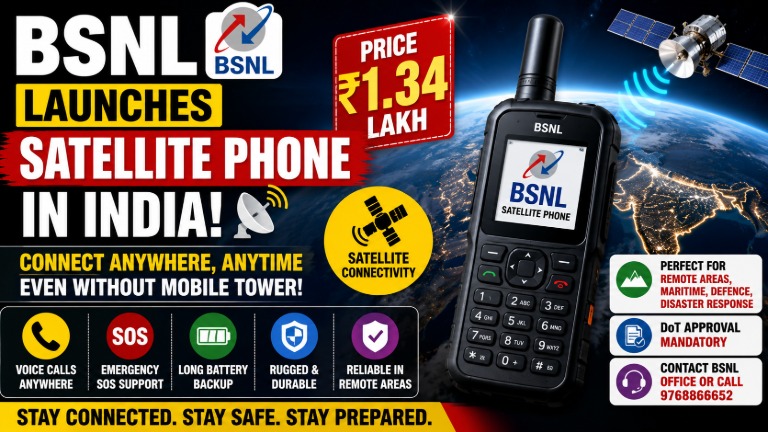

BSNL Launches Satellite Phone in India for ₹1.34 Lakh
State-owned telecom operator Bharat Sanchar Nigam Limited (BSNL) has launched a satellite phone in India priced at ₹1,34,166 (inclusive of taxes), marking a significant step towards improving communication in remote and inaccessible regions where conventional mobile networks fail to operate.
Unlike regular smartphones that depend on nearby cellular towers, BSNL’s latest satellite phone connects directly to satellites, allowing users to make voice calls even from locations without any mobile signal.
The launch highlights India’s growing focus on satellite-based communication technologies, especially for disaster management, defence, maritime operations, and remote industrial activities.
What Makes the BSNL Satellite Phone Special?
The biggest advantage of the BSNL satellite phone is that it works without relying on mobile towers.
Instead, it connects directly to satellites orbiting the Earth. This allows users to remain connected even in places where there is no cellular infrastructure.
Such locations include:
- Dense forests
- Mountain regions
- Offshore waters
- Border areas
- Deserts
- Mining sites
- Disaster-hit regions
- Remote villages
This makes the device particularly valuable during emergencies when terrestrial communication networks become unavailable.
Developed with Global Satellite Partners
BSNL says the satellite communication service has been developed in partnership with Inmarsat, one of the world’s leading satellite communication providers.
Using satellite infrastructure, the handset enables reliable voice communication across areas that remain outside the coverage of traditional telecom operators.
The initiative supports India’s broader efforts to strengthen emergency communication infrastructure and improve connectivity in underserved regions.
How Does the BSNL Satellite Phone Work?

Unlike conventional mobile phones, which first connect to the nearest cellular tower, satellite phones establish a direct link with communication satellites.
The process works as follows:
- The handset sends signals directly to a satellite.
- The satellite relays those signals to a ground station.
- The ground station routes the call to the intended recipient.
Since satellites cover much larger geographical areas than mobile towers, users can communicate even from isolated locations where standard networks do not exist.
This technology is particularly useful during natural disasters, when floods, earthquakes, cyclones, or landslides damage terrestrial telecom infrastructure.
Key Features of BSNL Satellite Phone
BSNL has equipped the satellite phone with several important features designed for mission-critical communication.
Satellite-Based Calling
Users can make voice calls without depending on conventional mobile towers.
Emergency SOS Support
The handset includes an SOS feature that enables users to seek immediate assistance during emergencies.
Rugged Construction
The device is built to withstand harsh weather conditions and demanding outdoor environments.
Long Battery Backup
BSNL claims the phone offers extended battery life, making it suitable for prolonged operations in remote areas without access to charging facilities.
Reliable Connectivity
Satellite communication ensures connectivity even in challenging terrain where regular telecom services remain unavailable.
Not for Regular Smartphone Users
Although the launch has attracted considerable attention, BSNL has clarified that this is not a replacement for everyday smartphones.
Instead, the satellite phone is designed primarily for specialised users requiring uninterrupted communication in remote or disaster-prone locations.
The handset is intended for professional, emergency, and strategic use rather than general consumer communication.
Department of Telecommunications Approval is Mandatory
One of the most important aspects of owning a satellite phone in India is the regulatory requirement.
Satellite phones are tightly regulated under Indian telecommunications laws.
Before purchasing or using the BSNL satellite phone, individuals and organisations must obtain explicit authorisation from the Department of Telecommunications (DoT).
Using or possessing a satellite phone without the required government approval may attract legal action under applicable regulations.
This approval process helps ensure secure and regulated use of satellite communication devices across the country.
Who Can Buy the BSNL Satellite Phone?
Unlike conventional smartphones, the BSNL Satellite Phone is not intended for the general public.
The service has been developed primarily for organisations and professionals working in remote or mission-critical environments where traditional mobile networks are unavailable.
Potential users include:
- Defence and security agencies
- Disaster management teams
- National and State Disaster Response Forces (NDRF/SDRF)
- Maritime and shipping companies
- Fishermen operating in deep-sea regions
- Mining and oil exploration companies
- Forest departments
- Border security personnel
- Adventure tourism operators
- Pilgrims travelling through remote Himalayan regions
- Scientific research teams
- Emergency rescue organisations
These users often operate in areas where uninterrupted communication can be life-saving.
BSNL Satellite Phone Price & Availability
BSNL has launched the satellite phone at:
Price: ₹1,34,166 (Inclusive of Taxes)
Interested users cannot simply purchase the device online or from retail stores.
Instead, they must:
- Obtain prior approval from the Department of Telecommunications (DoT).
- Contact the nearest BSNL office.
- Complete all regulatory formalities before purchase.
BSNL has also provided a customer support number:
Customer Helpline: 9768866652
Legal Rules You Must Know
Satellite phones are governed by strict regulations in India because they communicate directly through satellites rather than domestic cellular networks.
According to BSNL:
- Prior DoT authorisation is mandatory.
- Unauthorized possession or use may lead to legal action.
- Only approved users are permitted to operate the device.
These regulations help ensure secure use of satellite communication services, particularly in sensitive border and defence areas.
BSNL Satellite Phone vs Regular Smartphone
| Feature | BSNL Satellite Phone | Regular Smartphone |
|---|---|---|
| Network | Satellite | Mobile Towers |
| Works Without Towers | ✅ Yes | ❌ No |
| Remote Area Connectivity | Excellent | Limited |
| Emergency Communication | Excellent | Depends on Network |
| Internet Usage | Limited | High-Speed 4G/5G |
| Price | ₹1.34 Lakh | Much Lower |
| Government Approval | Required | Not Required |
Why Is Satellite Communication Becoming Important?
Satellite communication is increasingly becoming a crucial part of modern telecommunications.
Several factors are driving this shift:
- Natural disasters damaging mobile towers
- Increasing defence requirements
- Growth of remote industrial operations
- Maritime safety
- Space-based communication technologies
- Expansion of digital connectivity into underserved regions
Countries worldwide are investing heavily in satellite-based communication networks to complement terrestrial telecom infrastructure.
BSNL’s Growing Network Expansion
The launch of the satellite phone comes alongside BSNL’s ongoing expansion of its nationwide mobile network.
According to the company:
- Nearly 99,000 4G sites have already been commissioned.
- The government is considering approving additional BSNL 4G sites.
- BSNL continues strengthening digital connectivity across rural and remote India.
The satellite phone complements these efforts by addressing locations where even future terrestrial networks may remain impractical.
Advantages of BSNL Satellite Phone
Major Benefits
- Works where mobile towers are unavailable.
- Reliable during floods, earthquakes, cyclones and disasters.
- Direct satellite connectivity.
- Long battery life.
- Rugged construction.
- SOS emergency support.
- Ideal for defence, rescue and remote operations.
Limitations
Despite its advantages, the device also has some limitations:
- High purchase price.
- Requires government approval.
- Mainly designed for voice communication.
- Not intended for everyday smartphone usage.
- Limited consumer availability.
Key Highlights
- 📡 BSNL launches satellite phone in India.
- 💰 Price: ₹1,34,166 (Inclusive of Taxes).
- 🛰️ Connects directly to satellites instead of mobile towers.
- 🚨 SOS emergency communication supported.
- 🔋 Long battery backup.
- 🪖 Designed for defence, disaster response, maritime and remote operations.
- 📜 DoT approval mandatory before purchase.
- 🌍 Developed with Inmarsat satellite technology.
Frequently Asked Questions (FAQs)
1. What is the price of the BSNL Satellite Phone?
The BSNL Satellite Phone is priced at ₹1,34,166, inclusive of taxes.
2. Does it work without mobile towers?
Yes. The device connects directly to satellites, allowing communication even where no mobile network is available.
3. Can anyone buy the phone?
No. Buyers must obtain prior approval from the Department of Telecommunications (DoT).
4. Does it support emergency communication?
Yes. The handset includes an SOS feature designed for emergency situations.
5. Who should use the satellite phone?
It is best suited for defence personnel, rescue teams, maritime workers, remote industries, disaster response agencies, and others operating in isolated locations.
Expert View
BSNL’s satellite phone is not aimed at replacing smartphones but rather filling a critical communication gap in areas where conventional networks fail.
As India expands its disaster management capabilities and remote connectivity infrastructure, satellite communication devices are expected to play a much larger role in ensuring uninterrupted communication during emergencies.
The launch also demonstrates BSNL’s efforts to diversify beyond traditional telecom services and adopt next-generation communication technologies.
Conclusion
The launch of the BSNL Satellite Phone marks an important milestone in India’s communication ecosystem.
By enabling satellite-based voice communication, the device offers reliable connectivity in regions where traditional mobile networks are unavailable.
Although its high price and regulatory requirements mean it is not intended for ordinary consumers, it could prove invaluable for defence personnel, disaster management teams, maritime operators, and professionals working in remote areas.
As satellite communication continues to evolve, such technologies are expected to become increasingly important for enhancing public safety, disaster response, and national connectivity.
Disclaimer
This article is based on information released by BSNL and publicly available reports at the time of publication. Product specifications, pricing, regulatory requirements, and availability may change. Readers should refer to official BSNL communications and the Department of Telecommunications for the latest information.
Do Follow for More Info @ http://roydailyupdate.in
Do Connect WhatsApp @ https://chat.whatsapp.com/K5POJK9KbpN8egjjOCaOw6