

CJP Protest in Delhi: Police Crackdown Sparks Massive Political Storm
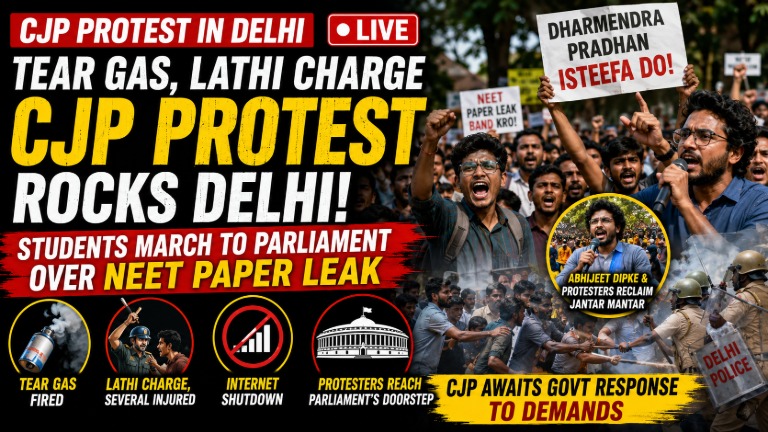
Thousands of protesters gathered in the national capital on July 20, 2026, as the Cockroach Janta Party (CJP) organised its “Sansad Chalo” march demanding the resignation of Union Education Minister Dharmendra Pradhan over the alleged NEET paper leak and examination irregularities.
The demonstration quickly turned into one of Delhi’s biggest protests in recent years after police used tear gas, water cannons, and baton charges to disperse crowds attempting to move towards Parliament.
Several protesters sustained injuries while many others were detained during the operation.
Why Did the Protest Take Place?
The CJP launched the protest alleging widespread irregularities in competitive examinations, particularly the NEET examination.
The party demanded:
- Immediate resignation of Union Education Minister Dharmendra Pradhan.
- Accountability over alleged examination irregularities.
- Greater transparency in national entrance examinations.
- Justice for students affected by paper leaks.
The protest attracted thousands of students, youth organisations, and civil society members from across the country.
Police Action at Jantar Mantar
As protesters attempted to march towards Parliament, Delhi Police deployed heavy security across central Delhi.
Authorities erected multiple barricades and deployed nearly 3,000 security personnel around sensitive locations.
According to reports:
- Tear gas shells were fired.
- Lathi charges were carried out.
- Several protesters were detained.
- Many suffered injuries due to the clashes.
Emergency medical teams shifted dozens of injured protesters to nearby hospitals for treatment.
Internet Shutdown in Central Delhi
To control the rapidly evolving situation, authorities suspended mobile internet services across parts of New Delhi district.
The communication restrictions slowed the spread of videos and updates from the protest site.
Journalists and protesters reportedly relied on nearby Wi-Fi networks to continue sharing information.
The internet shutdown has also triggered debate over digital rights and freedom of expression during public demonstrations.
CJP Leaders Meet Union Minister
Even as protests continued outside, CJP representatives Sourav Das and Ashutosh Ranka met Union Minister J.P. Nadda to submit a formal memorandum listing the protesters’ demands.
According to CJP leaders, the memorandum sought:
- Immediate resignation or removal of the Education Minister.
- Action over alleged examination irregularities.
- Release of activist Sonam Wangchuk.
- Protection of students’ rights.
The delegation stated that the minister assured them the demands would be discussed at the “appropriate level”, although no formal commitment was made.
Sonam Wangchuk Extends Hunger Strike
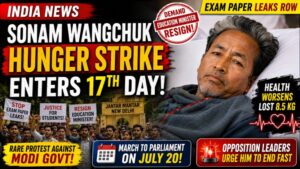
Activist Sonam Wangchuk announced that he would continue his indefinite hunger strike following the police action against protesters.
He stated that the fast would continue until either:
- Student representatives are allowed to meet Members of Parliament, or
- He is permitted to engage with parliamentarians directly.
Medical officials later reported that although his blood sugar levels remained low, his overall health condition was stable.
Protest Site Reclaimed After Police Action
Late Monday evening, CJP founder Abhijeet Dipke and supporters returned to Jantar Mantar after police had dismantled the protest stage earlier in the day.
The protesters reassembled at the site, signalling that the agitation would continue despite the crackdown.
The symbolic return became one of the defining moments of the day’s protest, drawing significant public attention.
Political Reactions Intensify
The police action triggered reactions from several opposition leaders and political organisations.
Communist Party of India (CPI) General Secretary D. Raja criticised the police operation, describing it as excessive force against students and youth.
Leaders from multiple opposition parties also discussed the protests inside Parliament, indicating that the issue is likely to dominate political discourse in the coming days.
Injured Protesters Taken to Hospitals
Hospitals across Central Delhi witnessed a rush of injured protesters following the clashes.
According to hospital sources:
- Around 38 injured protesters were admitted to Lady Hardinge Medical College.
- Approximately 65 people were brought to Ram Manohar Lohia (RML) Hospital.
Doctors reported injuries ranging from:
- Head injuries
- Bone fractures
- Eye irritation caused by tear gas
- Bruises and swelling from baton charges
Medical teams continued treating injured demonstrators late into the evening.
Protests Spread Across India
The Delhi demonstration quickly inspired solidarity protests in several states.
Gujarat
Around 150 protesters were detained in Ahmedabad after staging demonstrations demanding accountability over examination irregularities and supporting the Delhi movement.
Kerala
Police used water cannons against demonstrators marching toward the Secretariat in Thiruvananthapuram to protest the police action in Delhi.
Goa
A candlelight march was organised in Panaji’s Azad Maidan where participants expressed solidarity with Sonam Wangchuk and student protesters.
These demonstrations highlighted how the issue has expanded beyond Delhi into a nationwide movement.
Delhi Police Reviews Security Situation
Following hours of confrontation, Delhi Police held a high-level review meeting to assess the law and order situation.
Senior officials reportedly discussed:
- Violence during the protest.
- Security arrangements around Parliament.
- Investigation into clashes.
- Future preventive measures.
Authorities are expected to examine CCTV footage and other evidence as part of the ongoing investigation.
CJP Says Protest Will Continue
CJP leaders declared that the agitation would continue until their primary demands are addressed.
Speaking after meeting Union Minister J.P. Nadda, spokesperson Ashutosh Ranka thanked thousands of students who participated in the march.
According to the party, the movement has become a nationwide campaign demanding transparency, accountability, and reforms in India’s examination system.
The organisation has indicated that additional protests may be announced if no concrete response is received from the Central Government.
Why This Protest Matters
The latest protest has become one of the largest student-led demonstrations in recent years.
Beyond the immediate demand regarding the NEET paper leak, the movement has raised broader concerns over:
- Integrity of competitive examinations.
- Student confidence in recruitment systems.
- Government accountability.
- Police handling of peaceful demonstrations.
- Internet shutdowns during public protests.
Political observers believe the issue could remain a major national debate in the coming weeks.
FAQs
Why did the CJP organise the Delhi protest?
The protest was organised to demand the resignation of Union Education Minister Dharmendra Pradhan over alleged NEET paper leak and examination irregularities.
Where did the protest take place?
The main protest was held at Jantar Mantar in New Delhi, with protesters attempting to march toward Parliament.
Why was mobile internet suspended?
Authorities suspended mobile internet services in parts of central Delhi citing law and order concerns during the protests.
What happened to Sonam Wangchuk?
Sonam Wangchuk announced that he would continue his indefinite hunger strike following the police action against protesters.
Did the government respond?
Union Minister J.P. Nadda reportedly assured CJP representatives that their demands would be discussed at the appropriate level, but no formal commitment was announced.
Conclusion
The CJP protest in Delhi has emerged as one of the most significant public demonstrations over education-related issues in recent years. As thousands of students and supporters gathered to demand accountability over alleged examination irregularities, the situation escalated into clashes with police, widespread detentions, injuries, and an internet shutdown in central Delhi.
While government representatives have acknowledged receiving the protesters’ demands, uncertainty remains over the next course of action. With solidarity protests spreading across multiple states and activist Sonam Wangchuk continuing his hunger strike, the issue is likely to remain at the centre of national political and public discussion.
Disclaimer
Disclaimer: This article is based on publicly available reports and official statements available at the time of publication. The investigation and government response are ongoing, and further official updates may change certain details. RoyDailyUpdate does not independently verify allegations or claims made by any political organisation or individual.
Do Follow For More Info @ http://roydailyupdate.in
Do Connect WhatsApp @ https://chat.whatsapp.com/K5POJK9KbpN8egjjOCaOw6