

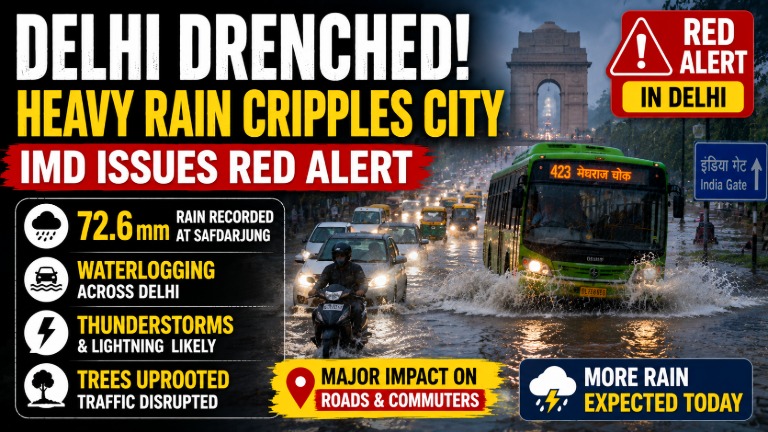
Heavy Rain Cripples Delhi as IMD Issues Red Alert
Heavy overnight rainfall brought normal life to a standstill across the national capital on Thursday, with several roads submerged, traffic severely disrupted, and trees uprooted in multiple locations.
The India Meteorological Department (IMD) has issued a Red Alert for Delhi, warning residents to prepare for more heavy rainfall accompanied by thunderstorms and lightning throughout the day.
The downpour affected road transport, railway commuters and office-goers as widespread waterlogging slowed traffic movement across major parts of the city.
Delhi Receives Heavy Overnight Rainfall
According to the India Meteorological Department, Delhi’s primary weather station at Safdarjung recorded 72.6 mm of rainfall during the 24-hour period ending at 8:30 AM.
Several other weather stations also recorded substantial rainfall:
| Weather Station | Rainfall |
|---|---|
| Safdarjung | 72.6 mm |
| Lodhi Road | 80.2 mm |
| Ridge | 77.8 mm |
| Palam | 63.0 mm |
| Ayanagar | 57.4 mm |
The widespread rainfall has significantly improved moisture levels across the capital but simultaneously created serious urban flooding in low-lying areas.
IMD Issues Red Alert
Following the intense overnight rainfall, IMD upgraded Delhi’s weather warning to a Red Alert.
According to the forecast:
- Heavy to very heavy rainfall is expected.
- Thunderstorms are likely throughout the day.
- Lightning activity may accompany rain.
- Strong wind gusts are possible.
- Residents have been advised to avoid unnecessary travel.
The minimum temperature settled at 24.3°C, nearly 3.6°C below normal, providing relief from the recent humid conditions.
Waterlogging Disrupts Daily Life
The continuous rainfall led to severe water accumulation across several major roads and intersections.
Among the worst-affected locations were:
- Vikas Marg
- East Delhi
- Munirka
- Sadar Bazar
- Dwarka
- New Delhi Railway Station
- Delhi-Noida Expressway
Motorists experienced long traffic jams as vehicles crawled through flooded roads.
Several commuters shared videos and photographs on social media showing submerged streets, stranded vehicles and overflowing drains.
Trees Uprooted in East of Kailash
The Delhi Fire Service confirmed that at least two large trees were uprooted in East of Kailash during the heavy rain.
Officials said:
- One tree collapsed near the ISKCON Temple.
- Another fell outside the National Heart Institute.
The fallen trees temporarily disrupted traffic while emergency teams worked to clear the roads.
Fortunately, no major injuries were reported immediately.
Why Is Delhi Receiving Such Heavy Rain?
Meteorologists explained that the current spell is linked to the northward shift of the monsoon trough.
Normally positioned over central India, the trough has now moved closer to the Himalayan foothills.
This shift has intensified moisture inflow over Delhi-NCR, resulting in prolonged and widespread rainfall over the past two days.
Weather experts believe rainfall activity will continue until the monsoon system gradually shifts further north.
Air Quality Improves
One positive outcome of the heavy rainfall has been a noticeable improvement in Delhi’s air quality.
According to the Central Pollution Control Board (CPCB):
- Air Quality Index (AQI): 61
- Category: Satisfactory
Rainfall helped wash away suspended dust particles and pollutants, significantly improving visibility and overall air quality across the city.
Delhi Likely to Receive More Rain Over the Next 24 Hours
According to the India Meteorological Department (IMD), rainfall activity is expected to continue across Delhi and the National Capital Region (NCR) over the next 24 hours.
The weather department has warned that:
- Moderate to heavy rainfall may continue.
- Thunderstorms accompanied by lightning are likely.
- Strong gusty winds may occur in isolated areas.
- Low-lying areas remain vulnerable to fresh waterlogging.
Meteorologists believe the current spell will gradually weaken only after the monsoon trough shifts further towards the Himalayan foothills.
Until then, intermittent heavy showers are expected across Delhi and adjoining regions.
Traffic Advisory Issued for Commuters
Authorities have advised commuters to plan their journeys carefully due to the widespread impact of waterlogging.
Several important routes witnessed slow-moving traffic, including:
- Delhi-Noida Expressway
- Vikas Marg
- Dwarka
- Munirka
- East Delhi
- Sadar Bazar
- Areas around New Delhi Railway Station
Traffic police urged motorists to avoid flooded stretches whenever possible and follow official traffic advisories.
Commuters using public transport were also advised to allow extra travel time because of weather-related delays.
Residents Asked to Take Precautions
With thunderstorms and lightning expected to continue, the IMD has issued several safety advisories.
Residents are advised to:
- Stay indoors during lightning activity.
- Avoid sheltering beneath trees.
- Keep electronic devices unplugged during severe thunderstorms.
- Avoid driving through flooded roads.
- Monitor official weather updates before travelling.
- Keep emergency supplies ready in case of prolonged rainfall.
Authorities have also appealed to parents to ensure children avoid playing near flooded drains or open waterlogged areas.
Monsoon Brings Relief Alongside Challenges
While the heavy rainfall has disrupted daily life, weather experts point out that it has also brought welcome relief from the intense summer heat.
The minimum temperature dropped to 24.3°C, nearly 3.6°C below the seasonal average, making weather conditions significantly cooler compared to previous days.
In addition, rainfall helped improve Delhi’s air quality, with the Air Quality Index (AQI) remaining in the ‘Satisfactory’ category.
Experts say continued rainfall may further improve atmospheric conditions, although prolonged waterlogging remains a major urban challenge.
Expert Analysis
The latest spell of heavy monsoon rain highlights Delhi’s recurring struggle with urban flooding despite ongoing infrastructure improvements.
Although rainfall during the monsoon season is expected, intense downpours within a short period continue to overwhelm drainage systems, leading to waterlogging, traffic congestion, and disruption of public services.
The IMD’s Red Alert reflects the possibility of continued heavy rainfall, making preparedness essential for both authorities and residents.
Improved forecasting has enabled timely warnings, but effective drainage management, flood mitigation, and urban planning remain critical for reducing the impact of extreme weather events in the future.
Key Highlights
- 🌧️ Delhi recorded 72.6 mm rainfall at Safdarjung.
- 🚨 IMD issued a Red Alert for heavy rain, thunderstorms, and lightning.
- 🚗 Waterlogging caused major traffic disruptions across several parts of the city.
- 🌳 Trees were uprooted in East of Kailash due to strong winds and rain.
- 🌡️ Minimum temperature dropped to 24.3°C.
- 🌿 Delhi’s AQI improved to the ‘Satisfactory’ category.
- ☔ More rainfall is expected over the next 24 hours.
Frequently Asked Questions (FAQs)
Why has IMD issued a Red Alert for Delhi?
The Red Alert was issued because heavy to very heavy rainfall accompanied by thunderstorms and lightning is expected, posing risks of flooding and disruption.
How much rainfall did Delhi receive?
Safdarjung recorded 72.6 mm of rainfall in the 24 hours ending at 8:30 AM, while Lodhi Road received 80.2 mm.
Which areas were affected by waterlogging?
Majorly affected locations include Vikas Marg, Munirka, Dwarka, East Delhi, Sadar Bazar, New Delhi Railway Station, and the Delhi-Noida Expressway.
Why is Delhi receiving continuous rainfall?
Weather experts attribute the rainfall to the northward shift of the monsoon trough towards the Himalayan foothills.
Has air quality improved after the rainfall?
Yes. According to the Central Pollution Control Board (CPCB), Delhi’s Air Quality Index (AQI) stood at 61, which falls under the ‘Satisfactory’ category.
Conclusion
Heavy monsoon showers have once again demonstrated both the benefits and challenges of Delhi’s rainy season. While the rainfall has lowered temperatures and improved air quality, it has also exposed persistent issues related to urban flooding and traffic management.
With the IMD forecasting more rain over the coming hours, residents are advised to remain cautious, follow official weather advisories, and avoid unnecessary travel through waterlogged areas.
Disclaimer
This article is based on official updates from the India Meteorological Department (IMD), Delhi authorities, and publicly available reports at the time of publication. Weather forecasts are subject to change, and readers should follow official advisories for the latest updates.
Do Follow For more info @ http://roydailyupdate.in
Do Connect WhatsApp @ https://chat.whatsapp.com/K5POJK9KbpN8egjjOCaOw6