

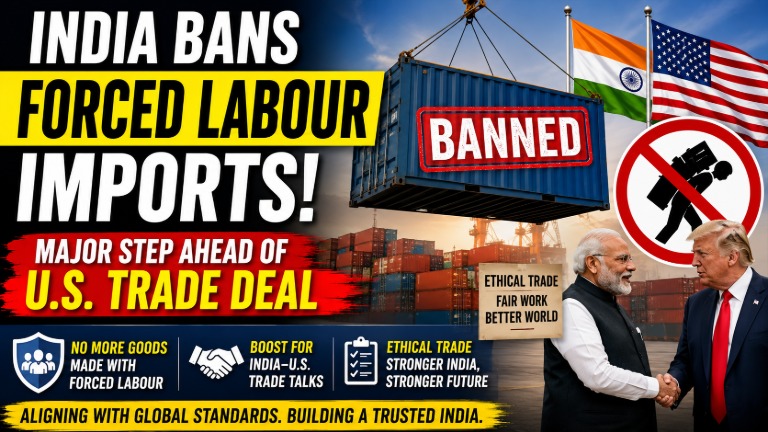
India Bans Imports Made Using Forced Labour Ahead of U.S. Trade Deal
In a significant move aimed at strengthening ethical trade practices and improving its position in ongoing negotiations with the United States, the Government of India has officially prohibited the import of goods produced using forced labour.
The notification, issued by the Ministry of Commerce and Industry, represents one of India’s most important trade policy updates in recent years. The decision comes at a time when India and the United States are working toward finalising an interim trade agreement while Washington reviews tariffs on countries that it believes have not adequately prevented imports linked to forced labour.
The announcement is expected to have implications for international trade, global supply chains, importers, exporters, and businesses dealing with foreign markets.
What Has the Government Announced?
According to the official notification, India has prohibited the import of any product that is wholly or partially manufactured using forced labour.
The notification clearly states:
- Imports of goods produced through forced labour are prohibited.
- The Central Government may notify additional categories of prohibited goods in the future.
- Investigations into suspected violations will be conducted by the Director General of Foreign Trade (DGFT).
- Detailed procedures will be specified in the Handbook of Procedures 2023.
This marks the first time India’s Foreign Trade Policy has specifically included provisions targeting imports linked to forced labour.
Why Is This Decision Important?
The announcement comes during sensitive trade discussions between India and the United States.
The U.S. administration is currently reviewing whether several countries, including India, have taken sufficient steps to prevent goods produced through forced labour from entering their markets.
Following an earlier investigation, the United States proposed imposing 12.5% tariffs on imports from countries that allegedly failed to effectively enforce restrictions against such products.
India was among the countries identified in the draft findings.
By introducing this prohibition, India appears to be reinforcing its commitment to internationally accepted labour standards while strengthening its case during trade negotiations.
What Is Forced Labour?
The Indian government has adopted the internationally recognised definition under the ILO Forced Labour Convention, 1930 (Convention No. 29).
According to the notification, forced labour refers to:
Any work or service extracted from a person under the threat of punishment and for which the individual has not voluntarily offered to work.
Forced labour may include:
- Human trafficking.
- Bonded labour.
- Debt-based labour exploitation.
- Forced prison labour.
- Coercive employment practices.
- Child labour in certain exploitative conditions.
Many countries have recently tightened restrictions against products linked to such practices as part of broader human rights and ethical sourcing initiatives.
India-U.S. Trade Deal Still Under Negotiation
India and the United States have been negotiating an interim trade agreement for several months.
Commerce Minister Piyush Goyal and Commerce Secretary Rajesh Agrawal have repeatedly stated that India will only finalise the agreement if it receives a meaningful competitive advantage compared to other trading partners.
One of the major factors delaying the agreement is uncertainty surrounding new U.S. tariff proposals.
The United States is conducting multiple investigations into international trade practices, including:
- Imports linked to forced labour.
- Excess manufacturing capacity affecting U.S. industries.
- Supply chain compliance.
- Fair trade practices.
The outcome of these investigations could significantly influence future tariff rates on imports from India.
India Has Already Objected to the Proposed Tariffs
Commerce Secretary Rajesh Agrawal recently confirmed that India has officially submitted its objections to the proposed U.S. tariffs.
According to the government, India has presented its position during consultations and continues discussions with American authorities.
Indian officials maintain that any future trade agreement must provide Indian exporters with a competitive advantage over exporters from other countries.
This remains one of the key negotiating points before any final agreement is signed.
How Will the New Rule Be Implemented?
The government has clarified that investigations into possible violations will be conducted through the Director General of Foreign Trade (DGFT).
Whenever there is suspicion that imported goods have been produced using forced labour:
- Authorities may initiate an inquiry.
- Evidence may be collected from importers and exporters.
- Goods may be restricted or prohibited if violations are established.
- Future procedural details will be outlined in the Handbook of Procedures.
This creates a formal enforcement mechanism rather than relying solely on existing labour laws.
A Shift Towards Ethical Trade
Experts believe the move reflects India’s growing focus on ethical sourcing and responsible global trade.
Many advanced economies now require businesses to ensure that products entering their markets are free from forced labour or other human rights violations.
Countries such as the United States, Canada, the United Kingdom, and members of the European Union have strengthened regulations concerning ethical supply chains.
India’s latest policy aligns its trade framework more closely with these international practices while enhancing confidence among global trading partners.
Experts Say the Move Strengthens India’s Global Trade Position
Trade experts have welcomed the government’s decision, describing it as a major step towards aligning India’s trade policies with internationally accepted labour and human rights standards.
According to Manoj Mishra, Partner and Tax Controversy Management Leader at Grant Thornton Bharat, the notification represents an important shift in India’s foreign trade framework.
He noted that while India has traditionally relied on domestic labour and criminal laws to tackle forced labour, the latest notification introduces a dedicated trade measure under the Foreign Trade Policy.
Experts believe this sends a positive signal to global investors and international trading partners who increasingly prioritise ethical sourcing and sustainable supply chains.
Why Ethical Supply Chains Matter
Over the past few years, governments across the world have tightened regulations against imports linked to forced labour.
Large multinational companies are also under growing pressure to ensure that their products are manufactured responsibly.
Businesses are now expected to verify every stage of their supply chain to confirm that workers are employed voluntarily and under fair working conditions.
India’s latest notification could encourage domestic importers and manufacturers to strengthen supplier verification systems and adopt better compliance practices.
Impact on Indian Businesses
For most genuine businesses, the new rule is unlikely to create major disruptions.
However, importers may now need to:
- Verify the origin of imported products.
- Maintain proper documentation from overseas suppliers.
- Conduct additional due diligence before importing goods.
- Ensure imported materials comply with international labour standards.
Companies dealing with high-risk supply chains may face increased compliance responsibilities, but these measures could also improve their credibility in global markets.
What Happens Next?
The government has stated that additional implementation guidelines will be included in the Handbook of Procedures 2023.
These guidelines are expected to clarify:
- Investigation procedures.
- Documentation requirements.
- Evidence collection.
- Enforcement mechanisms.
- Appeals process for affected businesses.
The Central Government also retains the authority to notify specific categories of goods that may be prohibited in the future if linked to forced labour.
India-U.S. Trade Talks Remain Crucial
While the latest notification is considered a positive development, it does not automatically guarantee the conclusion of the proposed India-U.S. interim trade agreement.
Both countries are still discussing several important issues, including:
- Tariff reductions.
- Market access.
- Manufacturing competitiveness.
- Supply chain security.
- Trade balance.
- Regulatory cooperation.
Officials have repeatedly stated that India will sign the agreement only if it provides a meaningful competitive advantage for Indian exporters.
The United States is also expected to announce the final outcome of its ongoing tariff investigations in the coming weeks, which could significantly influence future negotiations.
Why This Story Matters
India’s decision reflects the changing nature of global trade, where ethical sourcing and responsible manufacturing have become increasingly important.
By introducing restrictions on goods produced through forced labour, India is strengthening its trade framework while positioning itself as a more reliable and responsible trading partner.
The move may also improve investor confidence, support Indian exporters, and enhance the country’s standing during negotiations with major global economies.
Although the practical impact will depend on future implementation guidelines, the notification represents an important milestone in India’s evolving trade policy.
Frequently Asked Questions (FAQs)
Why has India banned imports made using forced labour?
The government aims to strengthen ethical trade practices, align with international labour standards, and support ongoing trade negotiations with countries such as the United States.
What is forced labour?
Forced labour refers to work or services extracted from a person through threats, coercion, or punishment without voluntary consent, as defined by the International Labour Organization (ILO) Convention No. 29.
Will this affect ordinary consumers?
Most consumers are unlikely to notice immediate changes. The policy mainly impacts importers, exporters, manufacturers, and international supply chains.
How does this affect the India-U.S. trade deal?
The move may improve India’s position during ongoing trade negotiations by demonstrating stronger action against products linked to forced labour, though several other issues remain under discussion.
Who will investigate violations?
The Director General of Foreign Trade (DGFT) will conduct investigations according to procedures specified in the Handbook of Procedures 2023.
Disclaimer
This article is intended solely for informational purposes based on official government notifications and publicly available reports. Trade policies and international negotiations may change over time. Readers are advised to refer to official notifications issued by the Ministry of Commerce and Industry and the Directorate General of Foreign Trade (DGFT) for the latest updates.
Do follow for More Info @ http://roydailyupdate.in
Do Connect WhatsApp @ https://chat.whatsapp.com/K5POJK9KbpN8egjjOCaOw6