

The NEET-UG 2026 Re-Examination:

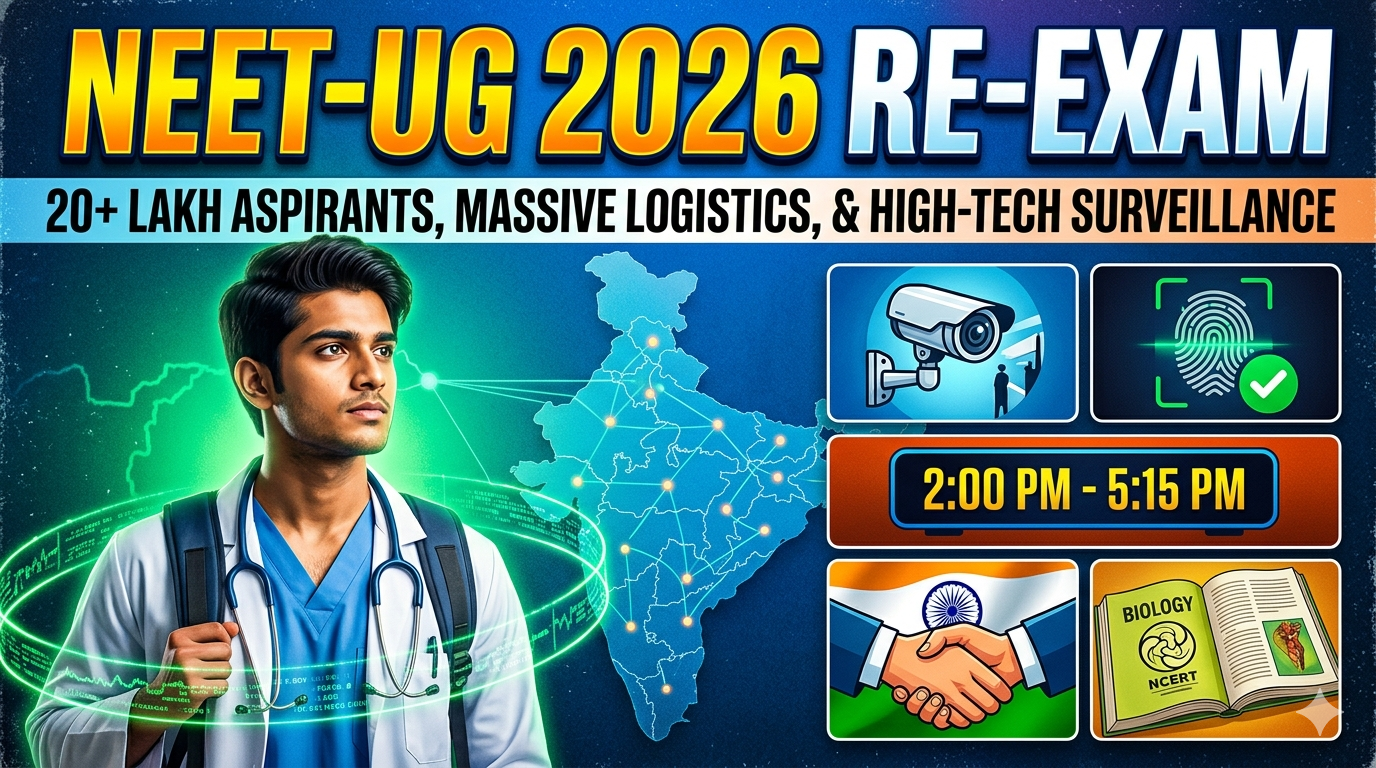
The National Eligibility cum Entrance Test-Undergraduate (NEET-UG) 2026 re-examination, held on June 21, 2026, marks a watershed moment in the history of Indian competitive examinations. Following the cancellation of the May 2026 session due to unprecedented allegations of paper leaks, the National Testing Agency (NTA) was tasked with the Herculean effort of restoring public trust. Over 20 lakh medical aspirants across 5,440 domestic centres and 14 international locations appeared for this make-or-break test.
This event was not merely an examination; it was a massive logistical operation involving nearly 7 lakh officials, high-tech surveillance, and a nationwide debate on the future of medical education.
The Architectural Scale of the Re-Test

The administrative response to the controversy was swift and comprehensive. To ensure transparency, the NTA implemented a multi-layered security framework that moved beyond traditional invigilation. Key security highlights included:
Virtual Monitoring
An expansive network of over 1.38 lakh CCTV cameras provided live feeds to a central oversight system, allowing monitors at the national, state, and ministry levels to intervene in real-time.
Anti-Cheating Technology
To counter the threat of electronic malpractice, 51,311 signal jammers were deployed, rendering unauthorised communication devices ineffective within examination halls.
Biometric Integrity
Mandatory face and Aadhaar-based biometric authentication were enforced to ensure that the candidate taking the exam was the same individual who registered, eliminating the risk of impersonation.
The involvement of multiple central departments—including the Indian Air Force, the Department of Posts, and the Central Armed Police Forces—underscored that this was a priority mission for the Indian government.
Academic Performance: Decoding the Difficulty Shift
For the millions of students who had spent months preparing for the original exam, the re-test presented a different set of challenges. Experts and students alike noted that the 2026 re-exam was “more demanding” than its predecessor.
1. Physics: The New Benchmark for Rigor
Physics emerged as the most formidable section. Unlike previous years where direct, formula-based questions were common, the 2026 re-test emphasized conceptual depth.
The Problem: Lengthy, calculation-intensive numerical problems dominated the paper.
The Impact: Students had to dedicate significantly more time to each question, creating a bottleneck that hampered their ability to address other sections.
Expert Take: Analysts suggest this shift is intentional. By moving away from rote memorization, the NTA is filtering for candidates with high analytical aptitude—a critical skill for prospective doctors.
2. Chemistry: Balanced yet Challenging
The chemistry section received mixed feedback. While it remained largely rooted in the NCERT syllabus, the phrasing of questions was more nuanced.
Organic Chemistry – held significant weightage, requiring deep conceptual understanding.
Physical Chemistry – featured complex numerical problems that mirrored the rigorous standards seen in engineering entrance exams.
3. Biology: The Steady Anchor
Biology remained the most accessible section. As expected, it was primarily NCERT-based, rewarding students who had maintained consistency in their revision. However, the section was noted for being lengthier, forcing students to read and interpret analytical data more quickly than they might have anticipated.
The Human Element: Resilience and Compassion
Beyond the numbers and statistics, the event was a powerful display of human resolve. The logistical burden the cost of travel, the stress of rescheduling, and the emotional fatigue was immense. Yet, the response was met with remarkable acts of compassion:
Government Sensitivity
Prime Minister Narendra Modi’s decision to wait at the airport to avoid disrupting traffic flow for students was a widely praised gesture, highlighting the state’s awareness of the students’ stress.
Inclusivity
The NTA accommodated over 10,000 candidates with disabilities and made special provisions for students with ongoing medical conditions, ensuring that physical vulnerability did not prevent their pursuit of a medical career.
Community Support
In Kolkata, the story of Shrishti Dubey, who was provided a dedicated room and ambulance support after a road accident, highlighted a growing trend of institutional empathy toward candidates facing personal crises.
Controversies and Lessons Learned
Despite the “fortress-like” arrangements, the examination highlighted friction points.
Strict Adherence to Timelines
The rigidity regarding entry times led to unfortunate instances where students—some delayed by accidents—were denied entry. These cases sparked a national conversation about the need for “humanity-first” flexibility in high-stakes testing.
Cultural and Security Balance
Incidents such as the one in Ajmer, Rajasthan, regarding dress code protocols, showcased the complexity of maintaining national security standards in a culturally diverse society.
These events serve as a learning curve. As India moves toward a more digitized examination infrastructure, finding the middle ground between rigid security and student-friendly policies will be the next major challenge for the NTA.
Strategic Preparation for Future Aspirants
For those preparing for future medical entrance exams, the 2026 re-test provides clear takeaways:
1. Conceptual Mastery over Memorization:The days of relying on “hacks” or direct formula application are fading. Focus on the why behind every concept.
2. Time Management as a Discipline: The increased complexity of Physics and lengthiness of Biology highlight the need for rigorous mock-test practice.
3. Endurance Training: Medical entrance is now a test of mental endurance. Incorporate stress-management techniques, such as mindfulness or regular physical activity, into your study routine to maintain long-term cognitive clarity.
The Road Ahead
The NEET-UG 2026 re-examination has undoubtedly left a lasting impact. While it has successfully restored the immediate process, the long-term success of this endeavour will be judged by the efficiency of the upcoming counseling and admission cycles. For the 20 lakh aspirants who walked through those gates, the day was not just about the final score; it was a testament to their ability to persevere in the face of uncertainty.
Disclaimer
This article is curated for educational and informational purposes only. It is based on publicly available news reports, expert academic analysis, and student feedback regarding the NEET-UG 2026 examination. The author and this website are not affiliated with the National Testing Agency (NTA), the Ministry of Education, or any government body. While every effort has been made to ensure the accuracy of the information provided, we assume no liability for any errors or omissions. Readers are strongly advised to consult the official NTA website ([https://nta.ac.in](https://nta.ac.in)) for all final decisions, official results, counseling dates, and policy updates.
Official Website for more info @ https://neet.nta.nic.in/
Do follow for more info @ http://roydailyupdate.in
Do Connect Whatsapp @ https://chat.whatsapp.com/K5POJK9KbpN8egjjOCaOw6
1 thought on “NEET-UG 2026 Re-Examination: A Case Study in National Resilience and Logistical Precision”