

‘Lift 20 kg, Work 12-Hour Shifts’: Viral Zepto Internship Ad Sparks Gender Bias Debate
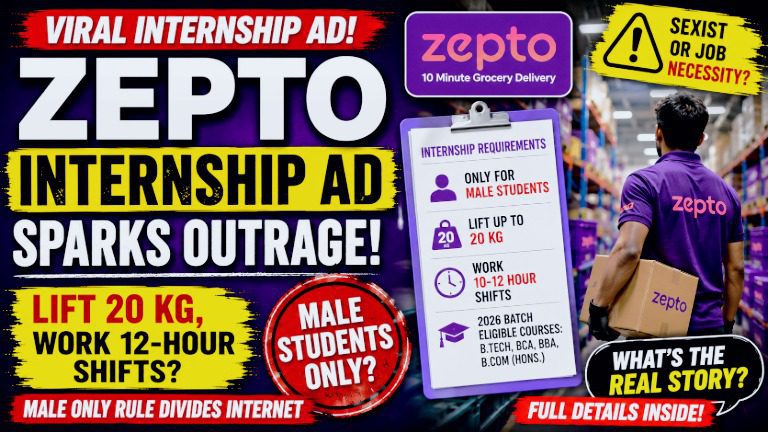
A purported Zepto internship advertisement has gone viral after a screenshot appeared to show that the opportunity was restricted to male students and required applicants to be capable of lifting up to 20 kg and remaining on their feet during 10–12-hour shifts.
The unusual combination of academic eligibility, gender-specific wording and physical requirements has triggered a debate on social media over whether the criteria were appropriate for an internship and whether the role was actually an operational position rather than a conventional corporate or technology internship.
Importantly, the listing circulating online has not been independently verified as an official Zepto-wide hiring policy, and there was no publicly available clarification from Zepto at the time the controversy gained traction.

What does the viral Zepto internship listing say?
The controversy began after a screenshot of an alleged Zepto campus recruitment listing was shared on X.
According to the screenshot described in the source material, the internship was reportedly open to male students from the 2026 graduating batch who had no active academic backlogs.
The listed eligible courses reportedly included:
B.Tech
BCA
BBA
B.Com (Hons.)
However, the eligibility criteria that attracted the most attention were not academic.
The listing reportedly stated that candidates should be able to lift up to 20 kg and remain standing during 10–12-hour shifts in a fast-paced working environment.
That wording immediately raised questions because many social media users interpreted the opportunity as a conventional student internship, while the physical requirements appeared more consistent with an operational or warehouse-related role.
Why did the advertisement go viral?
The screenshot was shared on X by user @PriyanshuP1405, who described the physical requirements as resembling “Hyrox level” standards.
The reference was a humorous comparison with HYROX, a fitness racing format that combines endurance and functional-strength exercises.
The post attracted attention because internship advertisements typically focus on factors such as:
educational qualifications,
technical skills,
communication,
analytical abilities,
availability,
academic performance and
relevant experience.
A requirement to lift 20 kg therefore appeared unusual to users who viewed the listing as a student or technology-oriented opportunity.
The controversy became even stronger because the screenshot reportedly specified that applications were open only to male students.
Why are people calling the criteria discriminatory?
One major criticism concerns the reported male-only eligibility condition.
Several users questioned why female students appeared to have been excluded from the opportunity.
Some described the listing as sexist or exclusionary, while others argued that gender should not be used as a substitute for assessing whether an individual candidate can perform the physical duties required by a particular job.
The broader issue is whether a physical requirement should be linked automatically to gender.
If a role genuinely requires an employee to repeatedly lift heavy objects, stand for long periods and work in an operational environment, employers can argue that candidates should be assessed against the actual physical requirements of that job.
However, critics argue that a blanket male-only condition can prevent women who are capable of performing those duties from applying.
That distinction is at the centre of the online debate.
Could the 20-kg requirement be connected to Zepto’s operations?
There is another side to the controversy.
Zepto’s business depends heavily on dark stores, inventory management and rapid order fulfilment.
Operational roles in warehouses and fulfilment centres can involve picking products, moving stock, replenishing shelves, packing orders and standing for extended periods.
Current publicly available listings for Zepto-related picker/packer roles also describe physical activities such as lifting, carrying and standing for extended periods.
An AICTE internship listing for Zepto’s logistics and operations programme in Rajpura also shows that the company has offered internships specifically focused on logistics, inventory management, warehouse space and supply-chain operations.
That context means a physical requirement by itself is not necessarily surprising for an operations internship.
The bigger question is whether the viral listing accurately represented such a role and whether restricting it to male students was genuinely necessary.
Is this really a technology internship?
That remains unclear from the viral material.
The courses mentioned in the screenshot reportedly included B.Tech, BCA, BBA and B.Com (Hons.), which cover a wide range of academic backgrounds.
But the physical requirements suggest that the role could have been connected to operational work rather than software development.
This distinction matters.
For example, an internship involving software engineering, data analysis or business analytics would generally be expected to have requirements related to programming, data handling, analytical skills or business knowledge.
A logistics internship, by contrast, may involve warehouse management, inventory handling and physical movement.
Zepto has publicly advertised different types of internships. Its careers page describes opportunities across functions, while publicly listed internships have included logistics and operations as well as recruitment and analytics-related positions.
Therefore, it would be premature to conclude from one viral screenshot that the physical requirements apply to Zepto internships generally.
The 10–12-hour shift issue
The reported working-hours requirement has also generated criticism.
According to the circulating screenshot, candidates were expected to be comfortable working 10–12-hour shifts.
For students, such a requirement naturally raises questions about workload, academic commitments and the nature of the internship.
A long shift can be understandable in an operational environment where businesses work around peak demand and fulfilment cycles. But an internship is also intended to provide structured learning and professional exposure.
That has prompted users to ask whether the opportunity should be viewed primarily as an internship or as an operational workforce position.
Without an official description of the role, however, it is difficult to determine how those hours were structured, whether they applied every day, or whether the screenshot accurately represented the final terms.
Social media reaction is divided
The response online has not been entirely negative.
While some users criticised the advertisement, others defended the possibility that the requirements reflected the actual demands of the job.
Their argument was straightforward: if the job requires lifting, standing and working in a warehouse environment, candidates should know those requirements before applying.
From this perspective, including a physical requirement can actually improve transparency.
The debate therefore has two distinct components:
First: Is it legitimate to require candidates to meet physical standards for an operational job?
Second: Is it necessary or appropriate to restrict such a role to men?
The first question can potentially be answered by the actual job responsibilities.
The second is more contentious because the physical capability of an individual candidate does not necessarily depend solely on gender.
What Zepto has officially said
At the time of the reported controversy, no publicly available clarification from Zepto was identified explaining the viral listing.
It is therefore unclear whether:
the screenshot was issued directly by Zepto;
it was created or circulated by a campus recruitment partner;
the role was specifically an operations or warehouse internship;
the male-only condition was role-specific;
the 20-kg requirement applied to all selected interns; or
the wording in the viral screenshot was complete and current.
This is an important caveat because a screenshot circulating on social media should not automatically be treated as proof of a company’s broader employment policy.
Zepto’s official careers page currently presents the company as hiring across multiple functions and does not, by itself, establish that the viral conditions apply to all internships.
Why the controversy matters beyond Zepto
The debate has broader implications for India’s rapidly expanding quick-commerce industry.
Companies operating dark stores and fulfilment networks require workers who can handle fast-moving inventory and operate under significant time pressure.
As quick commerce grows, companies increasingly need a combination of:
technology professionals,
supply-chain specialists,
warehouse workers,
operations managers,
customer-support staff,
delivery personnel and
interns supporting different business functions.
That means internship titles can sometimes cover very different kinds of work.
The controversy highlights the importance of clearly describing the actual job rather than relying on a generic internship label.
If a role is physically demanding, applicants should know the lifting, standing and shift requirements before applying.
At the same time, employers face questions about whether eligibility criteria are narrowly tailored to the genuine requirements of the position.
What students should check before applying
Students who encounter similar internship advertisements should not rely solely on viral social-media posts.
Before applying, candidates should verify:
The official company or campus recruitment source
Exact job title
Department and location
Internship duration
Working hours
Stipend and benefits
Physical requirements
Academic eligibility
Selection process
Whether the recruiter is officially authorised
This is particularly important when a job advertisement becomes viral because screenshots can be incomplete, outdated or stripped of the context surrounding the original posting.
The bigger question: job requirement or gender stereotype?
The Zepto controversy ultimately comes down to the difference between a genuine job requirement and a generalised hiring assumption.
If lifting 20 kg and standing for long periods are genuinely essential parts of a specific operations role, informing candidates about those requirements is reasonable.
But whether the role needs to be restricted to male candidates is a separate question.
A more inclusive approach could potentially focus on whether applicants can safely and effectively perform the essential functions of the job rather than assuming capability based on gender.
That is why the viral advertisement has generated a debate that goes beyond one internship.
It raises questions about how India’s new-age companies define internships, how operational jobs are advertised to students and how employers balance workplace requirements with equal access to opportunities.
What we know — and what remains unclear
Confirmed from the circulating report
A purported Zepto internship listing went viral on social media.
The screenshot reportedly restricted applications to male students.
The listed batch was reportedly the 2026 graduating class.
B.Tech, BCA, BBA and B.Com (Hons.) were reportedly among the eligible courses.
The listing reportedly mentioned lifting up to 20 kg.
It reportedly referred to 10–12-hour shifts.
The criteria triggered significant debate online.
Still unclear
Whether the screenshot was an official Zepto listing.
Whether the role was specifically an operations/dark-store internship.
Why the male-only criterion was included.
Whether the physical requirements applied throughout the internship.
Whether Zepto intended the listing to represent a broader hiring policy.
Whether Zepto has formally responded to the controversy.
Bottom line
The viral Zepto internship advertisement has become a talking point because it combines a male-only eligibility condition, a 20-kg lifting requirement and 10–12-hour shifts in a role aimed at students.
Critics see the criteria as exclusionary and question whether such requirements are appropriate for an internship. Supporters argue that operational and warehouse roles can involve genuine physical demands and that applicants should be informed about them upfront.
The key missing piece is an official clarification establishing exactly what the role involved and why the eligibility criteria were written that way.
Until that clarification is available, the viral screenshot should be treated as an alleged or purported internship listing rather than evidence of a company-wide Zepto hiring policy.
FAQs
What is the Zepto internship controversy?
A purported Zepto internship advertisement went viral after reportedly stating that the opportunity was for male students and required applicants to lift up to 20 kg and work 10–12-hour shifts.
Why did the Zepto internship ad go viral?
The combination of a male-only eligibility condition and physical requirements such as lifting 20 kg and standing for long shifts triggered widespread discussion on social media.
Was the Zepto internship really only for male students?
The circulating screenshot reportedly stated that it was open to male students. However, an official clarification establishing whether this was an authorised Zepto policy or a role-specific/campus recruitment condition was not publicly available at the time of the controversy.
Why would an internship require candidates to lift 20 kg?
If the role is connected to logistics, warehouse or dark-store operations, physical activities such as moving inventory can be part of the work. The exact nature of the viral role, however, has not been independently established.
Did Zepto officially confirm the viral advertisement?
No publicly available official clarification was identified at the time the controversy gained traction. Therefore, the screenshot should not automatically be treated as a company-wide Zepto hiring policy.
What courses were reportedly eligible?
The circulating listing reportedly mentioned B.Tech, BCA, BBA and B.Com (Hons.) among the eligible courses for the 2026 graduating batch.
What working hours were mentioned?
The screenshot reportedly referred to 10–12-hour shifts in a fast-paced environment.
Is Zepto hiring interns in other roles?
Yes. Publicly available listings show Zepto-related internships across areas including logistics and operations, recruitment and analytics, indicating that internship requirements can vary considerably by role.
What should students do before applying to a viral job advertisement?
Students should verify the opportunity through the company’s official careers page or an authorised campus placement source and check the role, location, working hours, stipend, eligibility and recruiter details.
Disclaimer
Disclaimer: This article is based on the viral recruitment screenshot and source material available at the time of publication. The internship advertisement described above is presented as a purported listing, and its authenticity, exact context and relationship to Zepto’s official recruitment policy had not been independently established at the time of writing. References to criticism or social-media reactions represent views expressed by users and should not be treated as established facts. Readers should verify recruitment information through Zepto’s official careers channels before relying on any job advertisement.
Do Follow For More Info @ http://roydailyupdate.in
Do WhatsApp @ https://chat.whatsapp.com/K5POJK9KbpN8egjjOCaOw6
About the Author
Ravi is a digital content writer and blogger at Roy Daily Update, covering job updates, breaking news, business, technology, Karnataka news, entertainment and major developments across India and the world.
He focuses on presenting trending developments in a clear, reader-friendly format while adding relevant context to help readers understand the facts behind viral stories.