

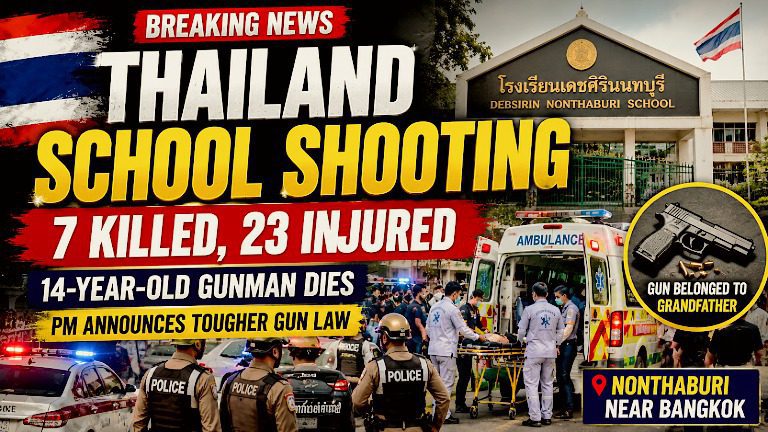
Thailand School Shooting: 14-Year-Old Gunman Kills Seven in Attack Near Bangkok; PM Vows Tougher Gun Laws
Thailand is facing renewed questions over gun control and public safety after a deadly shooting involving a 14-year-old student left seven victims dead and 23 people injured at a school near Bangkok. The teenage gunman also died after turning the weapon on himself, taking the total number of deaths to eight including the attacker, according to the latest Reuters reporting.
The shooting began at the teenager’s grandparents’ home before continuing at Debsirin Nonthaburi School, located in Nonthaburi province on the outskirts of Bangkok.
Among those killed at the school were teachers and staff members. The attack has shocked students, parents and the wider Thai public, while authorities have begun investigating how a teenager was able to access a firearm and carry out the attack.
Thailand’s Prime Minister Anutin Charnvirakul has expressed condolences to the victims and said the government would move toward tougher firearms controls following the tragedy. Reuters reports that the prime minister proposed a new law under which only government officials on duty would be permitted to carry firearms.
What Happened at the Thailand School?
According to authorities and eyewitness accounts, the incident unfolded in two locations.
The teenager first attacked his grandparents at their home. He then went to the school, where gunfire caused students and staff to flee or take shelter inside classrooms.
The school was placed under a major police response as authorities dealt with the active threat.
Students and school employees were seen leaving the campus in distress while emergency workers transported injured people to hospitals.
The incident occurred at Debsirin Nonthaburi School, a branch associated with the well-known Debsirin educational institution in Thailand.
The original Debsirin School was established in Bangkok in the late 19th century and has a long educational history in the country.
The fact that the shooting occurred in an educational environment has intensified concerns among parents and school communities about security measures and access to weapons.
Seven Victims Killed, Shooter Also Dies
The latest reporting indicates that seven people were killed in the rampage, while the teenage attacker subsequently died by suicide.
Police said the victims at the school were teachers and staff members.
A number of people were also wounded during the attack.
Reuters reported that 23 people were injured, while nine remained in critical condition.
The casualty figures are likely to remain an important part of the investigation because several injured victims were in serious condition.
Emergency services transported the wounded to hospitals as police secured the school and surrounding area.
Students Described a Scene of Fear
Students who escaped the school described hearing repeated gunshots.
One student told Reuters that she initially thought the noises could have been firecrackers or something falling inside the school.
The sound reportedly stopped for a short period before gunfire began again.
Another student described being in a classroom when the attacker approached.
Such accounts illustrate the confusion that students faced during the incident and the difficulty of immediately understanding what was happening.
Authorities had earlier warned people to stay away from the area and instructed those inside the building to remain hidden until rescuers could reach them.
The school environment, normally associated with education and safety, suddenly became the centre of an emergency response.
How Did the Teenager Obtain the Gun?
One of the central questions for investigators is how a 14-year-old obtained access to the firearm.
Police said the weapon used in the attack belonged to the teenager’s grandfather, who was a former teacher.
Reuters reported that the weapon was a handgun and that investigators found evidence showing the attacker had fired numerous rounds. Police also said additional ammunition remained after the shooting.
The circumstances surrounding the storage and accessibility of the firearm are expected to become an important part of the investigation.
The case has already renewed debate about whether existing safeguards are sufficient to prevent children and other unauthorised people from accessing privately owned weapons.
Thailand’s Gun Control Debate Returns
The shooting is likely to intensify Thailand’s long-running debate over firearms.
Thailand has laws regulating firearm ownership and possession, but enforcement and the availability of illegal weapons have remained persistent concerns.
The country has one of the highest levels of civilian firearm ownership in Southeast Asia.
The Small Arms Survey estimated in its 2017 global firearms assessment that Thailand had approximately 10.3 million civilian-held firearms, including legal and illicit weapons. The estimate placed Thailand among the countries with substantial civilian firearm ownership.
Separate Small Arms Survey research has also described Thailand as having the largest civilian firearm stockpile in Southeast Asia, with both registered and unregistered firearms contributing to the total.
These figures are estimates rather than a current official weapons census, and they should not be interpreted as a precise count of firearms currently in circulation.
Nevertheless, they demonstrate the scale of the country’s firearms challenge.
Prime Minister Calls for Tougher Gun Controls
The latest shooting has prompted an immediate political response.
Prime Minister Anutin Charnvirakul said a new firearms-control law would be proposed.
According to Reuters, the proposed measure would significantly restrict the carrying of firearms in public, with the prime minister saying that only government officials on duty should be permitted to carry guns.
The proposal could represent a significant tightening of Thailand’s existing approach to firearm carrying.
However, important questions remain about how such legislation would be implemented, what penalties would apply and whether it would address illegal weapons as well as licensed firearms.
The effectiveness of any new law will ultimately depend not only on the wording of the legislation but also on enforcement.
Why Gun Access Is Becoming a Major Issue
The Thailand shooting highlights a difficult policy problem faced by many countries: laws may regulate firearm ownership, but preventing weapons from reaching unauthorised people can be much more complicated.
In this case, police say the weapon belonged to a family member.
That raises questions about safe storage, access controls and the responsibilities of licensed firearm owners.
Authorities may therefore examine not only the teenager’s actions but also how the weapon was stored and whether existing regulations were followed.
A broader policy response could include stronger storage requirements, tighter background checks, improved monitoring of firearm licences and restrictions on access by minors.
Mental Health and Early Intervention
The investigation may also examine the teenager’s personal circumstances, behaviour and possible warning signs.
However, authorities and the public should be careful not to assume a simple connection between mental health problems and violence.
Most people experiencing mental health difficulties are not violent.
The more useful policy question is whether schools, families and authorities have effective systems for identifying serious behavioural concerns and responding appropriately when a young person presents a credible risk to themselves or others.
School counsellors, teachers, parents and mental-health professionals can potentially play an important role in early intervention.
But such measures need to operate alongside firearm-safety policies rather than replacing them.
Schools Across the Area Reacted
The shooting also had an immediate effect on other schools in the surrounding area.
Some nearby schools suspended classes or allowed students to return home early as authorities responded to the incident.
For students who witnessed the shooting or were trapped inside the school during the emergency, psychological effects may continue long after the physical danger has ended.
Schools could therefore face a second challenge: supporting students and teachers who experienced trauma.
Counselling and psychological support may become an important part of the recovery process.
Thailand Has Experienced Previous Mass Shootings
The latest attack is not an isolated incident in Thailand’s recent history.
The country has experienced several major shootings in recent years, including a devastating attack at a childcare centre in northeastern Thailand in 2022.
Thailand has also seen other high-profile shootings involving shopping centres and public locations.
Reuters described the latest incident as the country’s worst mass killing in nearly four years.
Each major incident has generated debate about firearms legislation, illegal weapons, enforcement and public safety.
The latest case could therefore become another turning point in Thailand’s gun-control debate.
What Could Change After the Shooting?
The government’s proposed firearms legislation could lead to several possible policy changes.
Potential areas of focus include:
Restrictions on carrying firearms in public
Stronger firearm-storage requirements
Tighter licensing procedures
Greater scrutiny of firearm owners
Stronger controls over illegal weapons
Improved enforcement
Additional safeguards against access by minors
Greater cooperation between police and other authorities
Better support for schools facing security threats
It remains too early to know which measures will ultimately become law.
The government’s immediate commitment to new legislation nevertheless indicates that firearms policy will remain a major political issue following the attack.
The Larger Question: Can Tougher Laws Prevent Future Attacks?
Introducing a new law can be an important step, but legislation alone cannot guarantee that similar incidents will never happen again.
Effective firearms policy generally depends on multiple layers of protection.
These can include responsible ownership, secure storage, licensing systems, law enforcement, intelligence gathering and rapid intervention when credible threats emerge.
The Thailand case demonstrates why access to a legally owned firearm can become a serious public-safety concern when weapons are not adequately secured.
The investigation may therefore provide important information about where the existing system failed.
What Happens Next?
Authorities will continue investigating the shooting, including the teenager’s movements before the attack, how he accessed the firearm and ammunition, and whether anyone had previously noticed warning signs.
Police will also need to establish a detailed timeline of events at the home and school.
Meanwhile, hospitals will continue treating injured victims, including those in critical condition.
For the families of those killed, the immediate priority is mourning and recovery.
For the government, however, the tragedy has created pressure to address the larger firearms problem.
Thailand Shooting: Key Facts
Location: Nonthaburi province, near Bangkok, Thailand
Date: August 7, 2026
Attacker: 14-year-old student
Victims killed: Seven
Shooter: Also died after turning the gun on himself
People injured: 23, according to the latest Reuters report
Critically injured: Nine
School: Debsirin Nonthaburi School
Weapon: Handgun belonging to the shooter’s grandfather, according to police
Government response: Prime Minister Anutin Charnvirakul has pledged a new firearms-control law.
Conclusion
The Thailand school shooting has left communities around Bangkok grieving and has once again placed the country’s firearms regulations under intense scrutiny.
The immediate tragedy is the loss of seven victims, along with the death of the teenage attacker, while dozens of others were injured. But the incident also raises difficult questions about firearm access, safe storage, enforcement and the ability of authorities and communities to identify risks before violence occurs.
The fact that police say the weapon belonged to the teenager’s grandfather makes firearm access a particularly important part of the investigation.
Prime Minister Anutin Charnvirakul’s decision to push for tougher firearms legislation shows that the government intends to respond to the tragedy with policy changes.
The challenge now will be turning that political response into effective measures that can reduce unauthorised access to firearms while strengthening public safety.
For students, teachers and families affected by the attack, however, the focus remains much more immediate: caring for the injured, supporting traumatised students and remembering those who lost their lives.
The coming weeks will show whether this tragedy becomes another moment of public debate—or a catalyst for lasting changes to Thailand’s gun-control system.
Thailand School Shooting: What Happens Next and Why the Attack Could Change Gun Laws
The deadly shooting near Bangkok has raised questions that extend far beyond the immediate investigation.
While police work to establish exactly what happened, the government is already facing pressure to explain how a 14-year-old was able to obtain a handgun and carry out an attack inside a school.
The central issue is not simply whether Thailand already has gun laws. It does.
The bigger question is whether those laws are being enforced effectively and whether existing safeguards are strong enough to prevent firearms from reaching children or other unauthorised people.
The Firearm Access Question
One of the most important facts emerging from the investigation is that police say the handgun used by the teenager belonged to his grandfather.
That detail could make firearm storage a major focus of the investigation.
A licensed firearm owner may comply with ownership requirements but still create a serious risk if a weapon and ammunition can be accessed by a child.
The investigation will therefore likely examine how the firearm was stored, who had access to it and whether the weapon was kept in accordance with applicable regulations.
The answers could influence the government’s future approach to firearm ownership.
Rather than focusing only on who can legally own a firearm, policymakers may also consider how firearms must be stored inside homes.
Why Safe Storage Matters
Safe-storage rules can be an important part of firearm regulation because they address the period between legal ownership and unauthorised access.
Potential measures include secure firearm safes, separate storage of ammunition, restricted access to keys or codes and penalties when owners fail to secure weapons properly.
Such measures are particularly important in homes where children or teenagers are present.
If investigators determine that inadequate storage contributed to the attack, Thailand could face pressure to strengthen requirements for firearm owners.
However, any future policy should be based on the evidence from the investigation rather than assumptions about the circumstances.
The Government’s Proposed Response
Prime Minister Anutin Charnvirakul has already indicated that the government intends to introduce tougher firearms legislation following the shooting.
Reuters reports that the prime minister proposed restricting public firearm carrying so that only government officials on duty would be permitted to carry guns.
If implemented, such a measure could represent a significant change.
The government would still need to determine how the rule would apply to licensed firearm owners, security personnel, businesses and other groups that may have legitimate reasons for firearm possession.
Enforcement would be equally important.
A strict law that is poorly enforced may have limited practical impact, particularly in a country where illegal firearms remain an issue.
Illegal Weapons Remain a Separate Challenge
Thailand’s firearm problem is not limited to legally registered weapons.
Researchers have previously estimated that the country has millions of civilian-held firearms, including both legal and illicit weapons. The Small Arms Survey has described Thailand as having the largest civilian firearm stockpile in Southeast Asia.
These figures are estimates and should not be treated as an exact current count.
Nevertheless, they illustrate why simply changing rules for licensed firearm owners may not solve the country’s wider firearms problem.
Authorities also need effective measures against illegal manufacturing, trafficking and possession.
Why Schools Are Under Pressure
Schools are traditionally expected to provide a controlled environment where children can learn safely.
A shooting inside a school can therefore have consequences that extend well beyond the immediate victims.
Students who heard gunfire, witnessed violence or feared for their lives may experience anxiety and distress after returning home.
Teachers and school employees can also be affected.
The psychological recovery process may continue for weeks, months or even longer.
Schools in the affected area may therefore need additional counselling services and support systems for students and staff.
The Psychological Impact on Students
Children respond differently to traumatic events.
Some may become withdrawn, while others may experience difficulty sleeping, anxiety, fear of returning to school or problems concentrating.
Parents and teachers may also struggle to know how much information children should receive about the incident.
Mental-health professionals can play an important role in helping affected students process what happened.
The response should focus on providing support rather than repeatedly exposing children to graphic descriptions or distressing footage of the attack.
Should Schools Increase Security?
The shooting will inevitably generate calls for stronger school security.
Possible measures could include controlled entry points, visitor screening, emergency communication systems, trained security personnel and improved coordination with local police.
But schools must also balance security with the educational environment.
Turning every school into a heavily fortified facility would have financial and social consequences.
The more sustainable approach may be a combination of prevention, emergency preparedness and rapid response.
Schools could conduct age-appropriate emergency drills, establish clear communication procedures and ensure teachers know what to do when a serious threat occurs.
Technology Could Play a Role
Modern security technology may also become part of the discussion.
Schools could potentially use access-control systems, emergency alert networks and surveillance systems to improve situational awareness.
However, technology cannot replace human judgment.
A camera may record an incident, but trained personnel still need to interpret warning signs and respond quickly.
Privacy concerns also need to be considered when introducing surveillance technologies in schools.
The goal should be to create safer schools without unnecessarily turning educational environments into high-surveillance spaces.
Could Thailand Introduce Stricter Licensing Rules?
Another possible area of reform is firearm licensing.
The government could consider stronger background checks, periodic reviews of licences and additional requirements for firearm owners.
Authorities could also examine whether individuals with a history of serious threats or dangerous behaviour should be subject to additional restrictions.
Again, the effectiveness of such measures would depend heavily on implementation.
A licensing system needs accurate databases, effective police coordination and consistent enforcement.
The Role of Parents and Families
The incident also raises questions for families.
Parents and guardians who legally own firearms may need to reconsider how weapons are stored and who can access them.
Children should never be able to obtain firearms or ammunition simply because they are kept somewhere accessible inside a family home.
Education about firearm safety could therefore become another component of Thailand’s response.
The responsibility cannot rest solely with the government.
Firearm owners also have an important role in preventing unauthorised access.
What Investigators Will Need to Establish
The investigation will likely focus on several key questions.
1. How did the teenager access the firearm?
Police have said the gun belonged to his grandfather. Investigators will need to establish how the teenager obtained it.
2. Was the weapon stored securely?
This could determine whether existing safe-storage requirements were followed.
3. How did the teenager obtain ammunition?
Investigators may examine where the ammunition came from and how much was accessible.
4. Were there warning signs?
Authorities may investigate whether anyone had observed threatening behaviour or other indications of a potential risk before the shooting.
5. Was the attack planned?
Thai authorities have described the attack as appearing prepared and deliberate. Investigators will need to establish the extent of planning and whether anyone else was involved.
6. Did the teenager have access to other weapons?
Authorities may examine the family home and other locations to determine whether additional firearms or ammunition were accessible.
Why the Age of the Attacker Matters
The fact that the alleged attacker was only 14 years old makes the case particularly disturbing.
It also creates difficult questions about juvenile access to weapons, parental responsibility and early intervention.
However, the investigation should avoid speculation until authorities establish the teenager’s circumstances.
It is important to distinguish confirmed evidence from rumours circulating online after a major tragedy.
Authorities should provide verified information while protecting the privacy of minors and victims.
Social Media and Misinformation
Major shootings often produce a flood of unverified information on social media.
Old photographs, unrelated videos and false claims can spread rapidly during an emergency.
Families searching for information about loved ones can be particularly vulnerable to misinformation.
For that reason, readers should rely on police, hospitals, government agencies and established news organisations for confirmed casualty information.
News outlets also have a responsibility to avoid publishing unverified claims about the attacker, victims or motive.
Thailand’s Wider Security Debate
The shooting comes after several major firearms-related incidents in Thailand in recent years.
Those incidents have repeatedly prompted public discussions about gun ownership and enforcement.
The latest attack could therefore become another test of the government’s ability to turn public concern into practical policy.
The government may face pressure from several directions.
Some citizens will demand significantly tougher firearm controls.
Others may argue that enforcement against illegal weapons should receive greater attention.
The government will need to balance these competing concerns while ensuring that new measures are legally enforceable and practically effective.
What Could a New Law Look Like?
If the government proceeds with new legislation, reforms could potentially address several areas:
Public carrying: Restricting when and where firearms may be carried.
Safe storage: Strengthening requirements for storing weapons and ammunition.
Licensing: Increasing scrutiny of applicants and existing licence holders.
Illegal firearms: Expanding enforcement against unregistered weapons.
Penalties: Increasing consequences for unsafe storage or unlawful possession.
Access by minors: Creating stronger safeguards to prevent children from accessing firearms.
Enforcement: Improving coordination between police and licensing authorities.
The final legislation will determine whether these proposals become meaningful reforms.
Could the Shooting Affect Thailand’s Tourism Image?
Thailand is one of the world’s major tourism destinations.
A single shooting does not determine the overall safety of a country, and visitors should not automatically interpret the incident as evidence that Thailand is generally unsafe.
Nevertheless, highly publicised mass-casualty incidents can influence perceptions.
The government’s response will therefore matter not only domestically but also internationally.
A transparent investigation and credible safety measures could help reassure the public and visitors.
Economic Impact Likely to Be Limited Unless Violence Escalates
The immediate economic impact of an isolated shooting is likely to be much smaller than the impact of prolonged political instability or widespread violence.
Financial markets generally distinguish between isolated criminal incidents and events that threaten broader economic stability.
However, repeated high-profile attacks can affect consumer confidence and perceptions of public safety.
For Thailand, maintaining confidence among residents, tourists and investors will therefore depend partly on demonstrating that authorities can respond effectively.
What Happens to the School Now?
The affected school community will face a long recovery process.
Classes may resume only after authorities determine that the site is secure.
Students and teachers may need counselling before returning to normal routines.
Parents may also demand additional security measures before allowing children to return.
School administrators will therefore have to balance emotional recovery with the practical need to restore education.
The Bigger Lesson
The central lesson from the tragedy may not be simply that Thailand needs stricter gun laws.
The bigger question is whether the country can build a system in which firearms are difficult for unauthorised people to access, threats are identified early and emergency responses are fast and coordinated.
Those objectives require several institutions to work together.
Police need effective intelligence and enforcement.
Schools need emergency plans.
Families need secure firearm storage.
Healthcare systems need trauma support.
Government agencies need reliable licensing and firearm databases.
And policymakers need evidence-based legislation.
No single measure can eliminate the risk entirely.
What Readers Should Watch in the Coming Days
Several developments will be particularly important:
Investigation findings: Authorities may release more information about how the teenager obtained the firearm.
Gun-law proposal: The government’s promised legislation could provide the clearest indication of the policy response.
Victim updates: The condition of critically injured victims could change the final casualty figures.
School reopening: Authorities will determine when the affected school can safely resume classes.
Security measures: Other schools may introduce temporary or permanent security changes.
Public debate: Thailand’s broader discussion over civilian firearm ownership is likely to intensify.
Final Analysis
The Thailand school shooting is a devastating reminder that firearm access, school safety and enforcement are interconnected issues.
The fact that authorities say the weapon belonged to a family member makes secure storage and unauthorised access central questions in the investigation.
At the same time, the existence of illegal firearms means Thailand’s response cannot focus exclusively on licensed gun owners.
The government now has an opportunity to examine the entire firearms-control system—from licensing and storage to enforcement and illegal weapons.
But legislation will be judged by its implementation.
The families of the victims deserve answers, injured people need continued medical care, and students and teachers who experienced the attack need long-term psychological support.
For Thailand, the most important question now is whether the tragedy leads to practical changes that can reduce the possibility of another school shooting.
The coming weeks will reveal whether the government’s proposed reforms become lasting policy or remain primarily a response to public anger following another national tragedy.
FAQs
1. What happened in the Thailand school shooting?
A 14-year-old boy opened fire after an incident that began at his grandparents’ home and continued at a school in Nonthaburi province near Bangkok. Seven people were killed and 23 injured, according to the latest reporting.
2. How many people were killed in the Thailand shooting?
Seven victims were killed. The teenage attacker also died after turning the gun on himself.
3. How many people were injured?
The latest reported figure is 23 injured, with nine reported to be in critical condition.
4. How old was the Thailand shooter?
Authorities identified the attacker as a 14-year-old student.
5. Which school was attacked?
The shooting took place at Debsirin Nonthaburi School in Nonthaburi province near Bangkok.
6. What gun was used in the attack?
Police said the teenager used a handgun that belonged to his grandfather.
7. What has Thailand’s government said after the shooting?
Prime Minister Anutin Charnvirakul has expressed condolences and indicated that the government intends to introduce tougher firearm-control measures.
8. Why is the shooting important for Thailand’s gun-control debate?
The incident has renewed questions about how firearms are stored, how minors can gain access to weapons, enforcement of existing regulations and the availability of illegal firearms.
9. Is Thailand planning a new gun law?
The prime minister has announced plans for tougher firearm legislation, although the precise details and implementation of any new law will depend on the government’s legislative process.
10. Will the casualty figures change?
They could. Several injured victims have reportedly been in critical condition, so authorities may provide updated figures as the medical situation develops.
Disclaimer
Disclaimer: This article is intended for informational and educational purposes only. Information about the Thailand shooting, casualties, investigation and government response is based on reports available at the time of publication and may change as authorities release further updates. Roy Daily Update does not independently verify every detail reported by third-party news organisations and does not intend to speculate about the victims, attacker, motive or ongoing investigation. Readers should refer to official statements and reliable news sources for the latest confirmed information. Any images used with this article are for illustrative or editorial purposes where applicable.
Do Follow For More Info @ http://roydailyupdate.in
Do WhatsApp @ https://chat.whatsapp.com/K5POJK9KbpN8egjjOCaOw6
About the Author
Ravi H Irannanavar is a blogger and digital content creator who covers breaking news, business and stock-market developments, government and recruitment updates, technology, sports and major national and international events. Through Roy Daily Update, he focuses on presenting important developments in a clear, reader-friendly format while adding relevant background and context to help readers understand the bigger picture.
The content published on Roy Daily Update is prepared using information from credible news reports, official announcements and publicly available sources. The aim is to provide timely, informative and easy-to-understand coverage for readers.