

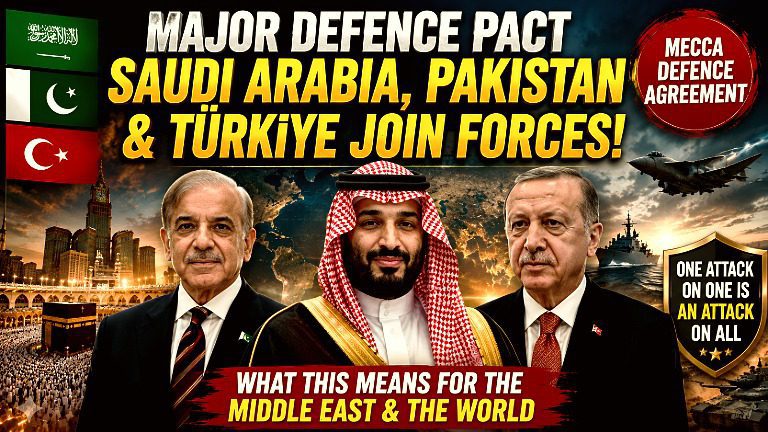
Saudi Arabia, Pakistan and Türkiye Sign Defence Pact:
A major new security development is taking shape in the Middle East after Saudi Arabia, Pakistan and Türkiye signed a joint defence agreement in Mecca on August 7, 2026.
The agreement marks a significant step in military cooperation between the three countries at a time when regional security tensions remain elevated. According to the joint statement, the three countries have agreed that an armed attack against one of them will be treated as an attack against all three.
The pact is therefore more than a routine military cooperation arrangement. It sends a strong strategic message about collective security and could influence how Saudi Arabia, Pakistan and Türkiye approach future regional crises.
At the same time, the agreement does not automatically mean that the three countries have created a NATO-style military alliance. The exact mechanisms through which the commitment would operate, including how individual military responses would be coordinated, will be important to watch.
What Is the New Mecca Defence Agreement?
The agreement, signed in Mecca, establishes a framework for closer defence cooperation between Saudi Arabia, Pakistan and Türkiye.
Its most significant element is the collective-security principle: an armed attack against one of the participating countries is to be regarded as an attack against all three.
That language is strategically important because it raises the potential cost of military action against any one member.
The pact also builds on defence relationships that already existed between the three countries. Pakistan and Saudi Arabia have maintained military cooperation for decades, while Pakistan and Türkiye have developed increasingly close defence-industry and military relationships.
Saudi Arabia and Türkiye have also expanded their defence cooperation in recent years, including cooperation involving Turkish defence products and military technology.
The new trilateral framework brings these separate relationships into a broader security arrangement.
Why Was the Agreement Signed Now?
Timing is one of the most important aspects of the development.
The agreement comes while the Middle East is experiencing serious military and geopolitical uncertainty. Saudi Arabia has faced security concerns connected to the wider regional conflict, while Pakistan and Türkiye are also concerned about instability affecting their security and economic interests.
For Riyadh, regional security is directly connected to economic ambitions.
Saudi Arabia is pursuing major economic diversification and infrastructure programmes under its long-term development strategy. Prolonged regional instability can threaten energy infrastructure, shipping routes, investment confidence and major development projects.
A stronger relationship with Pakistan and Türkiye could therefore provide Saudi Arabia with additional diplomatic and defence partnerships beyond its traditional security relationships.
Saudi Arabia’s Strategic Interest 
Saudi Arabia has significant economic and strategic interests across the Gulf and wider Middle East.
The kingdom remains one of the world’s most important energy producers, while its economy is undergoing a major transformation designed to reduce dependence on oil.
Security is therefore closely connected to economic policy.
Oil facilities, airports, ports, shipping lanes, tourism destinations and major infrastructure projects all depend on a stable security environment.
The new agreement can be viewed as part of Riyadh’s broader effort to strengthen its network of strategic relationships.
Instead of relying exclusively on one external security partner, Saudi Arabia has increasingly developed relationships with several major regional and international powers.
The agreement with Pakistan and Türkiye adds another layer to that strategy.
What Pakistan Brings to the Partnership
Pakistan has longstanding military ties with Saudi Arabia.
Pakistani military personnel have historically provided training and other forms of defence cooperation to Saudi forces. The two countries also signed a bilateral Strategic Mutual Defence Agreement in September 2025, creating an earlier framework for collective security cooperation.
The new trilateral arrangement therefore represents an expansion of an existing relationship rather than the creation of an entirely new partnership.
Pakistan also has extensive experience in conventional military operations and maintains a large armed force.
Its geographical position is another strategic factor.
Pakistan sits at the intersection of South Asia, the Arabian Sea and the wider Middle Eastern region. Closer security cooperation with Saudi Arabia can therefore have implications beyond bilateral defence relations.
For Islamabad, stronger ties with Riyadh also have potential economic and diplomatic importance.
Türkiye Adds a Major Defence-Technology Dimension
Türkiye brings another important element to the partnership: a rapidly expanding domestic defence industry.
Over the past decade, Turkish companies have developed and exported a broad range of military technologies, including unmanned systems, naval platforms and other defence equipment.
Türkiye’s defence relationship with Pakistan has also expanded substantially.
The two countries have cooperated on naval platforms, aircraft-related programmes and other military projects. Saudi Arabia, meanwhile, has also increased defence cooperation with Turkish companies.
Bringing these relationships together could create opportunities for greater defence-industrial cooperation, technology development and military interoperability.
However, the scale of such cooperation will depend on future agreements and implementation.
Does the Pact Target Iran?
One of the biggest questions surrounding the agreement is whether it is specifically designed to counter Iran.
The agreement itself is presented as a defensive arrangement and does not formally identify a particular country as its adversary.
That distinction matters.
Saudi Arabia has faced serious tensions with Iran, while the wider region has also experienced conflict involving Iranian allies and regional armed groups.
However, describing the agreement simply as an anti-Iran alliance would oversimplify the strategic calculations of all three countries.
Türkiye, Pakistan and Saudi Arabia each maintain different relationships with Iran.
Their interests are not identical, and all three governments have reasons to avoid uncontrolled regional escalation.
The agreement can therefore be interpreted more broadly as an attempt to strengthen collective deterrence while preserving diplomatic flexibility.
A New Security Architecture?
The pact could contribute to a gradual change in the Middle East’s security structure.
For decades, regional security has been heavily influenced by relationships between Gulf states and major Western powers.
But regional countries have increasingly sought greater strategic autonomy.
Saudi Arabia has developed closer relations with China, Türkiye, Pakistan and other countries while continuing its important relationship with the United States.
Türkiye, meanwhile, remains a NATO member but has pursued an increasingly independent foreign policy.
Pakistan maintains longstanding relationships with China, Gulf states and Western countries while balancing its own South Asian security priorities.
A trilateral arrangement involving these three countries could therefore become another component of a more complicated, multi-partner regional security system.
What Could Change in Defence Cooperation?
The immediate impact may not be visible through a single military deployment.
Defence agreements often produce their biggest effects through gradual cooperation.
Possible areas could include:
Joint military exercises
Intelligence cooperation
Training programmes
Defence technology partnerships
Maritime security
Counterterrorism cooperation
Military logistics
Air-defence coordination
Defence-industrial collaboration
The effectiveness of the agreement will ultimately depend on how extensively these mechanisms are developed.
A signed document creates a political commitment, but sustained military cooperation requires planning, funding, interoperability and regular exercises.
Economic Implications Could Also Be Important
Defence partnerships can have economic consequences.
Saudi Arabia’s financial resources, Türkiye’s growing defence industry and Pakistan’s military capabilities could create opportunities for increased defence trade.
Joint production and technology partnerships could become particularly important.
For Türkiye, Saudi Arabia represents a major market and investment partner.
For Pakistan, stronger defence and economic ties with Riyadh could provide additional opportunities at a time when Islamabad continues to focus on strengthening its external economic relationships.
For Saudi Arabia, cooperation with Türkiye and Pakistan could support its efforts to develop domestic defence capabilities and reduce dependence on foreign suppliers.
What Does the Agreement Mean for the Region?
The most immediate message is one of deterrence.
By declaring that an attack on one participant would be considered an attack against all three, the countries are attempting to make potential adversaries think carefully before taking military action.
However, deterrence works only when other countries believe the commitments are credible.
That means future developments will be closely watched.
Will the three governments conduct joint military exercises?
Will they establish permanent coordination mechanisms?
Will defence industries cooperate more closely?
Will the countries develop joint responses to maritime or missile threats?
The answers to these questions will determine whether the agreement becomes a largely symbolic political statement or develops into a deeper security partnership.
Why the Mecca Location Matters
The location of the signing also carries considerable symbolism.
Mecca is one of the most important religious centres in the Islamic world, and holding the signing there gives the agreement additional political and symbolic significance.
The participation of the Saudi leadership, Pakistan’s prime minister and Türkiye’s president also highlights the importance each government attaches to the relationship.
The symbolism, however, will need to be followed by practical cooperation if the pact is to have a lasting strategic impact.
What Happens Next?
The next stage will be implementation.
The three governments are likely to face questions about the practical meaning of the collective-defence commitment and how it would operate during a crisis.
Regional governments, international powers and defence analysts will also examine whether the agreement changes military calculations in the Gulf and surrounding areas.
For investors and businesses, the key issue will be whether the pact contributes to greater regional stability.
A more predictable security environment could support energy markets, shipping, tourism and large-scale investment projects. Conversely, if regional tensions continue to escalate, the agreement could become part of a much broader contest over security influence.
Conclusion
The new Saudi Arabia-Pakistan-Türkiye defence agreement represents an important development in Middle Eastern geopolitics.
Its collective-security provision gives the pact a significance beyond ordinary military cooperation, while the existing defence relationships among the three countries provide a foundation for deeper collaboration.
For Saudi Arabia, the agreement strengthens its regional security network. For Pakistan, it expands an already important relationship with Riyadh while deepening ties with Türkiye. For Türkiye, it provides another opportunity to expand its strategic and defence-industry role in the Gulf.
Yet the agreement’s real significance will depend on what happens next.
If the three countries translate the pact into regular exercises, intelligence sharing, defence-industrial cooperation and coordinated security planning, it could become an important component of the region’s evolving security architecture.
If implementation remains limited, its primary impact may instead be diplomatic and symbolic.
Either way, the Mecca agreement signals that Saudi Arabia, Pakistan and Türkiye are seeking a greater role in shaping regional security at a time when the Middle East is undergoing one of its most uncertain periods in years.
What the Saudi-Pakistan-Türkiye Defence Pact Could Mean
The newly signed Saudi Arabia–Pakistan–Türkiye defence agreement could become one of the more consequential security developments in the region, but its real impact will depend on how the three governments translate the political commitment into practical military cooperation.
The agreement signed in Mecca on August 7 says an armed attack against any one of the three countries will be regarded as an attack against all three. Reuters and other reports confirm that the pact comes amid heightened regional tensions and builds on years of bilateral defence cooperation.
A Collective Defence Commitment With Strategic Ambiguity
The most important phrase in the agreement is its collective-defence provision.
At first glance, the wording may remind observers of NATO’s Article 5 principle. However, it would be premature to describe the new arrangement as an “Islamic NATO.” The publicly available details do not establish an identical institutional structure, permanent joint command or automatic military response mechanism.
That distinction is important.
The agreement creates a political and strategic commitment, but the practical response to an attack could depend on the circumstances, the nature of the threat and decisions taken by the three governments.
The ambiguity may actually provide the three countries with diplomatic flexibility while still sending a deterrent message.
Why Saudi Arabia Is Interested
For Saudi Arabia, security has become increasingly connected to its economic transformation.
The kingdom is investing heavily in infrastructure, tourism, technology, energy and other sectors as part of its long-term economic diversification strategy. Regional conflict creates risks for these ambitions by potentially affecting oil infrastructure, shipping, foreign investment and business confidence.
A broader defence network gives Riyadh additional strategic options.
Saudi Arabia already maintains a major security relationship with the United States, so the new pact should not necessarily be interpreted as an immediate replacement for Washington’s role.
Instead, it can be viewed as another layer in Saudi Arabia’s increasingly diversified foreign-policy strategy.
The kingdom can maintain relationships with the United States and other global powers while simultaneously strengthening cooperation with regional partners.
Pakistan’s Role Goes Beyond Military Cooperation
Pakistan brings substantial military experience and a longstanding defence relationship with Saudi Arabia.
The two countries already have a bilateral Strategic Mutual Defence Agreement signed in 2025. That agreement also contained a collective-security principle, making the new trilateral pact an expansion of an existing strategic relationship rather than an entirely new beginning.
Pakistan’s military ties with Saudi Arabia include training and defence cooperation developed over several decades.
Islamabad also has strategic relationships with Türkiye, particularly in defence production and military technology.
This gives Pakistan a potentially important position between the Gulf and wider South Asian security environments.
Türkiye Brings Defence Technology
Türkiye’s contribution could be particularly important in the defence-industrial sphere.
Over the past several years, Turkish defence companies have expanded their international presence, especially in unmanned aerial systems, naval platforms and other military technologies.
Pakistan has already developed close defence-industrial links with Türkiye.
A stronger trilateral relationship could therefore create opportunities for:
Joint defence production
Military technology cooperation
Drone systems
Naval cooperation
Training
Intelligence sharing
Cybersecurity
Defence research
Joint exercises
However, these possibilities should not be treated as confirmed outcomes of the new agreement unless specific contracts or programmes are announced.
Is Iran the Main Target?
The timing inevitably raises questions about Iran.
Saudi Arabia has faced security challenges connected to Iran and Iran-aligned armed groups, while the wider Middle East remains highly unstable.
However, the three countries have not publicly presented the agreement as an alliance directed against a specific country.
That distinction is strategically significant.
Türkiye maintains its own diplomatic and economic relationship with Iran. Pakistan also shares a border with Iran and has strong reasons to prevent instability along its western frontier.
Therefore, the pact appears broader than simply an anti-Iran arrangement.
It can instead be understood as an attempt to strengthen deterrence while giving the three governments greater room to respond collectively to future security threats.
The Nuclear Question
Pakistan’s status as a nuclear-armed country inevitably adds another dimension to discussions surrounding the agreement.
However, the existence of Pakistan’s nuclear arsenal does not mean the new agreement automatically creates a Pakistani nuclear umbrella for Saudi Arabia.
The publicly available information does not establish such an arrangement.
Any claims that the pact guarantees the deployment or transfer of nuclear weapons should therefore be treated cautiously unless the governments themselves provide explicit evidence.
The more immediate significance is conventional defence cooperation and collective deterrence.
Could the Pact Affect India’s Strategic Calculations?
India is likely to monitor the development carefully because all three countries have important relationships with New Delhi, but their individual ties with India are different.
India has substantial economic and energy relations with Saudi Arabia.
At the same time, India has historically had difficult relations with Pakistan, while its relationship with Türkiye has also faced diplomatic disagreements.
The new pact therefore presents a complicated picture for Indian policymakers.
It does not automatically represent an anti-India alliance. Nevertheless, India’s strategic community will likely examine whether closer military cooperation among Pakistan, Saudi Arabia and Türkiye eventually develops into defence-industrial or intelligence arrangements that could affect India’s security environment.
For New Delhi, the most important issue may ultimately be implementation rather than the signing itself.
Economic and Defence Industry Opportunities
The agreement could eventually have economic consequences beyond military affairs.
Saudi Arabia has financial resources and an ambitious industrial-development agenda. Türkiye has a growing defence manufacturing sector, while Pakistan has substantial military experience and established defence production capabilities.
This combination could encourage new projects involving defence manufacturing, maintenance, training and technology.
Saudi Arabia has also been seeking to develop greater domestic defence-production capabilities as part of its broader economic strategy.
If Turkish companies and Pakistani defence institutions become more closely involved, the partnership could support that objective.
Still, the scale of any future defence-industry cooperation will depend on commercial agreements, technology-transfer rules, financing and government approvals.
Maritime Security Could Become Important
The three countries also have significant maritime interests.
Saudi Arabia has coastlines along the Red Sea and the Arabian Gulf. Pakistan sits on the Arabian Sea, while Türkiye controls strategically important maritime access between the Black Sea and Mediterranean through the Turkish Straits.
This gives maritime security a potentially important role in future cooperation.
Possible areas include:
Protection of commercial shipping
Naval training
Maritime surveillance
Counter-piracy operations
Port security
Search and rescue
Protection of critical infrastructure
Any such cooperation would have implications for global trade because the Middle East remains central to international energy and shipping networks.
What Could the Agreement Mean for the United States?
The pact also raises questions about Washington’s role in the Middle East.
The United States remains a major security partner for Saudi Arabia and has extensive military relationships across the Gulf.
But regional countries have increasingly sought greater strategic autonomy.
The new agreement therefore illustrates a broader trend: Middle Eastern states are building overlapping partnerships rather than depending exclusively on a single external power.
For Washington, a stronger regional security network involving Saudi Arabia, Türkiye and Pakistan could have both positive and complicated consequences.
If it contributes to regional stability, it could reduce pressure on US forces. But if competing alliances emerge, managing strategic relationships could become more complicated.
Why the Agreement May Matter for Global Energy Markets
Saudi Arabia’s position in global energy markets makes regional security developments particularly important.
Any serious disruption to Saudi oil production, export infrastructure or regional shipping could affect crude prices and inflation expectations worldwide.
For countries such as India, China, Japan and South Korea, energy-market stability is especially important because they are major importers of crude oil.
A stronger security framework could therefore have an indirect economic benefit if it contributes to regional stability.
But markets will ultimately react to actual events rather than the agreement alone.
What Investors Should Watch Next
The signing itself is only the first stage.
Investors and analysts should watch for concrete developments such as:
Joint military exercises
Regular exercises would indicate that the agreement is moving beyond political symbolism.
Defence-production agreements
New contracts involving Turkish or Pakistani defence companies could reveal the pact’s economic significance.
Intelligence cooperation
Institutionalised intelligence sharing would deepen the security relationship.
Maritime security initiatives
Cooperation around shipping and strategic waterways could have wider regional consequences.
Saudi defence-industry investment
Increased domestic production could create opportunities for foreign defence companies and joint ventures.
Regional diplomatic developments
Any changes involving Iran, the United States or Gulf security could influence the pact’s future direction.
A Potential Shift Toward Regional Strategic Autonomy
Perhaps the biggest long-term question is whether the agreement represents a wider movement toward greater regional strategic autonomy.
Saudi Arabia, Türkiye and Pakistan each have different foreign-policy priorities, but all three have shown interest in maintaining multiple strategic relationships.
That makes the pact significant even if it never develops into a formal military bloc comparable to NATO.
The Middle East is increasingly characterised by overlapping partnerships rather than simple alliances.
Countries can cooperate in defence with one partner, trade with another and maintain diplomatic channels with a third.
The Mecca agreement fits into that increasingly complex environment.
Conclusion: The Real Test Begins After the Signing
The Saudi Arabia-Pakistan-Türkiye defence agreement is strategically important because it combines three countries with significant military, economic and geopolitical influence.
Its collective-defence language sends a clear deterrence signal, while existing bilateral relationships provide a foundation for deeper cooperation.
But the pact’s ultimate importance cannot yet be measured simply by the signing ceremony.
The real test will come through implementation.
If the three countries establish regular military exercises, intelligence mechanisms, defence-industrial partnerships and coordinated security planning, the agreement could contribute to a substantially different regional security architecture.
If those mechanisms remain limited, its main effect could be diplomatic and symbolic.
For now, the agreement signals that Saudi Arabia, Pakistan and Türkiye want a stronger collective role in shaping regional security at a time when geopolitical uncertainty remains exceptionally high.
FAQ Section
What defence agreement did Saudi Arabia, Pakistan and Türkiye sign?
Saudi Arabia, Pakistan and Türkiye signed a joint defence agreement in Mecca on August 7, 2026. The agreement includes a collective-security provision under which an armed attack against one participating country would be regarded as an attack against all three.
Is the new pact an anti-Iran alliance?
The agreement has not been publicly described as an alliance against Iran. Although it comes amid heightened regional tensions involving Iran, the pact is presented as a defensive and collective-security arrangement.
Is this a NATO-style military alliance?
It would be premature to describe the agreement as a NATO-style alliance. The collective-defence language is significant, but the publicly available details do not establish an identical institutional structure or automatic military response mechanism.
Why is Saudi Arabia interested in the agreement?
Saudi Arabia has major economic and security interests across the Gulf and wider Middle East. A stronger relationship with Pakistan and Türkiye could provide Riyadh with additional defence partnerships and strengthen its broader regional security network.
What does Pakistan bring to the partnership?
Pakistan brings a large and experienced military, longstanding defence ties with Saudi Arabia and growing defence cooperation with Türkiye.
What does Türkiye contribute?
Türkiye has a rapidly expanding defence industry, including capabilities in unmanned systems, naval platforms and other military technologies. Its existing defence relationship with Pakistan could support deeper trilateral cooperation.
Could the agreement affect India?
India is likely to monitor the development because it has important economic and diplomatic relationships with Saudi Arabia while maintaining complex relationships with Pakistan and Türkiye. However, the agreement should not automatically be interpreted as an anti-India alliance.
Could the pact affect oil prices?
The agreement itself does not directly determine crude oil prices. However, if stronger regional security cooperation contributes to greater stability around energy infrastructure and shipping routes, it could potentially reduce some geopolitical risk.
Disclaimer
Disclaimer: This article is intended for informational and educational purposes only. It is based on publicly available information, official statements and broader geopolitical analysis available at the time of publication. The article does not constitute political, legal, investment, defence or professional advice. Geopolitical situations can change rapidly, and readers should verify the latest developments through official government statements and reliable news sources before drawing conclusions.
Do Follow For More Info @ http://roydailyupdate.in
Do WhatsApp @ https://chat.whatsapp.com/K5POJK9KbpN8egjjOCaOw6
About the Author
Ravi H. Irannanavar is the founder and editor of Roy Daily Update, an independent digital news platform covering world affairs, geopolitics, business, stock markets, technology, government policies and trending developments. His focus is on presenting complex national and international stories in a clear, accessible and reader-friendly format while highlighting the wider implications for Indian readers.