

Robot vs Usain Bolt: China’s Humanoid Robot Runs 100m in 9.39 Seconds — Did It Really Break the Record?
A remarkable performance by a Chinese humanoid robot has triggered comparisons with one of the greatest sprinters in history.
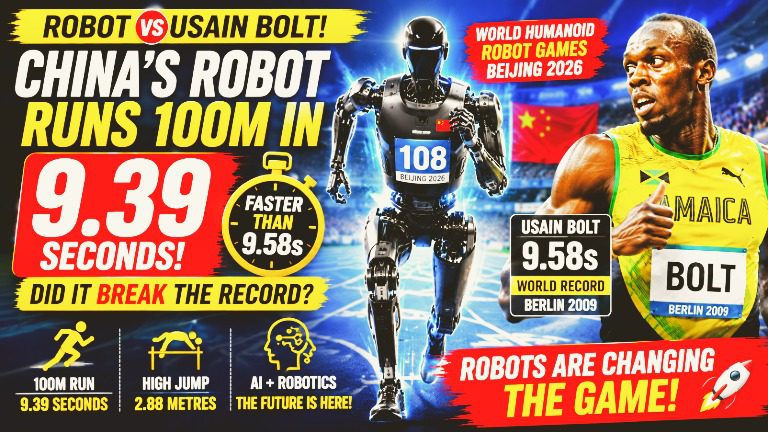
At the World Humanoid Robot Games in Beijing, a humanoid robot reportedly completed a 100-metre sprint in 9.39 seconds. On paper, that is faster than Jamaican sprint legend Usain Bolt’s 9.58-second 100m world record, set in Berlin in 2009.
The headline immediately raises an obvious question: Has a robot actually beaten Usain Bolt’s world record?
The answer is no — not in the official human athletics sense.
The reported 9.39-second performance came in a humanoid-robot competition, rather than a recognised World Athletics event. The robot and human sprinting records are therefore not directly comparable as official sporting records.
Nevertheless, the performance highlights how quickly humanoid robotics is advancing.
What happened in Beijing?
Humanoid robots competed in the World Humanoid Robot Games in Beijing on August 22, in an Olympics-style competition designed specifically to test the physical capabilities of robots.
The event included athletic-style challenges such as running and jumping.
One of the most eye-catching claims from the competition was the reported 100-metre time of 9.39 seconds.
That figure is faster than Bolt’s 9.58-second human world record.
Bolt established his 100m record at the 2009 World Championships in Berlin, and the mark has remained one of the most famous records in athletics.
For a machine designed to resemble the human body, completing the distance in less than 10 seconds is a striking demonstration of robotics technology.
Did the robot actually break Usain Bolt’s world record?
No.
The 9.39-second robot performance should not be described as a new human 100m world record.
Bolt’s 9.58-second mark belongs to the official human athletics record system. A humanoid robot competing in a separate robotics competition is governed by completely different conditions and rules.
The comparison is therefore mainly illustrative rather than an official record comparison.
In other words, the robot may have recorded a faster time over the same nominal distance, but it did not replace Bolt in the record books.
This distinction is important because human athletic records are established under specific competition rules, equipment regulations and measurement standards.
Why is a robot running that fast impressive?
Running on two legs is considerably more complicated for a humanoid machine than simply moving a motorised vehicle from one point to another.
A robot must coordinate multiple joints while maintaining balance.
Its control system needs to synchronise movements involving the hips, knees, ankles and other components. At the same time, sensors and software must continually monitor the robot’s position and help prevent it from falling.
At high speeds, even a small instability can cause a robot to lose balance.
This makes humanoid running an important engineering challenge.
Robot’s 2.88-metre jump creates another sensation
The running performance was not the only eye-catching result reported from the competition.
A humanoid robot reportedly achieved a 2.88-metre standing high jump.
That figure is considerably higher than the 0.95-metre humanoid record cited from the previous year’s competition.
It also appears higher than the 2.45-metre human high-jump world record set by Cuba’s Javier Sotomayor in 1993.
But again, the comparison requires an important qualification.
A standing high jump by a robot is not the same event as the conventional high jump performed by human athletes.
Human high jump involves a running approach and specific competition rules and techniques. A standing jump is fundamentally different.
Therefore, the robot’s reported 2.88-metre performance does not mean that it has broken Sotomayor’s official human high-jump world record.
Why are robots being put into sporting competitions?
The competitions are not simply designed for entertainment.
Sport provides robotics engineers with an unusually demanding environment in which to test machines.
A factory robot can operate within a controlled environment. A humanoid robot designed for real-world use, however, may eventually need to walk across uneven surfaces, climb obstacles, carry objects, react quickly and maintain its balance.
Running and jumping put those capabilities under extreme pressure.
A successful robot needs several technologies to work together, including:
Artificial intelligence
Motion-control software
Sensors
Motors and actuators
Battery systems
Balance-control technology
Real-time decision-making systems
Lightweight mechanical components
A failure in any one of these areas can cause the robot to fall or lose control.
China is becoming a major centre for humanoid robotics
The Beijing competition also highlights China’s growing ambitions in humanoid robotics.
Chinese technology companies and research organisations have been developing robots capable of walking, running and performing increasingly complicated movements.
The long-term objective extends beyond sporting competitions.
Humanoid robots could eventually be deployed in factories, warehouses, logistics operations, dangerous industrial environments and disaster-response situations.
A robot capable of moving in a way similar to humans could potentially work in environments designed for people without requiring every facility to be redesigned for machines.
What makes the 9.39-second figure important?
Even though it is not an official replacement for Bolt’s record, the reported time is significant from an engineering perspective.
A humanoid robot needs to maintain balance while producing rapid acceleration and coordinating its legs.
Humans have evolved specialised biological systems for this. Robots must reproduce some of those abilities using mechanical components, sensors and software.
The competition therefore provides engineers with an opportunity to measure how effectively those systems work together.
The bigger story is not necessarily “robot beats Usain Bolt.”
It is that machines are increasingly capable of performing physical movements that were once considered uniquely human.
Could robots eventually become faster than humans?
It is possible that specialised robots could eventually outperform humans in particular physical tasks.
Machines do not have the same biological limitations as humans. Engineers can design motors, joints and mechanical systems specifically for speed, power or endurance.
But being faster in one particular movement does not mean a robot is generally superior to a human athlete.
Human athletes combine speed, balance, endurance, adaptability and complex decision-making in ways that remain difficult for machines to reproduce.
Robotics competitions are therefore better viewed as technology demonstrations and engineering benchmarks, rather than direct replacements for traditional human sporting records.
The real takeaway
The reported 9.39-second 100m performance is certainly attention-grabbing because it is faster than Usain Bolt’s 9.58-second world record.
However, the robot has not officially broken Bolt’s human athletics record.
Likewise, the reported 2.88-metre standing jump should not be treated as a new human high-jump world record because the event and rules are different.
What the Beijing competition does demonstrate is the rapid progress being made in humanoid robotics.
The machines are moving beyond simply walking.
They are now being engineered to run, jump, balance, accelerate and compete.
And that may ultimately be more significant than whether a robot can claim a number faster than one of the greatest human athletes of all time.
FAQs
- Did a Chinese humanoid robot run 100m in 9.39 seconds?
According to the information provided about the World Humanoid Robot Games in Beijing, a humanoid robot reportedly completed 100 metres in 9.39 seconds.
- Is 9.39 seconds faster than Usain Bolt’s record?
Yes. Numerically, 9.39 seconds is faster than Usain Bolt’s official 100m world record of 9.58 seconds.
- Did the robot officially break Usain Bolt’s world record?
No. The robot’s performance occurred in a humanoid-robot competition and does not replace the official human athletics world record.
- What is Usain Bolt’s 100m world record?
Usain Bolt’s official 100m world record is 9.58 seconds, set in Berlin in 2009.
- Did a robot jump 2.88 metres?
The supplied report says that a humanoid robot reportedly achieved a 2.88-metre standing high jump.
- Did the robot break the human high-jump world record?
No. The reported robot performance was a standing jump, while the human 2.45-metre record belongs to the conventional high-jump event, which uses different techniques and rules.
- Why are humanoid robots competing in sports?
Sporting challenges allow engineers to test robots’ balance, coordination, speed, sensors, actuators and motion-control systems under demanding conditions.
- What could these robots be used for?
Humanoid robots could eventually have applications in factories, warehouses, logistics, disaster-response environments and other areas requiring human-like movement.
Disclaimer
Disclaimer: This article is based on the information provided in the source material and publicly reported claims concerning the World Humanoid Robot Games. Reported robot performances and comparisons with human athletic records should not be interpreted as official human sporting records unless recognised by the relevant sporting authorities. Details surrounding the event may be updated as additional information becomes available. Readers should verify important information through official sources before relying on it. This article is intended for informational purposes only.
Do Follow For More Info @ http://roydailyupdate.in
Do WhatsApp @ https://chat.whatsapp.com/K5POJK9KbpN8egjjOCaOw6
About the Author
Ravi is a digital content creator and blogger at RoyDailyUpdate, covering trending news, technology, business, jobs, entertainment and stories gaining attention online. His focus is on presenting developing stories in a clear, reader-friendly format while highlighting the key facts and context behind viral claims.