

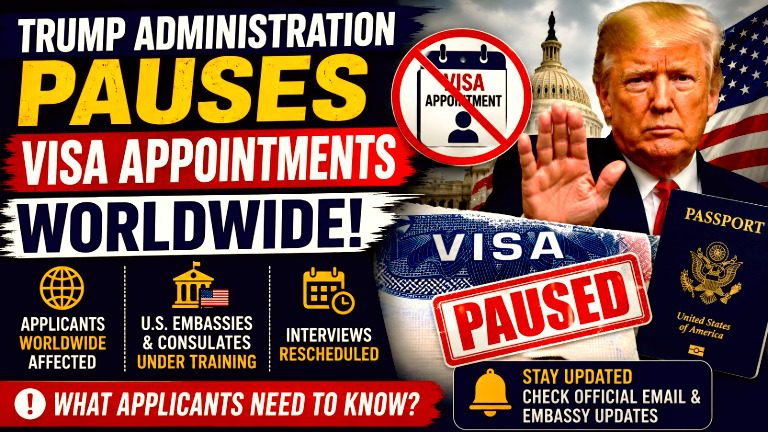
US Visa Appointments Paused Worldwide: Trump Administration Launches Global Training, Immigrant Applicants Face Delays
The Donald Trump administration has temporarily paused or adjusted U.S. visa appointments worldwide as the State Department begins a global training programme for consular officers. The move comes amid a broader tightening of U.S. immigration policy and has raised concerns among visa applicants, particularly those pursuing immigrant visas.
The State Department said the changes are linked to training being conducted at U.S. embassies and consulates around the world. Applicants whose interviews had already been scheduled have reportedly received notifications that their appointments are being rescheduled and that new dates will be communicated later.
For Indians and other applicants planning to travel, work, study or settle in the United States, the development is important—but it is also necessary to distinguish between immigrant visa processing and non-immigrant visa categories such as tourist or student visas. Current reporting indicates that the major disruption is focused on immigrant visa appointments, while the State Department has described the broader scheduling changes as related to its training programme.
What exactly has happened to US visa appointments?
The Trump administration has introduced a global training initiative for U.S. consular officers.
According to the State Department, visa appointment schedules will be adjusted to accommodate the training. The department has not provided a specific end date for the changes.
The Financial Times, which first reported the development, said immigrant visa applicants with scheduled interviews received emails informing them that their appointments were being rescheduled and that they would receive information about a new appointment date.
This means applicants should not automatically assume that their visa applications have been rejected.
In many cases, the immediate issue is delay or rescheduling rather than refusal.
Is the US stopping all visas?
This is one of the most important points to understand.
The phrase “visa appointments worldwide” can sound as though every category of U.S. visa has been completely suspended. However, available reporting indicates that the most significant pause concerns immigrant visa appointments.
Non-immigrant visas—including categories used for tourism, business, study and temporary employment—should not automatically be treated as cancelled simply because of the global immigrant-visa pause. Applicants should rely on direct communication from the relevant U.S. embassy or consulate for their specific category.
Why is the Trump administration doing this?
The State Department says the training is designed to help consular officers evaluate visa applicants more comprehensively and consistently.
One stated objective is to train officers to identify applicants who could potentially become dependent on U.S. public benefits. This is connected to the administration’s broader emphasis on the “public charge” concept when assessing immigration applications.
The administration has been pursuing a significantly stricter immigration policy during Trump’s second term.
The wider programme has included increased immigration enforcement, visa revocations and tighter scrutiny of applicants.
The latest training initiative therefore comes against a much broader policy background rather than being an isolated administrative exercise.
What happens to applicants who already had interviews?
Applicants who had scheduled immigrant visa interviews may face rescheduling.
Reports indicate that some applicants received emails from U.S. embassies or consulates informing them that their appointments would be moved and that another date would be provided later.
For affected applicants, the key point is that a rescheduled appointment is not the same as a visa denial.
Applicants should:
Check the email account used for their visa application.
Monitor messages from the relevant U.S. embassy or consulate.
Check their official visa-application account regularly.
Keep passports and supporting documents ready.
Avoid assuming that a cancelled or postponed appointment means the application itself has been rejected.
Avoid paying third parties claiming they can obtain an earlier appointment unless the service is officially authorised.
Because no clear nationwide timeline has been announced, applicants should be prepared for uncertainty.
Why is this significant for Indians?
The United States is one of the most important destinations for Indian students, professionals, families and immigrants.
Indian applicants use several different U.S. visa categories, ranging from temporary visitor and student visas to employment-related visas and family-based immigrant visas.
Therefore, the effect of the latest development will vary considerably depending on the applicant’s visa category.
For someone waiting for an immigrant visa interview to reunite with family or complete permanent-residency processing, a postponement could have major consequences.
For someone applying for a temporary non-immigrant visa, the situation may be different.
The U.S. State Department’s own visa scheduling information continues to show different processing conditions at individual posts, demonstrating why applicants should check the specific embassy or consulate handling their case rather than relying only on broad social-media reports.
US immigration crackdown has already faced legal challenges
The visa appointment disruption comes shortly after another major legal development involving the Trump administration’s immigration policies.
A federal judge recently struck down a policy that had suspended immigrant visa processing for applicants from 75 countries.
The judge ruled that the policy exceeded the statutory authority of Secretary of State Marco Rubio. The decision was part of a series of legal challenges against Trump’s immigration measures.
The administration has nevertheless continued pursuing stricter immigration enforcement.
Another recent measure involved plans to revoke certain B1/B2 visitor visas held by foreign nationals who have applied for or are seeking asylum in the United States. Reuters reported that the move could potentially affect a very large number of people, although the exact number was not confirmed by the State Department.
Taken together, these developments indicate that immigration and visa screening remain major priorities for the administration.
What does “public charge” mean?
The public-charge concept generally concerns whether an immigrant could become primarily dependent on certain government benefits.
The Trump administration’s latest training programme is reportedly intended to make consular officers more effective at assessing whether applicants may become dependent on U.S. public assistance.
The assessment can involve multiple aspects of an applicant’s circumstances.
However, applicants should not assume that simply having limited income automatically means their visa will be rejected.
Visa decisions depend on the category involved, applicable U.S. immigration law and the individual circumstances of the applicant.
Human rights groups raise concerns
The latest move has also attracted criticism from human rights organisations.
Critics of Trump’s broader immigration policies argue that increasingly strict screening and visa restrictions can interfere with due process and create discriminatory outcomes.
Rights groups have also raised concerns about increased scrutiny of political views, social-media activity and activism in immigration decisions.
The administration, however, has argued that tougher screening is necessary to protect U.S. national security and ensure that immigration rules are properly enforced.
What should US visa applicants do now?
The most practical advice for applicants is to wait for official communication rather than relying on viral posts or unofficial agents.
If an appointment has been rescheduled, applicants should keep checking for the replacement date.
If an applicant has not received any notification, there is no need to assume that their visa application has been cancelled.
Those with urgent travel, family-reunification or immigration deadlines should also consider speaking with a qualified U.S. immigration lawyer where appropriate.
Most importantly, applicants should distinguish between:
Appointment delay → not necessarily a visa refusal
Application refusal → a separate decision by the consular authorities
Visa category → determines which rules and scheduling arrangements apply
When will normal visa appointments resume?
There is currently no confirmed universal date for the full restoration of normal immigrant visa appointment scheduling.
The State Department has said the schedule will be adjusted to accommodate the global training initiative, but it has not specified how long the training will last.
That means applicants should expect further updates from individual U.S. embassies and consulates.
The situation could also evolve because several aspects of the Trump administration’s immigration programme are facing legal challenges.
Bottom line
The Trump administration’s latest move has created fresh uncertainty for people seeking U.S. visas worldwide.
The immediate disruption appears particularly significant for immigrant visa applicants, with scheduled interviews being postponed or rescheduled as U.S. consular officers undergo a global training programme. The State Department says the training is intended to make visa screening more comprehensive and consistent, including identifying applicants who may become dependent on U.S. public benefits.
For Indian applicants, the most important takeaway is not to assume that every U.S. visa category has been stopped. The impact depends on the visa type and the specific U.S. consular post handling the application.
Until the State Department provides a clear timeline, applicants should monitor official communications closely and avoid relying on unverified claims about cancellations or new appointment dates.
FAQs
Q1. Has the US stopped all visa appointments worldwide?
No. The latest reports primarily concern immigrant visa appointments, while the State Department has said visa schedules are being adjusted because of global consular training. Applicants should check the rules for their specific visa category.
Q2. Why are US visa appointments being rescheduled?
The State Department says U.S. consular officers are undergoing a global training programme designed to improve and standardise visa screening.
Q3. Does a rescheduled interview mean my visa has been rejected?
No. Rescheduling an interview does not by itself mean that a visa application has been refused.
Q4. Are Indian applicants affected?
Indian applicants seeking affected visa categories may experience appointment delays or rescheduling. The exact impact depends on the visa category and the relevant U.S. consular post.
Q5. Are tourist visas also affected?
The reported global pause is focused on immigrant visa processing. Applicants for non-immigrant visas should check their specific embassy or consulate for the latest appointment information.
Q6. When will US visa appointments resume normally?
The State Department has not announced a universal date for the return to normal scheduling.
Q7. Why is the US increasing visa screening?
The administration says the training will help officers conduct more comprehensive and consistent evaluations, including identifying applicants who may become dependent on public benefits.
Disclaimer
Disclaimer: This article is based on publicly available reports and information available at the time of publication. Visa rules, appointment schedules and immigration policies can change without prior notice. Readers should verify their individual visa status and appointment information through official U.S. government or embassy channels. Roy Daily Update does not provide immigration or legal advice and is not responsible for decisions made based on this article.
Do Follow For More Info @ http://roydailyupdate.in
Do WhatsApp @ https://chat.whatsapp.com/K5POJK9KbpN8egjjOCaOw6
About the Author
Ravi is the founder and content creator at Roy Daily Update, covering breaking news, trending stories, business, stocks, technology, jobs and important developments from India and around the world. His focus is on presenting complicated news in a simple, reader-friendly format while highlighting the information that matters most to everyday readers.