

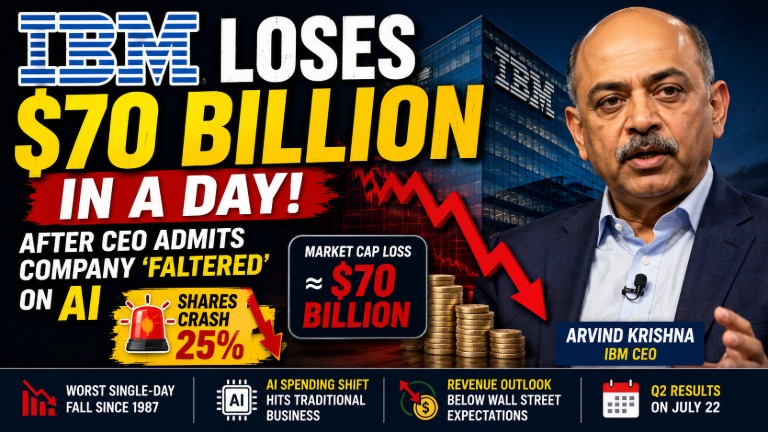

IBM Shares Crash 25%, Wiping Out Nearly $70 Billion After CEO Admits Company “Faltered” on AI
Technology giant IBM suffered one of the biggest stock market shocks in its history after its shares plunged 25% in a single trading session, erasing nearly $70 billion (around ₹5.8 lakh crore) in market value.
The sharp decline came after IBM CEO Arvind Krishna acknowledged that the company had “faltered” and failed to adapt quickly enough to the rapidly changing artificial intelligence (AI) landscape.
The comments sent shockwaves across Wall Street and triggered a broad sell-off in software stocks, raising fresh concerns about how traditional technology companies are coping with the AI revolution.
What Triggered the Massive IBM Stock Crash?
During an investor update, Arvind Krishna admitted that IBM had underestimated how dramatically AI would change enterprise spending patterns.
According to the CEO:
- Several major client deals failed to close.
- Businesses shifted spending toward AI infrastructure.
- IBM could not respond quickly enough to changing customer priorities.
As investors reacted to the disappointing outlook, IBM shares recorded their worst single-day performance since at least 1968, surpassing even the crash seen during the 1987 Black Monday market collapse.
Nearly $70 Billion in Market Value Wiped Out
Before the sell-off, IBM’s market capitalisation stood at approximately $272.78 billion.
Following the 25% decline:
- Nearly $70 billion in shareholder value disappeared.
- IBM recorded one of the largest one-day losses in its corporate history.
- Investors questioned the company’s AI strategy and future growth prospects.
The fall also affected sentiment across the broader software sector.
Other Technology Stocks Also Declined
IBM’s disappointing update dragged several major technology companies lower.
Among the companies that witnessed declines were:
- Microsoft
- Salesforce
- ServiceNow
- Intuit
Most software stocks fell between 2% and 5%, reflecting growing investor concerns about enterprise software spending.
AI Spending Is Reshaping Corporate Priorities
One of the biggest reasons behind IBM’s slowdown is the massive shift in corporate investment toward AI infrastructure.
According to Krishna, many customers redirected their quarterly technology budgets toward purchasing:
- AI servers
- High-performance processors
- Storage systems
- Networking equipment
- Memory chips
These purchases were driven by fears of future supply shortages and rising hardware prices.
As a result, spending on traditional enterprise software and consulting services declined more sharply than IBM had anticipated.
IBM CEO Explains the Unexpected Shift
In a letter to investors, Arvind Krishna said:
“While we anticipated some supply-chain related impact, we did not anticipate the magnitude of the capital expenditure reprioritisation.”
The statement suggests IBM underestimated how aggressively businesses would prioritise AI-related investments over conventional IT spending.
This shift significantly impacted the company’s second-quarter revenue expectations.
Revenue Forecast Misses Wall Street Expectations
IBM now expects second-quarter revenue of around:
- $17.2 billion
Wall Street analysts had previously estimated:
- $17.86 billion
That represents a shortfall of approximately $660 million, making it IBM’s weakest projected quarterly revenue growth in over a year.
The company now expects revenue growth of only 1%, disappointing investors who had anticipated stronger AI-driven momentum.
Why AI Is Hurting IBM’s Traditional Business
IBM has historically relied on several core business segments, including:
- Enterprise software
- IT consulting
- Mainframe computers
- Cloud infrastructure
However, the current AI boom has changed customer priorities.
Instead of investing in software upgrades, companies are spending heavily on physical AI infrastructure such as:
- NVIDIA AI chips
- GPU servers
- High-speed networking
- AI data centres
This shift has reduced demand for several of IBM’s traditional products and services.
Cybersecurity Spending Also Increasing
Krishna also highlighted another major trend affecting technology budgets.
As artificial intelligence becomes more advanced, organizations are increasing investments in:
- Cybersecurity
- Threat detection
- Data protection
- AI security solutions
Businesses are concerned that increasingly sophisticated AI systems could expose vulnerabilities in existing software and digital infrastructure.
This has further redirected technology budgets away from some of IBM’s traditional offerings.
Can IBM Recover From the AI Shift?
Despite the sharp decline in its share price, IBM is not standing still. The company has been investing heavily in emerging technologies to reduce its dependence on its traditional mainframe business.
One of IBM’s biggest strategic bets is quantum computing, where it aims to become a global leader over the next decade.
The company has announced plans to invest more than $10 billion to develop the world’s first large-scale fault-tolerant quantum computer by 2029.
IBM is also expanding its AI ecosystem through partnerships with leading AI companies, including OpenAI, while continuing to strengthen its hybrid cloud business through Red Hat.
However, analysts believe these initiatives are still in the early stages and may take several years before they contribute significantly to IBM’s revenue.
Analysts Call It an “Ugly Moment“

Following IBM’s earnings warning, several market analysts described the situation as one of the biggest setbacks for the software industry this year.
According to analysts:
- AI infrastructure spending is dominating enterprise budgets.
- Traditional software companies face increasing pressure.
- Investors are questioning future growth prospects.
- More earnings downgrades could follow if spending trends continue.
Some experts believe the current shift toward AI hardware could continue for several more quarters before software spending stabilises.
Why Investors Are Concerned

Investors are worried because IBM’s challenges may reflect a broader trend across the technology industry.
Large enterprises now appear to be prioritising investments in:
- AI chips
- Data centres
- GPU servers
- High-speed networking
- Cybersecurity
Instead of purchasing new enterprise software or consulting services.
This changing spending pattern could impact several legacy technology companies beyond IBM.
Key Dates to Watch
Investors are now focusing on IBM’s upcoming financial results.
Important Date
Second Quarter Earnings: July 22, 2026
Markets will closely monitor:
- Revenue performance
- AI business growth
- Red Hat performance
- Cloud revenue
- Guidance for the remainder of 2026
Management commentary during the earnings call will likely influence IBM’s share price over the coming weeks.
What This Means for the Global AI Race
IBM’s experience highlights how rapidly artificial intelligence is reshaping the global technology industry.
Companies that fail to adapt quickly risk losing market share as customers redirect spending toward AI infrastructure.
Meanwhile, businesses leading the AI ecosystem—including chip manufacturers, cloud providers, and AI software developers—continue attracting the majority of enterprise technology investments.
The latest developments also demonstrate that even century-old technology giants must continuously reinvent themselves to remain competitive.
FAQs
Why did IBM shares fall 25%?
IBM shares fell after CEO Arvind Krishna admitted the company had failed to adapt quickly enough to changing AI spending trends, leading to weaker-than-expected revenue projections.
How much market value did IBM lose?
IBM lost nearly $70 billion in market capitalisation during a single trading session.
Who is IBM’s CEO?
IBM is led by Arvind Krishna, an Indian-origin executive who became CEO in 2020.
Why are companies spending more on AI infrastructure?
Businesses are prioritising AI servers, GPUs, storage systems, networking equipment, and cybersecurity to support rapidly growing artificial intelligence workloads.
What is IBM investing in for future growth?
IBM is investing heavily in quantum computing, hybrid cloud services, Red Hat, and artificial intelligence partnerships to strengthen its long-term business.
Conclusion
IBM’s historic stock market decline serves as a reminder of how quickly the technology landscape is evolving in the era of artificial intelligence. CEO Arvind Krishna’s candid admission that the company “faltered” in responding to changing customer priorities triggered one of the biggest one-day losses in IBM’s history.
While the company continues to invest in quantum computing, hybrid cloud technologies, and AI partnerships, investors remain cautious about whether these long-term initiatives can offset slowing growth in IBM’s core businesses. The upcoming quarterly earnings report on July 22 will be closely watched for signs of recovery and the company’s strategy to compete more effectively in the rapidly expanding AI economy.
Disclaimer
This article is intended solely for informational and educational purposes. The information is based on publicly available reports, company statements, and credible news sources available at the time of publication. Financial markets are subject to rapid changes, and stock prices or company guidance may change after publication. Readers should consult official company filings and financial advisors before making investment decisions.
Do follow for more info @http://roydailyupdate.in
Do Connect WhatsApp @ https://chat.whatsapp.com/K5POJK9KbpN8egjjOCaOw6