

India’s Vikram-1 Launch Opens a New Chapter in the Global Space Race
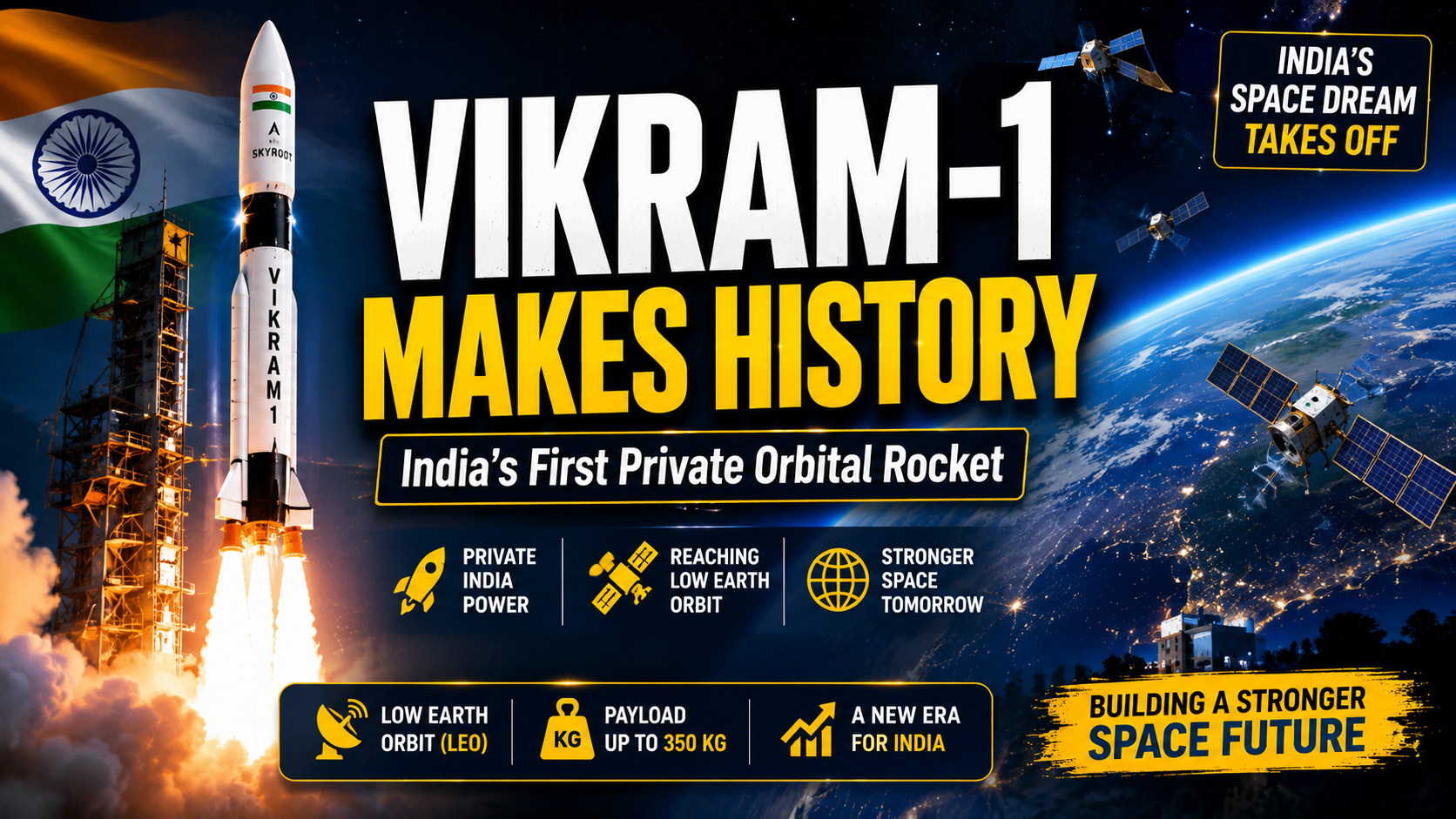
India has taken a historic leap in its space journey after Skyroot Aerospace’s Vikram-1 successfully placed multiple technology demonstration satellites into Low Earth Orbit (LEO).
The successful launch marks the first time a privately developed Indian orbital rocket has reached space, making India one of the few nations capable of supporting private orbital launch services.
Beyond being a technological achievement, the mission signals India’s growing ambition to become a major player in the rapidly expanding global commercial space industry.
The launch also strengthens India’s position in the increasingly competitive race for access to Low Earth Orbit, one of the world’s most valuable regions for satellite deployment.
What Is Vikram-1?
Vikram-1 is India’s first privately developed orbital launch vehicle built by Hyderabad-based startup Skyroot Aerospace, one of India’s leading private space companies.
The rocket successfully lifted off from the Satish Dhawan Space Centre in Sriharikota and delivered multiple payloads into Low Earth Orbit during a textbook mission.
The vehicle is capable of carrying payloads weighing up to 350 kilograms into Low Earth Orbit, making it ideal for launching:
- Small satellites
- Earth observation satellites
- Communication payloads
- Technology demonstration missions
- Scientific experiments
The mission demonstrates that private Indian companies are now capable of independently designing, manufacturing, and launching orbital-class rockets.
Why Is This Launch Historic?
Until recently, India’s space launches were almost entirely handled by ISRO.
However, after the Indian government opened the space sector to private participation in 2020 and introduced the Indian Space Policy 2023, private companies gained the opportunity to build launch vehicles and offer commercial launch services.
Vikram-1 is the first major success under this new ecosystem.
The mission establishes India among the select nations where private companies possess orbital launch capability, highlighting the country’s growing technological strength and entrepreneurial ecosystem.
It also opens new business opportunities in the global satellite launch market, which continues to expand rapidly as demand for smaller satellites increases.
Understanding Low Earth Orbit (LEO)
The real importance of Vikram-1 lies in its destination—Low Earth Orbit, commonly known as LEO.
Low Earth Orbit is the region extending from approximately 160 kilometres to 2,000 kilometres above Earth’s surface.
Satellites placed in this orbit usually complete one revolution around Earth every 90 to 120 minutes.
Because of its close proximity to Earth, LEO provides several advantages:
- Faster communication speeds
- Lower signal delays
- Better Earth imaging quality
- Lower launch costs
- Easier maintenance for certain missions
These benefits make LEO the preferred destination for communication satellites, Earth observation systems, weather monitoring, disaster management, navigation support, and internet constellations.
Why Is Low Earth Orbit Becoming So Valuable?
Experts often describe Low Earth Orbit as the new “gold rush” in space.
Unlike land on Earth, no country officially owns orbital space.
However, under current international regulations, the first organisations to place satellites into specific orbital regions gain practical advantages because later entrants must coordinate around existing satellites.
As more countries and companies launch thousands of satellites, competition for desirable orbital positions is becoming increasingly intense.
Today, many major global projects—including SpaceX’s Starlink and China’s expanding satellite constellations—are focused on securing strategic positions in Low Earth Orbit.
The growing demand has transformed LEO into one of the world’s most valuable technological frontiers.
Global Competition Is Intensifying
Several countries are investing billions of dollars to establish dominance in Low Earth Orbit.
The United States currently leads through private companies such as SpaceX, which has already launched thousands of satellites.
China is rapidly expanding its own mega-constellation projects while investing heavily in reusable rocket technologies and commercial launch providers.
European nations, Japan, and emerging space economies are also increasing investments in satellite deployment and commercial launch services.
Against this backdrop, India’s successful Vikram-1 mission demonstrates that the country is steadily entering the global commercial launch market with growing confidence.
How Vikram-1 Benefits India
The successful mission offers several strategic advantages for India.
It reduces dependence on government launch schedules by enabling private launch capabilities.
It strengthens India’s commercial space ecosystem by encouraging investment in space startups and advanced manufacturing.
It also improves India’s ability to deploy small satellites quickly for civilian, scientific, and national security purposes.
Most importantly, Vikram-1 showcases India’s ability to compete in one of the fastest-growing sectors of the global economy, paving the way for future innovation and international partnerships in space technology.
India’s Private Space Sector Still Faces Major Challenges
While Vikram-1’s successful mission is a landmark achievement, experts believe India’s private space ecosystem still has significant hurdles to overcome before it can compete with global leaders such as the United States and China.
One of the biggest challenges is launch frequency. Countries leading the commercial space race conduct launches far more frequently, enabling them to deploy satellite constellations faster and secure a stronger presence in Low Earth Orbit.
Another challenge is the absence of a fully reusable launch vehicle. Reusable rockets dramatically reduce launch costs and allow companies to conduct missions more frequently. India is currently developing the Next Generation Launch Vehicle (NGLV), but the project is expected to become operational only in the mid-2030s.
Until then, private launch providers such as Skyroot Aerospace and Agnikul Cosmos will play a critical role in expanding India’s commercial launch capacity.
Why Private Space Companies Matter
The emergence of private space companies marks a significant shift in India’s approach to space exploration.
Instead of relying solely on ISRO, India now has an ecosystem where startups can develop rockets, satellites, propulsion systems, and advanced space technologies.
Private participation offers several benefits:
- Faster innovation
- Increased launch capacity
- Lower launch costs
- Global commercial opportunities
- Job creation in high-tech industries
- Stronger national security through rapid satellite deployment
As demand for satellite launches continues to grow worldwide, India’s private space sector could become a major contributor to the country’s economy.
National Security Implications
Beyond commercial opportunities, Low Earth Orbit has become increasingly important for national security.
Satellites operating in LEO support:
- Border surveillance
- Intelligence gathering
- Disaster management
- Military communications
- Navigation systems
- Weather forecasting
A robust private launch ecosystem gives India the ability to quickly replace or deploy satellites whenever required, strengthening the country’s strategic capabilities in an increasingly competitive geopolitical environment.
Government Support for India’s Space Startups
The Government of India has introduced several reforms to encourage private investment in space technology.
Key initiatives include:
- Opening the space sector to private companies in 2020
- Implementing the Indian Space Policy 2023
- Creating IN-SPACe to facilitate private participation
- Launching a ₹1,000 crore venture capital fund for space startups
Industry experts, however, believe that greater government procurement and long-term commercial contracts will be essential to help Indian startups scale their operations.
What Lies Ahead?
The success of Vikram-1 is expected to accelerate investment in India’s private space industry.
Future missions from companies like Skyroot Aerospace and Agnikul Cosmos are likely to focus on:
- Larger payload capacity
- Reusable launch vehicles
- More frequent commercial launches
- International satellite deployment
- Advanced propulsion technologies
If these developments continue, India could emerge as one of the world’s leading commercial launch destinations over the next decade.
FAQs
What is Vikram-1?
Vikram-1 is India’s first privately developed orbital launch vehicle, built by Hyderabad-based Skyroot Aerospace.
Why is the Vikram-1 launch important?
The mission marks India’s entry into private orbital launch capability and strengthens the country’s position in the global commercial space industry.
What is Low Earth Orbit (LEO)?
Low Earth Orbit is the region between approximately 160 km and 2,000 km above Earth’s surface, widely used for communication, Earth observation, navigation, and scientific satellites.
Who developed Vikram-1?
Vikram-1 was developed by Skyroot Aerospace, one of India’s leading private space technology startups.
Why is Low Earth Orbit becoming crowded?
Governments and private companies worldwide are launching thousands of satellites for broadband internet, communication, navigation, weather monitoring, and national security, increasing competition for orbital positions.
Conclusion
The successful launch of Vikram-1 marks a defining moment in India’s space journey. Beyond demonstrating the capabilities of the country’s private aerospace sector, the mission highlights India’s growing ambition to become a key player in the global commercial space economy.
As competition for Low Earth Orbit intensifies, establishing a strong private launch ecosystem will be critical for India’s technological advancement, economic growth, and national security. While challenges such as reusable launch technology and higher launch frequency remain, Vikram-1 has laid a strong foundation for the next phase of India’s space revolution.
Disclaimer:
This article is published for informational and educational purposes only. The information is based on official announcements, publicly available reports, and credible news sources available at the time of publication. Space missions, policies, and technical developments may change over time. Readers are advised to refer to official statements from ISRO, Skyroot Aerospace, and relevant government authorities for the latest updates.
Do Follow For More Info @ http://roydailyupdate.in
Do WhatsApp @ https://chat.whatsapp.com/K5POJK9KbpN8egjjOCaOw6