

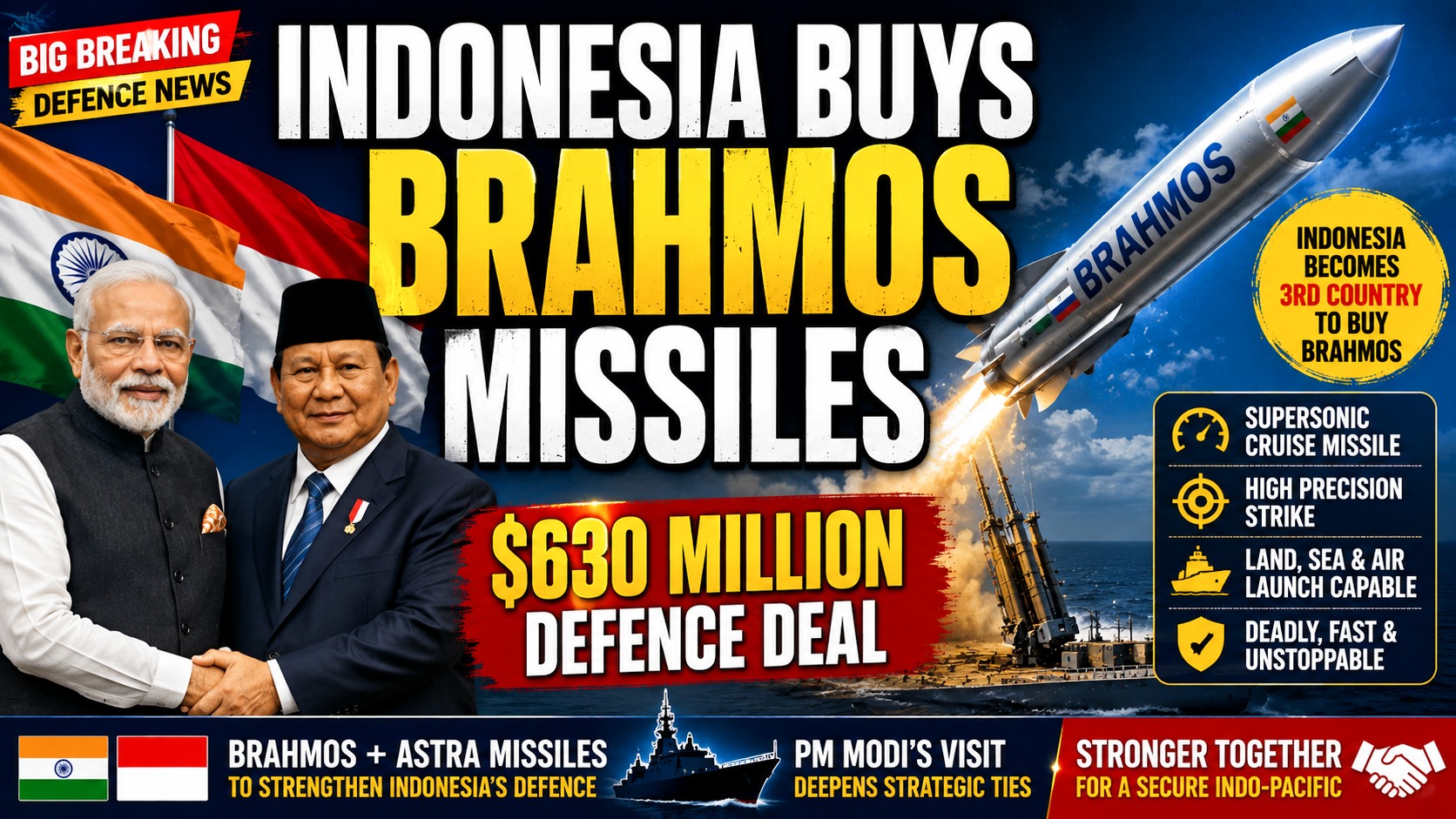

Indonesia to Buy BrahMos Missiles from India
India has taken another significant step toward becoming a major global defence exporter as Indonesia agreed to purchase the BrahMos supersonic cruise missile system along with Astra beyond-visual-range air-to-air missiles, marking one of the biggest defence agreements between the two countries in recent years.
The announcement came during Prime Minister Narendra Modi’s two-day visit to Jakarta, where he held high-level discussions with Indonesian President Prabowo Subianto on defence cooperation, maritime security, trade, regional connectivity and Indo-Pacific strategic coordination.
According to Indian government officials, the missile package is estimated to be worth around $630 million, making it one of India’s largest defence export deals with a Southeast Asian nation.
The agreement also reinforces India’s growing position as a trusted defence manufacturing hub under the ‘Make in India’ initiative while strengthening strategic partnerships across the Indo-Pacific region.
A Landmark Defence Partnership Between India and Indonesia 

The proposed defence package includes the supply of:
- BrahMos supersonic cruise missiles
- Astra beyond-visual-range air-to-air missiles
- Technical support
- Training programmes
- Maintenance services
- Missile infrastructure
- Long-term logistics assistance
Officials familiar with the negotiations indicated that Indonesia is expected to acquire the missile systems in phases, allowing its armed forces to gradually integrate the advanced weapon systems into existing defence infrastructure.
The phased procurement model is expected to make deployment smoother while ensuring Indonesian defence personnel receive comprehensive operational training.
What Makes the BrahMos Missile Special?
The BrahMos missile is jointly developed by India and Russia through BrahMos Aerospace, one of the world’s most successful defence joint ventures.
It is widely regarded as one of the fastest operational supersonic cruise missiles currently deployed anywhere in the world.
Key Features
- Supersonic speed approaching Mach 3
- Extremely high precision strike capability
- Capable of being launched from:
- Land
- Naval ships
- Submarines
- Fighter aircraft
- Low radar signature
- High survivability against enemy air defence systems
- Precision attack capability against both land and naval targets
Its combination of speed, accuracy and versatility has made the BrahMos one of India’s flagship defence exports.
Indonesia Becomes the Third BrahMos Export Customer
With this agreement, Indonesia is expected to become the third country to formally acquire the BrahMos missile system.
Earlier export agreements include:
- Philippines
- Vietnam
Indian defence officials have also indicated that several other countries have expressed serious interest in purchasing the missile system, including:
- United Arab Emirates
- Saudi Arabia
- Brazil
- Egypt
- Argentina
- South Africa
- Several ASEAN nations
Growing international demand reflects increasing confidence in India’s indigenous defence manufacturing capabilities.
Astra Missile Also Part of the Package
Apart from the BrahMos missile, India will also supply the Astra air-to-air missile.
The Astra is India’s indigenous beyond-visual-range missile developed by the Defence Research and Development Organisation (DRDO).
It enables fighter aircraft to engage enemy aircraft from long distances before they become visible to pilots.
Indonesia is expected to integrate Astra missiles with its Russian-made Sukhoi fighter aircraft, significantly enhancing its air combat capabilities.
Why Indonesia Needs BrahMos Missiles
Indonesia occupies one of the world’s most strategically important geographical positions.
The country consists of over 17,000 islands and sits along several major international shipping lanes.
Its maritime boundaries stretch across the:
- South China Sea
- Java Sea
- Sulawesi Sea
- Indian Ocean
- Pacific Ocean
Growing geopolitical tensions in the Indo-Pacific have prompted Indonesia to modernise its armed forces, particularly its navy and coastal defence systems.
The BrahMos missile provides Indonesia with:
- Long-range coastal defence
- Anti-ship strike capability
- Maritime deterrence
- Enhanced strategic flexibility
- Faster military response capability
Defence analysts believe the acquisition will substantially improve Indonesia’s ability to safeguard its maritime interests.
Modi and Prabowo Discuss Broader Strategic Cooperation
Beyond the missile agreement, Prime Minister Narendra Modi and President Prabowo Subianto discussed several broader areas of bilateral cooperation.
Key topics included:
- Maritime security
- Defence industrial cooperation
- Artificial Intelligence
- Semiconductor supply chains
- Critical minerals
- Blue economy
- Counter-terrorism
- Cybersecurity
- Regional connectivity
- Indo-Pacific stability
Both leaders reiterated their commitment to maintaining a free, open and rules-based Indo-Pacific, a principle that has become increasingly important amid evolving regional security dynamics.
India’s Defence Export Ambitions Continue to Grow
The Indonesia agreement represents another milestone in India’s ambitious defence export strategy.
Over the past decade, India has transformed from being one of the world’s largest arms importers into an emerging defence exporter.
Government initiatives such as:
- Make in India
- Atmanirbhar Bharat
- Defence Industrial Corridors
- Increased private sector participation
have significantly strengthened India’s defence manufacturing ecosystem.
Today, Indian defence equipment—including missiles, artillery systems, radars, helicopters, patrol vessels and electronic warfare systems—is attracting interest from dozens of countries worldwide.
A Major Strategic Boost for India’s Indo-Pacific Vision
The proposed BrahMos missile deal is not merely a defence transaction—it represents a significant strategic milestone in India’s broader Indo-Pacific policy. As geopolitical competition intensifies across the region, New Delhi is strengthening partnerships with like-minded nations to promote a free, open and rules-based Indo-Pacific.
Indonesia, the largest economy and most populous nation in Southeast Asia, occupies a strategically important location connecting the Indian and Pacific Oceans. Closer defence cooperation between the two countries is expected to improve maritime security, safeguard critical sea lanes and deepen regional stability.
Prime Minister Narendra Modi has consistently emphasised India’s “Act East Policy” and MAHASAGAR (Mutual and Holistic Advancement for Security Across Regions) vision, both of which aim to strengthen partnerships with ASEAN countries.
Why the BrahMos Missile Is in High Global Demand
The BrahMos missile has emerged as one of the most sought-after defence systems due to its combination of speed, precision and operational flexibility.
Several factors have increased international demand:
- Proven operational capability.
- Supersonic speed makes interception extremely difficult.
- Ability to strike both land and naval targets.
- Deployment from land, sea and air platforms.
- Lower reaction time against hostile threats.
- High accuracy and survivability.
Interest in the BrahMos system grew further after India reportedly used the missile during military operations against Pakistan in 2025, demonstrating its operational effectiveness under combat conditions.
Countries seeking to modernise their coastal defence systems now view the BrahMos as a reliable deterrent against maritime threats.
India’s Defence Export Strategy Gains Momentum
India has significantly expanded its defence manufacturing ecosystem over the past decade.
According to official government data, India’s defence exports have increased several-fold compared to a decade ago, driven by policy reforms, private sector participation and indigenous technology development.
Key export products now include:
- BrahMos cruise missiles
- Akash air defence systems
- Artillery guns
- Radars
- Patrol vessels
- Helicopters
- Electronic warfare systems
- Armoured vehicles
- Surveillance equipment
The Indonesia agreement further strengthens India’s ambition of becoming one of the world’s leading defence exporters by the end of this decade.
Growing India–Indonesia Economic Partnership
The missile agreement comes at a time when economic ties between India and Indonesia are also witnessing rapid growth.
According to official figures:
- Bilateral trade reached approximately $28.15 billion during 2024–25.
- Indonesia remains India’s second-largest trading partner within ASEAN.
- Cooperation continues across sectors such as:
- Energy
- Infrastructure
- Mining
- Pharmaceuticals
- Digital technology
- Agriculture
- Maritime trade
Both countries are expected to explore new investment opportunities during Prime Minister Modi’s visit.
What Does This Mean for Regional Security?
Although neither India nor Indonesia has described the missile deal as targeting any specific country, defence analysts believe the agreement reflects the growing emphasis on strengthening deterrence capabilities in the Indo-Pacific.
The South China Sea has witnessed increasing geopolitical tensions in recent years, making maritime security a key priority for many regional nations.
Enhanced defence cooperation between India and Indonesia is expected to contribute to:
- Stronger maritime surveillance.
- Improved coastal defence.
- Greater interoperability between armed forces.
- Enhanced regional deterrence.
- Protection of international shipping routes.
Analysts note that the agreement also demonstrates increasing confidence in India’s indigenous defence technology.
Expert Analysis
The Indonesia BrahMos missile agreement marks another major milestone in India’s transformation from one of the world’s largest arms importers into a credible global defence exporter.
The deal carries importance beyond its estimated $630 million value. It reinforces India’s strategic role in Southeast Asia, expands defence-industrial cooperation with ASEAN countries and showcases the growing international acceptance of Indian-made military technology.
For Indonesia, the acquisition supports its long-term military modernisation programme and strengthens its ability to protect vast maritime boundaries.
For India, every successful defence export enhances diplomatic influence, creates high-skilled manufacturing jobs, boosts research and development, and strengthens long-term strategic partnerships.
If successfully implemented, the agreement could encourage additional ASEAN countries to consider Indian defence systems in the future.
Key Highlights
- 🇮🇳 India will supply BrahMos supersonic cruise missiles to Indonesia.
- ✈️ Indonesia will also procure Astra beyond-visual-range air-to-air missiles.
- 💰 The defence package is estimated at around $630 million.
- 🚀 Indonesia is expected to become the third international customer for BrahMos.
- 🌏 The deal strengthens India–Indonesia strategic cooperation in the Indo-Pacific.
- ⚓ Discussions also covered maritime security, regional connectivity and defence industrial collaboration.
- 📈 India’s defence export ambitions receive another significant boost.
Frequently Asked Questions (FAQs)
What is the BrahMos missile?
The BrahMos is a supersonic cruise missile jointly developed by India and Russia. It can be launched from land, sea and air platforms and is among the fastest operational cruise missiles in the world.
Why is Indonesia buying BrahMos missiles?
Indonesia aims to modernise its armed forces, strengthen coastal defence capabilities and enhance maritime security across its extensive archipelago.
How much is the deal worth?
According to Indian government sources, the proposed defence package is valued at approximately $630 million, although official contract details may be finalised during implementation.
What other missiles are included?
The agreement also includes the supply of Astra beyond-visual-range air-to-air missiles, which are expected to be integrated with Indonesia’s Sukhoi fighter aircraft.
Which countries have already purchased BrahMos missiles?
India has signed BrahMos export agreements with the Philippines and Vietnam. Indonesia is expected to become the third international customer.
Conclusion
The proposed BrahMos missile agreement between India and Indonesia represents far more than a conventional defence export. It highlights India’s emergence as a trusted defence manufacturing nation while deepening strategic cooperation with one of Southeast Asia’s most influential countries.
As regional security challenges continue to evolve, partnerships based on technology sharing, defence cooperation and maritime security are expected to play an increasingly important role. If fully implemented, the agreement could pave the way for broader defence collaboration and reinforce India’s position as a key security partner in the Indo-Pacific.
Disclaimer
This article is based on official statements, government sources and publicly available reports available at the time of publication. The final terms, value and implementation timeline of the defence agreement may change after formal contract execution. Readers should refer to official announcements from the Governments of India and Indonesia for the latest updates.
Do Follow for more info @ http://roydailyupdate.in
Do Connect WhatsApp @ https://chat.whatsapp.com/K5POJK9KbpN8egjjOCaOw6