


Mumbai Rains Trigger Massive Disruptions
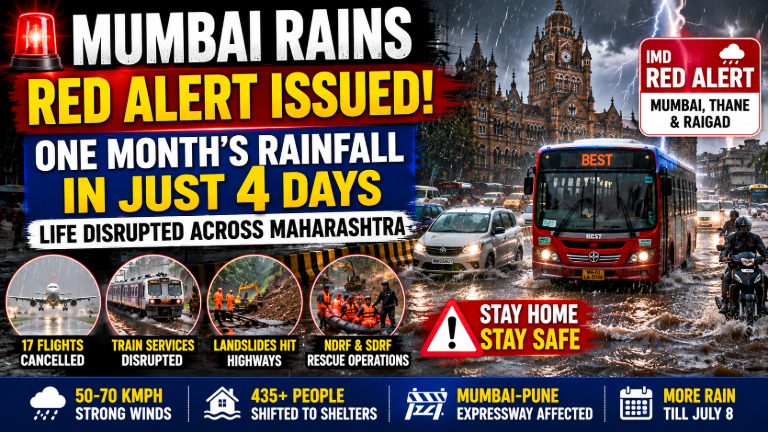
Mumbai and several parts of Maharashtra witnessed one of the most intense monsoon spells of the 2026 season as relentless rainfall, powerful winds and landslides severely disrupted normal life across the state. The India Meteorological Department (IMD) issued a Red Alert for Mumbai, Thane and Raigad, warning residents to remain indoors unless absolutely necessary.
According to Maharashtra Chief Minister Devendra Fadnavis, Mumbai has already received an entire month’s average rainfall within just four days, placing enormous pressure on civic infrastructure, transport networks and emergency response teams.
Heavy rain affected road, rail and air connectivity, while authorities launched rescue operations, evacuated vulnerable residents and deployed disaster response forces across multiple districts.
Mumbai Records Extraordinary Rainfall
Officials described the rainfall over the past few days as exceptional, with several weather stations recording extremely high precipitation levels.
Chief Minister Devendra Fadnavis, after reviewing the situation at the State Disaster Control Room, confirmed that:
- Mumbai received nearly one month’s rainfall in just four days.
- Wind speeds reached between 50 and 70 kmph, with stronger gusts expected.
- Around 300 trees were uprooted in a single day.
- Disaster management teams have been deployed throughout vulnerable regions.
The state government has appealed to residents to avoid unnecessary travel until weather conditions improve.
IMD Issues Red Alert Across Mumbai Region
The India Meteorological Department upgraded its warning from Orange Alert to Red Alert after weather conditions worsened rapidly.
The warning covers:
- Mumbai
- Thane
- Raigad
The IMD warned of:
- Extremely heavy rainfall
- Localised flooding
- Strong winds
- Falling trees
- Landslides
- Traffic disruptions
- Reduced visibility
Officials have advised people living in low-lying areas to remain alert and follow evacuation instructions whenever issued.
Flights, Trains and Roads Face Major Disruptions
The severe weather significantly affected transportation throughout Maharashtra.
Air Travel
Operations at Mumbai’s Chhatrapati Shivaji Maharaj International Airport were heavily impacted.
Authorities reported:
- 17 flights cancelled
- More than 217 flights delayed
- Multiple flights diverted to Hyderabad, Bengaluru, Ahmedabad and Vadodara due to poor visibility and adverse weather conditions.
Several airlines also issued travel advisories asking passengers to check flight schedules before leaving for the airport.
Railway Services
Heavy rainfall also disrupted suburban and long-distance train services.
Among the major disruptions:
- Services between Kanjurmarg and Bhandup were temporarily suspended after debris affected overhead electrical equipment.
- Landslides disrupted railway movement along the Mumbai–Pune route.
- Multiple long-distance trains were delayed, cancelled or diverted.
- Waterlogging affected sections of the Mumbai–Ahmedabad railway corridor.
Railway Minister Ashwini Vaishnaw reviewed restoration efforts and instructed railway officials to expedite repair work.
Highways Closed After Landslides
Continuous rainfall triggered multiple landslides across the Western Ghats.
The worst affected routes included:
- Mumbai–Pune Expressway
- Mumbai–Goa Highway
- Varandha Ghat
- Kashedi Ghat
Authorities confirmed that nearly 100 tonnes of debris had fallen onto sections of the Mumbai–Pune Expressway.
Restoration teams worked throughout the day using heavy machinery to reopen blocked lanes.
By Monday evening:
- Three lanes towards Pune had reopened.
- One lane towards Mumbai was operational.
- Clearance work continued on remaining sections.
Rescue Operations Intensify Across Maharashtra
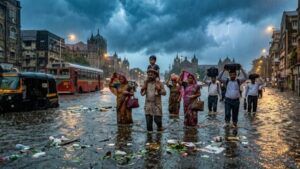
Emergency teams including the National Disaster Response Force (NDRF) and State Disaster Response Force (SDRF) were deployed across vulnerable districts.
Authorities carried out several rescue missions involving:
- Flooded residential colonies
- Landslide-hit villages
- Stranded motorists
- Missing persons
- Evacuated families
More than 435 residents from flood-prone areas in Panvel were shifted to temporary relief shelters.
Around 200 people living near the Ulhas River in Badlapur were also evacuated as river levels crossed the warning mark.
Local administrations arranged food, medical assistance and temporary accommodation for displaced residents.
Fatalities and Rain-Related Accidents Reported
The ongoing monsoon has unfortunately claimed several lives.
Among the major incidents reported:
- A landslide buried a house in Pune district, killing residents.
- A balcony collapse in Navi Mumbai claimed one life.
- Tree falls injured multiple people across Mumbai.
- Container accidents were reported at JNPA Port.
- Search operations continued for people feared swept away in floodwaters.
Officials urged citizens to avoid rivers, waterfalls and waterlogged roads during the ongoing heavy rainfall.
Chief Minister Devendra Fadnavis Reviews Emergency Situation
As heavy rains continued to lash Maharashtra, Chief Minister Devendra Fadnavis conducted multiple high-level review meetings with officials from the State Disaster Management Authority, Brihanmumbai Municipal Corporation (BMC), Mumbai Police, NDRF, SDRF and other departments.
Speaking after the review meeting, the Chief Minister said the administration was working round the clock to minimise disruption and ensure public safety.
He confirmed that emergency response teams had been deployed across all vulnerable districts, while district collectors were instructed to remain on high alert throughout the monsoon spell.
Fadnavis also appealed to citizens not to venture out unless absolutely necessary, especially during periods of intense rainfall or strong winds.
Cloudburst Warning Issued for Parts of Maharashtra
While Mumbai remained the primary focus, the India Meteorological Department also warned that several districts across Maharashtra could witness extremely heavy rainfall over the coming days.
Districts under heightened monitoring include:
- Nashik
- Pune
- Raigad
- Ratnagiri
- Sindhudurg
- Palghar
- Thane
Meteorologists warned that isolated locations may experience cloudburst-like rainfall, resulting in flash floods, overflowing rivers and landslides in hilly regions.
Authorities have advised residents living near rivers, dams and hillside settlements to remain alert and cooperate with evacuation teams if required.
BMC Intensifies Flood Control Measures
The Brihanmumbai Municipal Corporation (BMC) activated its emergency monsoon response mechanism as waterlogging affected several low-lying areas across Mumbai.
Municipal workers were deployed continuously to:
- Clear blocked storm-water drains.
- Remove fallen trees.
- Pump out floodwater.
- Restore traffic movement.
- Repair damaged infrastructure.
Control rooms remained operational throughout the day to respond to complaints related to flooding, electricity failures and fallen structures.
Senior BMC officials stated that high-capacity pumps were functioning at major flood-prone locations to reduce water accumulation as quickly as possible.
Schools, Offices and Businesses Face Disruptions
Heavy rainfall also affected educational institutions and businesses across several parts of Maharashtra.
Many schools announced temporary closures or shifted to online classes as a precautionary measure.
Several private companies advised employees to work from home due to severe traffic congestion and public transport disruptions.
Government offices continued functioning with reduced attendance as many employees experienced delays because of flooded roads and railway interruptions.
Commercial establishments in several waterlogged markets reported lower footfall throughout the day.
Economic Impact of Continuous Rainfall
Experts believe prolonged heavy rainfall could temporarily affect economic activity across Mumbai and neighbouring industrial regions.
Transport disruptions have impacted:
- Daily commuters
- Cargo movement
- Logistics operations
- Airport schedules
- Port activities
- Small businesses
- Retail markets
The closure of important highways, especially the Mumbai–Pune Expressway, also slowed the movement of goods between western Maharashtra and Mumbai.
Economists note that while monsoon rainfall remains crucial for agriculture, prolonged urban flooding can significantly affect productivity in India’s financial capital.
Weather Forecast: More Rain Expected
The India Meteorological Department has indicated that the current weather system is likely to remain active over the Konkan region for the next few days.
Forecasts suggest:
- Heavy to very heavy rainfall in Mumbai.
- Extremely heavy rainfall in isolated locations.
- Wind speeds of 50–70 kmph along coastal districts.
- Rough sea conditions over the Arabian Sea.
- Continued risk of landslides in hilly areas.
Fishermen have been strongly advised not to venture into the sea until weather conditions improve.
Safety Advisory for Residents
Authorities have issued several important advisories to ensure public safety during the ongoing monsoon.
Residents are advised to:
- Avoid unnecessary travel during heavy rainfall.
- Stay away from flooded roads and underpasses.
- Do not drive through waterlogged streets.
- Keep mobile phones fully charged.
- Follow official weather updates only.
- Avoid standing under trees or weak structures during strong winds.
- Stay away from rivers, lakes and overflowing drains.
- Contact emergency services immediately if assistance is required.
Parents have also been requested to closely monitor children and discourage them from entering flooded areas.
Expert Analysis
The latest spell of heavy rainfall highlights Mumbai’s continuing struggle to balance rapid urbanisation with climate resilience.
Receiving an entire month’s average rainfall within just four days demonstrates the growing frequency of extreme weather events associated with changing climate patterns. Although significant investments have been made in storm-water drainage systems, transport infrastructure and disaster management, such unprecedented rainfall continues to test the city’s preparedness.
Experts believe future urban planning must prioritise:
- Improved drainage infrastructure
- Scientific flood forecasting
- Restoration of natural water bodies
- Better traffic management
- Climate-resilient urban development
- Stronger disaster preparedness
The coordinated response by the Maharashtra government, BMC, NDRF, SDRF and emergency agencies has helped minimise casualties, but long-term infrastructure upgrades remain essential.
Key Highlights
- 🌧️ Mumbai received nearly one month’s rainfall in just four days.
- 🚨 IMD issued a Red Alert for Mumbai, Thane and Raigad.
- ✈️ 17 flights were cancelled, while over 217 flights faced delays.
- 🚆 Railway services were disrupted due to landslides and overhead equipment failures.
- 🛣️ Mumbai–Pune Expressway witnessed multiple landslides and temporary closures.
- 🌳 Around 300 trees were uprooted across Mumbai.
- 🚒 NDRF and SDRF teams rescued hundreds of stranded residents.
- 🏠 More than 435 people were shifted to relief shelters.
- 🌊 Strong winds reached 70 kmph in several coastal regions.
- ⚠️ Heavy rainfall is expected to continue over the next few days.
Frequently Asked Questions (FAQs)
Why did Mumbai receive such heavy rainfall?
A strong monsoon system over the Arabian Sea, combined with favourable atmospheric conditions, resulted in continuous heavy rainfall across Mumbai and coastal Maharashtra.
Why did IMD issue a Red Alert?
A Red Alert is issued when extremely heavy rainfall is expected, posing significant risks of flooding, landslides, traffic disruptions and damage to infrastructure.
How badly was air travel affected?
At least 17 flights were cancelled, over 217 flights delayed, and several aircraft were diverted to nearby airports because of poor visibility and adverse weather.
Was the Mumbai–Pune Expressway closed?
Yes. Multiple landslides temporarily blocked sections of the expressway. Restoration work continues, although several lanes have already reopened.
Is more rain expected?
Yes. IMD has forecast continued heavy rainfall over Mumbai and neighbouring districts during the next few days.
Conclusion
Mumbai’s latest monsoon spell has once again demonstrated both the power of nature and the resilience of one of India’s busiest metropolitan cities. Despite receiving nearly an entire month’s rainfall within four days, emergency agencies, civic authorities and disaster response teams have worked continuously to restore normalcy.
With heavy rainfall expected to continue, citizens are urged to remain vigilant, follow official advisories and avoid unnecessary travel until weather conditions improve. The coming days will remain critical as Maharashtra continues to battle one of the strongest monsoon spells of the year.
Disclaimer
This article is based on official weather updates, government statements and publicly available reports at the time of publication. Weather forecasts, rainfall data and transport advisories may change as the situation develops. Readers are advised to follow updates issued by the India Meteorological Department (IMD), Brihanmumbai Municipal Corporation (BMC) and local authorities.
Do Follow for more info @ http://roydailyupdate.in
Do Connect WhatsApp @ https://chat.whatsapp.com/K5POJK9KbpN8egjjOCaOw6