

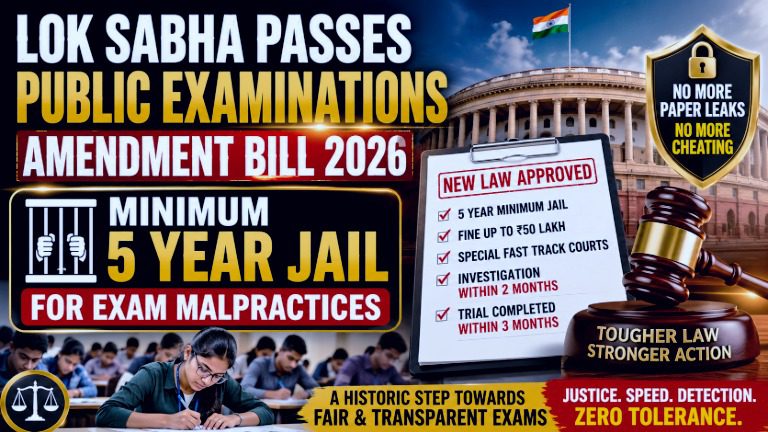
Lok Sabha Passes Public Examinations Amendment Bill 2026
In a significant move aimed at restoring public confidence in India’s examination system, the Lok Sabha has passed the Public Examinations (Prevention of Unfair Means) Amendment Bill, 2026 by a voice vote. The legislation introduces stricter punishments for exam-related offences, faster investigations, Special Fast Track Courts, and enhanced penalties for organised cheating syndicates.
The amendment comes against the backdrop of several high-profile examination paper leak controversies that triggered nationwide protests and renewed demands for stronger legal safeguards to protect the integrity of competitive examinations.
If implemented as proposed, the new law is expected to become one of India’s toughest legal frameworks against examination fraud.
Why Was the Amendment Bill Introduced?
India has witnessed multiple incidents of question paper leaks, organised cheating networks, impersonation, and digital examination fraud over the past few years.
Several recruitment examinations and entrance tests faced allegations of leaked question papers, resulting in:
Cancellation of examinations
Delayed recruitment
Legal disputes
Financial losses
Emotional distress among lakhs of students
The widespread protests by students demanding accountability and transparent recruitment eventually pushed the government to strengthen the Public Examinations (Prevention of Unfair Means) Act, 2024 through this comprehensive amendment.
According to the government, the objective is to ensure that honest candidates are not disadvantaged by organised criminal activities that manipulate examination systems.
Stronger Punishments Under the New Law
One of the biggest highlights of the amendment is the sharp increase in punishment for individuals found guilty of examination malpractices.
The revised provisions include:
Minimum imprisonment increased from 3 years to 5 years
Maximum imprisonment increased from 5 years to 10 years
Maximum fine increased from ₹10 lakh to ₹50 lakh
The government believes that tougher punishments will discourage individuals and criminal groups from attempting paper leaks or other unfair practices.
Crackdown on Organised Cheating Networks
The amendment places special emphasis on dismantling organised examination fraud syndicates.
Authorities have observed that paper leaks are often carried out by well-organised criminal networks involving multiple individuals across different states.
To address this, the amendment significantly strengthens penalties for organised crimes connected to public examinations.
The proposed punishment now includes:
Minimum imprisonment increased from 5 years to 7 years
Minimum fine increased from ₹1 crore to ₹10 crore
These stringent provisions are intended to target large-scale criminal operations rather than only individual offenders.
Service Providers Also Face Strict Action
The amendment does not limit liability to candidates alone.
Private agencies, technology vendors, examination service providers, and organisations responsible for conducting examinations can also face severe penalties if found involved in fraudulent activities.
The revised provisions increase:
Maximum financial penalty from ₹1 crore to ₹5 crore
Blacklisting period from 4 years to 8 years
This ensures that organisations entrusted with conducting examinations maintain the highest standards of security and transparency.
Directors and Senior Officials Can Be Prosecuted
Another major feature of the amendment is personal accountability for senior management.
If directors or senior officials knowingly participate in or facilitate examination fraud, they may face:
Minimum imprisonment of 5 years
Financial penalties up to ₹5 crore
By fixing responsibility at the leadership level, the government hopes to prevent negligence and strengthen institutional accountability.
Background: The 2024 Public Examinations Act
The original Public Examinations (Prevention of Unfair Means) Act, 2024 was enacted to address growing concerns over paper leaks and unfair practices in public examinations.
The law covers examinations conducted by:
* Union Public Service Commission (UPSC)
* Staff Selection Commission (SSC)
* National Testing Agency (NTA)
* Railway Recruitment Boards
* Banking recruitment agencies
* Other notified public examination authorities
However, recent incidents highlighted the need for even stronger deterrence and faster judicial processes, leading to the 2026 amendment.
Restoring Faith Among Students
Competitive examinations represent years of preparation, financial investment, and emotional commitment for millions of students.
Whenever an examination is cancelled due to paper leaks, genuine candidates often suffer the most.
Through stricter laws, Parliament aims to reassure students that future examinations will be conducted fairly, transparently, and without interference from organised cheating networks.
The government has stated that safeguarding the credibility of public examinations remains essential for ensuring equal opportunities and merit-based recruitment across India.
Special Fast Track Courts to Ensure Speedy Justice
One of the most significant reforms introduced by the Public Examinations Amendment Bill 2026 is the establishment of Special Fast Track Courts to hear cases related to examination offences.
Under the new provisions:
Every State Government and Union Territory Administration must designate a Court of Session as a Special Fast Track Court.
The designation will be made in consultation with the respective High Court.
All pending cases under the Public Examinations Act will also be transferred to these courts.
The objective is to prevent long legal delays and ensure that examination-related crimes are dealt with swiftly.
Investigation Must Be Completed Within Two Months
To improve accountability, the amendment mandates that investigation agencies complete their inquiries within two months.
Previously, prolonged investigations often delayed justice and affected recruitment processes.
The Bill also empowers the Central Government to:
Constitute a Special Task Force (STF) for investigation.
Refer cases to a Central Investigating Agency, wherever necessary.
Coordinate with State Police and specialised cybercrime units.
This provision aims to ensure that evidence is collected quickly, digital trails are secured, and organised cheating networks are dismantled without unnecessary delay.
Day-to-Day Trial Within Three Months
Apart from faster investigations, the Bill also sets strict timelines for judicial proceedings.
According to the amendment:
Trials will be conducted on a day-to-day basis.
Cases should ideally be completed within three months from the filing of the chargesheet.
This marks a major shift from traditional criminal trials, where cases often remain pending for years.
By ensuring speedy disposal, the government hopes to restore confidence among students and recruitment agencies.
High Court Appeal Mechanism Introduced
The legislation also creates a dedicated appellate system.
Under the new provisions:
Appeals against judgments, sentences, or orders of the Special Fast Track Courts will lie before a Division Bench of the High Court.
High Courts are expected to dispose of appeals, as far as possible, within three months of admission.
Appeals against bail orders have also been specifically provided for.
This structured mechanism is intended to balance speedy justice with adequate legal safeguards.
What Does the New Law Mean for Students?
For genuine candidates, the amendment is expected to strengthen the credibility of competitive examinations.
Students may benefit from:
Greater protection against paper leaks.
Improved transparency in recruitment.
Reduced chances of examination cancellation.
Faster action against offenders.
Increased confidence in merit-based selection.
Millions of aspirants preparing for examinations such as UPSC, SSC, Railway Recruitment, Banking, Defence, and various entrance tests have repeatedly demanded stronger legal action against organised cheating.
The new law directly addresses many of these concerns.
Impact on Examination Agencies
Recruitment bodies and examination authorities will also be expected to adopt stricter security measures.
These may include:
Enhanced digital monitoring systems.
Improved cybersecurity infrastructure.
Secure question paper transportation.
Stronger identity verification mechanisms.
Better coordination with law enforcement agencies.
Private technology vendors and examination partners will also be required to maintain higher compliance standards, as violations could now attract severe penalties.
Why the Government Says These Changes Were Necessary
According to the Statement of Objects and Reasons accompanying the Bill, repeated incidents of question paper leaks and organised examination fraud had weakened public trust in competitive examinations.
The government stated that the amendments are intended to:
Protect the interests of honest candidates.
Strengthen the fairness and transparency of examinations.
Eliminate organised cheating syndicates.
Ensure timely investigations and trials.
Create a stronger legal deterrent through harsher punishments.
Officials believe these reforms will significantly improve the integrity of India’s public examination system.
A Major Step Towards Fair Examinations
The passage of the Public Examinations (Prevention of Unfair Means) Amendment Bill, 2026 marks an important milestone in India’s efforts to combat examination fraud.
With stricter jail terms, substantially higher financial penalties, mandatory investigation timelines, and Special Fast Track Courts, the legislation seeks to protect the future of millions of deserving students.
While the effectiveness of the law will ultimately depend on robust implementation and coordination among investigating agencies, examination authorities, and the judiciary, the amendment sends a clear message that organised examination fraud will face serious legal consequences.
For students preparing for competitive examinations across the country, the new law represents a renewed commitment to fairness, transparency, and merit-based opportunities.
Frequently Asked Questions (FAQs)
What is the Public Examinations Amendment Bill 2026?
It is a law passed by the Lok Sabha to strengthen the Public Examinations (Prevention of Unfair Means) Act, 2024 by introducing stricter punishments, faster investigations, and Special Fast Track Courts for examination-related offences.
What is the minimum punishment under the new law?
The minimum imprisonment for using unfair means in public examinations has been increased from 3 years to 5 years.
What is the maximum fine for examination malpractice?
The maximum fine has been increased from ₹10 lakh to ₹50 lakh, while organised crimes can attract fines of up to ₹10 crore.
What are Special Fast Track Courts?
These are designated Courts of Session that will exclusively hear cases related to offences under the Public Examinations Act and aim to complete trials within three months.
Why was this amendment introduced?
The amendment was introduced following repeated incidents of question paper leaks and organised cheating that affected the credibility of public examinations and triggered nationwide student protests.
Disclaimer
This article is based on information available from parliamentary proceedings, government statements, and publicly reported sources regarding the Public Examinations (Prevention of Unfair Means) Amendment Bill, 2026. The provisions discussed are subject to further legislative procedures, official notifications, and implementation by the concerned authorities. Readers are advised to refer to official government notifications for the latest updates.
Do Follow For More Info @ http://roydailyupdate.in
Do WhatsApp @ https://chat.whatsapp.com/K5POJK9KbpN8egjjOCaOw6