

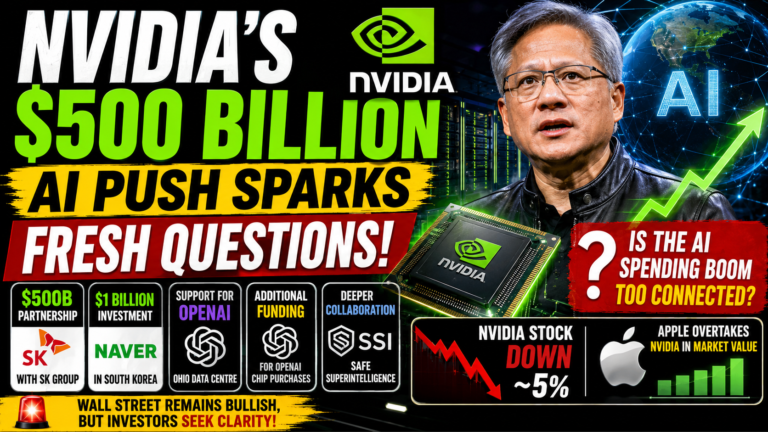
Nvidia’s $500 Billion AI Push Sparks Investor Debate
The artificial intelligence (AI) industry has entered another phase of rapid expansion, but Nvidia’s latest announcements have also triggered fresh questions about whether the sector’s extraordinary growth is becoming increasingly dependent on a tightly connected financial ecosystem.
According to recent reports, Nvidia has unveiled more than $500 billion worth of partnerships, investments, and financing commitments, reinforcing its position as the world’s most influential AI infrastructure company. While the announcements underline the chip giant’s ambition to dominate the next generation of AI computing, they have also prompted investors and analysts to examine whether the industry’s funding model is becoming too concentrated around a handful of companies.
The discussion comes at a time when global technology firms—including Microsoft, Amazon, Meta, OpenAI, and several AI startups—continue to spend billions of dollars on AI infrastructure, data centres, advanced graphics processors (GPUs), and cloud computing capacity.
Nvidia Continues to Lead the Global AI Revolution
Over the past three years, Nvidia has transformed from a leading semiconductor manufacturer into the backbone of the global AI economy.
Its advanced GPUs power:
Generative AI platforms
Large Language Models (LLMs)
AI cloud infrastructure
Robotics
Autonomous vehicles
Scientific computing
Enterprise AI applications
Demand for Nvidia’s AI chips has surged dramatically following the explosive popularity of ChatGPT and other generative AI applications.
Today, almost every major AI company relies on Nvidia hardware to train and operate sophisticated AI models.
More Than Just a Chip Company
What makes Nvidia unique is that it is no longer simply selling chips.
The company now participates in multiple layers of the AI ecosystem.
These include:
Manufacturing AI processors
Investing in AI startups
Financing infrastructure projects
Partnering with cloud providers
Supporting AI research companies
Collaborating on large-scale data centres
This expanding role has significantly increased Nvidia’s influence over the global AI industry.
However, it has also raised questions among investors regarding how interconnected AI financing has become.
Nvidia Announces Over $500 Billion in New Commitments
According to recent industry reports, Nvidia announced several major strategic initiatives across Asia and the United States.
Among the most notable commitments are:
$500 Billion Partnership with SK Group
Nvidia announced a massive long-term partnership with South Korea’s SK Group.
The collaboration is expected to strengthen AI infrastructure, semiconductor manufacturing, and advanced computing capabilities across Asia.
The investment reflects the growing importance of international AI infrastructure as countries compete to become leaders in artificial intelligence.
$1 Billion Investment in Naver
The company also confirmed a $1 billion investment in South Korean technology giant Naver.
Naver has been aggressively expanding its AI capabilities, cloud computing services, and large language models.
The partnership demonstrates Nvidia’s willingness to invest directly in companies that are building AI-powered products and services.
Support for OpenAI’s Ohio Data Centre
Another major announcement involves financing support linked to OpenAI’s planned Ohio data centre.
Large AI models require enormous computational resources.
Modern AI data centres contain tens of thousands of GPUs working together to train increasingly sophisticated models.
Supporting these facilities ensures continued demand for Nvidia’s hardware.
Additional Funding Linked to OpenAI
Reports also indicate Nvidia has expanded financing arrangements connected to OpenAI’s future chip purchases.
Rather than serving only as a supplier, Nvidia is becoming involved in financing projects that ultimately purchase its own technology.
This business model has become one of the biggest talking points among investors.
Collaboration with Safe Superintelligence
Nvidia also announced a deeper partnership with Safe Superintelligence (SSI), the AI startup founded by former OpenAI chief scientist Ilya Sutskever.
SSI focuses on developing advanced AI systems with safety as its primary objective.
The partnership highlights Nvidia’s growing involvement in next-generation AI research beyond commercial infrastructure.
Why Investors Are Asking Questions
While these investments demonstrate Nvidia’s confidence in AI, some market observers believe they also expose a growing concentration of financial relationships.
Several investors argue that Nvidia now occupies multiple positions within the same AI ecosystem.
For example:
Nvidia finances AI companies.
Those companies purchase Nvidia chips.
Nvidia supplies cloud providers.
Cloud providers build AI infrastructure.
AI startups rely on that infrastructure.
Nvidia benefits again through hardware sales.
This interconnected cycle has prompted concerns that the industry’s rapid expansion may increasingly rely on financing flowing among the same group of technology companies.
Is the AI Investment Cycle Becoming Self-Reinforcing?
Some analysts describe the situation as a “self-reinforcing investment cycle.”
In simple terms:
Nvidia invests in AI companies.
AI companies build infrastructure.
Infrastructure purchases Nvidia GPUs.
Nvidia earns higher revenue.
Nvidia uses profits for further investments.
Supporters argue this creates a healthy innovation ecosystem.
Critics worry it could amplify financial risks if AI spending slows unexpectedly.
AI Spending Continues to Reach Record Levels
Despite concerns, spending across the AI industry remains historically high.
Major technology companies continue investing billions into:
AI cloud services
Data centres
Custom AI chips
Semiconductor manufacturing
AI software platforms
Machine learning infrastructure
Enterprise AI adoption
Industry analysts believe AI infrastructure spending could remain elevated for several years as companies race to deploy increasingly powerful AI systems.
Nvidia’s Dominance Shows No Immediate Signs of Slowing
Although competition is growing from AMD, Intel, Google, Amazon, Microsoft, and several custom chip developers, Nvidia still maintains a commanding lead in AI accelerators.
Its CUDA software ecosystem, advanced GPU architecture, and long-standing developer community continue to provide significant competitive advantages.
For many AI developers, switching away from Nvidia remains technically challenging and financially costly.
Nvidia Shares Slip as Investors Reassess Risks
The growing debate over Nvidia’s expanding financial role was reflected in the stock market.
Following reports surrounding its latest AI investments and financing commitments, Nvidia’s shares fell nearly 5%, allowing Apple to briefly regain its position as the world’s most valuable publicly traded company by market capitalization.
Although such market fluctuations are common after major announcements, the decline highlighted investor concerns about whether AI infrastructure spending can continue at its current pace.
Another indicator attracting attention was the increase in Nvidia’s credit-default swap (CDS) prices. CDS instruments are often used by investors to assess perceived financial risk. While a rise does not necessarily indicate financial weakness, it suggests that some investors are becoming more cautious about Nvidia’s expanding financial exposure.
Wall Street Remains Bullish on Nvidia
Despite the recent volatility, Wall Street analysts continue to express strong confidence in Nvidia’s long-term prospects.
According to Bloomberg data cited in media reports:
78 out of 81 analysts covering Nvidia maintain a “Buy” recommendation.
Only a small number recommend holding or selling the stock.
Most analysts believe AI infrastructure demand remains exceptionally strong.
Many experts argue that the current AI investment cycle is still in its early stages, with governments, enterprises, cloud providers, and technology companies expected to invest heavily over the next several years.
Microsoft’s, Meta’s and Amazon’s Earnings Under Spotlight
Investors are now turning their attention to the quarterly earnings reports of major technology companies, including:
* Microsoft
* Meta Platforms
* Amazon
These companies are among Nvidia’s largest customers and collectively spend tens of billions of dollars on AI infrastructure every year.
Their upcoming capital expenditure (CapEx) guidance will provide valuable insight into whether AI spending is continuing at the same pace or beginning to moderate.
If these companies announce higher AI investments, it could reinforce confidence in Nvidia’s long-term growth. Conversely, any indication of slower spending could influence investor sentiment across the semiconductor sector.
Why AI Infrastructure Spending Matters
Artificial intelligence models require enormous computing power to train and operate efficiently.
Modern AI systems depend on:
High-performance GPUs
Massive cloud data centres
High-speed networking equipment
Advanced storage solutions
Energy-efficient computing infrastructure
As AI adoption expands across industries—including healthcare, finance, manufacturing, education, cybersecurity, and autonomous vehicles—the demand for these technologies is expected to grow significantly.
This trend has positioned Nvidia as one of the biggest beneficiaries of the AI revolution.
Could the AI Boom Face Challenges?
While the long-term outlook remains positive, analysts acknowledge several risks that investors should monitor:
Rising Capital Costs
Building AI infrastructure requires billions of dollars in investment. Higher borrowing costs or tighter financial conditions could slow future expansion.
Increased Competition
Competitors such as AMD, Intel, Google, Amazon, Microsoft, and several AI-focused startups are developing alternative AI chips to reduce dependence on Nvidia.
Regulatory Scrutiny
Governments worldwide are paying closer attention to the growing influence of large AI companies. Regulatory changes could affect future partnerships, acquisitions, or investment strategies.
Supply Chain Constraints
Although semiconductor supply has improved compared to previous years, demand for advanced AI processors continues to outpace production capacity in some segments.
Nvidia’s Strategic Vision
Despite these concerns, Nvidia continues to position itself not only as a hardware manufacturer but also as a strategic partner in shaping the future of artificial intelligence.
By combining semiconductor leadership with investments, financing support, and research collaborations, the company aims to strengthen its influence across every layer of the AI ecosystem.
This integrated strategy has enabled Nvidia to become one of the world’s most valuable technology companies and a central player in the ongoing AI transformation.
Final Thoughts
Nvidia’s latest $500 billion AI investment push underscores the extraordinary pace at which the artificial intelligence industry is evolving. While the company’s aggressive expansion has reinforced its leadership in AI infrastructure, it has also sparked important conversations about the sustainability of increasingly interconnected financing models.
For now, investor confidence remains largely intact, supported by robust demand for AI computing, optimistic analyst forecasts, and continued spending by major technology companies.
However, upcoming earnings reports from Microsoft, Meta, and Amazon are expected to play a crucial role in determining whether the current AI investment boom can maintain its momentum.
As artificial intelligence becomes more deeply embedded in businesses and everyday life, Nvidia’s strategy—and the broader AI spending cycle—will remain under close watch from investors, governments, and the global technology industry.
Frequently Asked Questions (FAQs)
Why is Nvidia investing more than $500 billion in AI?
Nvidia is expanding its partnerships, financing, and infrastructure commitments to strengthen its leadership in the global AI ecosystem and meet growing demand for AI computing.
Why are investors concerned?
Some investors believe Nvidia’s investments, financing, and hardware sales are becoming increasingly interconnected, raising questions about whether AI growth depends on the same group of companies.
Did Nvidia’s stock fall?
Yes. Nvidia shares declined by around 5% following reports about its latest financing commitments, although Wall Street analysts remain largely optimistic about its long-term prospects.
Which companies are closely linked to Nvidia’s AI strategy?
Major partners include OpenAI, Microsoft, Amazon, Meta, SK Group, Naver, and AI startup Safe Superintelligence (SSI), among others.
Is Wall Street still positive on Nvidia?
Yes. Most analysts continue to recommend buying Nvidia shares, citing strong long-term demand for AI infrastructure and computing.
Disclaimer
This article is based on publicly available reports, market analysis, and industry announcements regarding Nvidia’s AI investments and financing commitments. The information is intended for educational and informational purposes only and should not be considered financial or investment advice. Readers should consult qualified financial professionals before making investment decisions.
Do Follow For More Info @ http://roydailyupdate.in
Do WhatsApp @ https://chat.whatsapp.com/K5POJK9KbpN8egjjOCaOw6