

NSE Pre-Open Session Rules Change From September 7: New Timings, Market Order Rules Explained
NSE Pre-Open Session New Rules: The National Stock Exchange (NSE) is changing the way its pre-open session operates from Monday, September 7, 2026. While the overall pre-open window will continue to run from 9:00 AM to 9:15 AM, the order-entry period will now be split into two phases.
The most important change for traders is that market orders will be allowed during the first five minutes but will not be permitted during the second five-minute phase. During the second phase, investors will be able to place, modify or cancel only limit orders.
The revised framework is designed to bring the pre-open process into closer alignment with the auction-based mechanism used under the Closing Auction Session (CAS) in the equity cash market. NSE’s current framework also confirms the new 9:10 AM–9:12 AM order-matching period and 9:12 AM–9:15 AM buffer period.
For investors and traders who routinely place orders before the market opens, understanding these changes is important because an order type that was previously accepted during the later part of the order-entry window may now be rejected.
NSE pre-open session: What is changing from September 7?
The NSE pre-open session will continue to operate for 15 minutes, from 9:00 AM to 9:15 AM. However, the order-entry stage is being divided into two five-minute phases.
The new structure is:
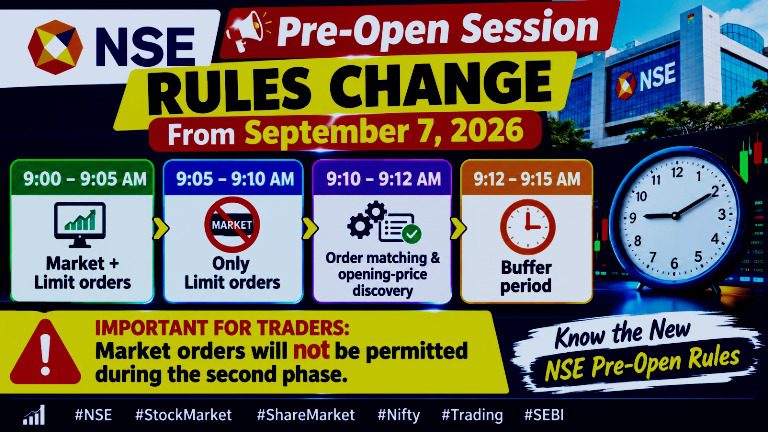
NSE Pre-Open Stage Time What Investors Can Do
Phase 1 9:00 AM–9:05 AM Limit and market orders allowed
Phase 2 9:05 AM–9:10 AM Only limit orders allowed
Order matching 9:10 AM–9:12 AM Opening price determined and orders matched
Buffer period 9:12 AM–9:15 AM Transition to regular trading
During the first phase, investors can enter, modify and cancel both limit orders and market orders.
During the second phase, only limit orders can be entered, modified or cancelled. Market orders will not be permitted and will be rejected when market-order restrictions are active. NSE also provides for a system-driven random closure during the final two minutes of the relevant order-entry phase.
Phase 1: 9:00 AM to 9:05 AM
The first phase will begin at 9:00 AM and continue until 9:05 AM.
During this period, traders will be able to submit:
Limit buy orders
Limit sell orders
Market buy orders
Market sell orders
Modifications to eligible orders
Cancellations of eligible orders
This means the first five minutes remain the main window for investors who want to use market orders during the pre-open process.
The order book built during this phase contributes to the price-discovery process. The exchange uses the demand and supply represented by eligible orders to determine the equilibrium opening price.
Phase 2: 9:05 AM to 9:10 AM
The second phase is the major change investors should pay attention to.
From 9:05 AM to 9:10 AM, only limit orders will be accepted.
Market orders will not be permitted during this period. NSE’s updated framework specifically states that market orders placed when market orders are restricted will be rejected by the exchange.
Investors will still be able to modify or cancel eligible limit orders during this phase.
The exchange may also trigger a system-driven random closure during the final two minutes, which is intended to reduce the possibility of traders attempting to influence the auction through last-second order activity.
What does this mean for traders?
If you normally wait until the later part of the pre-open session to place a market order, you will need to change that approach.
For example, if an investor attempts to place a market order at 9:07 AM, the order will not be accepted under the new restricted phase.
A limit order, however, can still be placed, subject to the applicable rules and risk controls.
This makes it particularly important for active traders to understand the difference between the two order types.
What is a limit order?
A limit order allows an investor to specify the maximum price they are willing to pay when buying or the minimum price they are willing to accept when selling.
For example, if a trader wants to buy a stock at no more than ₹500, the investor can place a buy limit order at ₹500.
The order will execute only if the auction mechanism can match it according to the applicable rules.
What is a market order?
A market order does not specify a particular execution price. Instead, it seeks execution at the price available through the applicable market mechanism.
Because market orders can contribute to price discovery and can carry greater uncertainty regarding execution price, their availability is now restricted during the second phase of the revised pre-open process.
The key point is simple:
9:00 AM–9:05 AM: Market + limit orders
9:05 AM–9:10 AM: Limit orders only
What happens between 9:10 AM and 9:12 AM?
After the order-entry period ends, the NSE will enter the order-matching and trade-confirmation period.
This will run from approximately 9:10 AM to 9:12 AM under the revised framework.
During this stage:
The opening price is determined.
Eligible orders are matched.
Trades are confirmed.
Investors cannot continue modifying or cancelling orders as they could during the order-entry stage.
The opening price is determined through the call-auction mechanism based on demand and supply.
NSE describes the equilibrium price as the price at which the maximum executable volume can be traded. If multiple prices meet the maximum-volume condition, further criteria such as order imbalance and proximity to the previous closing price are used.
What happens from 9:12 AM to 9:15 AM?
A buffer period will run from 9:12 AM to 9:15 AM.
This period is designed to facilitate the transition from the pre-open auction process to the normal continuous trading session.
Regular equity-market trading begins at 9:15 AM.
Therefore, the revised system does not extend the pre-open session beyond its existing 15-minute overall window. Instead, it changes how that 15-minute period is structured.
Why is NSE changing the pre-open session?
The revised framework is connected to the broader changes being introduced in India’s equity-market auction mechanisms.
SEBI introduced the framework for a Closing Auction Session (CAS) in the equity cash segment through its January 16, 2026 circular. NSE subsequently issued operational guidelines and related trading modalities.
The CAS uses a similar two-stage order-entry structure.
According to NSE’s current CAS framework, the closing auction includes an initial period in which both limit and market orders can be entered, followed by a period in which only limit orders are permitted. The session then moves into order matching and trade confirmation.
The revised pre-open structure therefore creates greater consistency between the opening and closing auction mechanisms.
How does the new system compare with the old system?
Previously, the equity-market pre-open order collection period broadly allowed orders to be entered, modified and cancelled during the initial order-collection window, with a random closure toward its end. NSE’s current equity pre-open documentation describes the pre-open session as a call auction used to determine the opening price.
Under the revised framework, the order-entry stage is more clearly separated:
Old approach:
Order collection followed by matching.
New approach:
First five minutes: limit + market orders
Next five minutes: limit orders only
Two-minute matching window
Three-minute transition period
This structure provides a clearer distinction between the stage where market orders can enter the auction and the later stage where only price-specific limit orders are accepted.
Which securities are covered?
The pre-open mechanism applies across eligible securities covered by the applicable NSE pre-open framework.
This includes securities in the equity-market ecosystem subject to the exchange’s rules and eligibility criteria. Traders should check the specific security and segment before placing an order because auction rules can differ across market segments.
The NSE also operates pre-open mechanisms for relevant equity derivatives. Its current derivatives framework uses the same broad 9:00 AM–9:15 AM structure, including the 9:00–9:05 period for both limit and market orders and the 9:05–9:10 period for limit orders only.
What investors should do from September 7
The rule change does not require ordinary investors to take any special action, but traders who actively participate in the pre-open session should review their order-placement strategy.
Here are the most important points:
1. Remember the 9:05 AM cut-off
The biggest practical change is the 9:05 AM cut-off for market orders.
If you intend to use a market order during the permitted pre-open period, you need to be aware of this deadline.
2. Use limit orders after 9:05 AM
During Phase 2, only limit orders will be permitted.
3. Don’t assume a market order will remain pending
A market order submitted during the restricted period can be rejected rather than simply waiting for the market to open.
4. Check your broker’s order interface
Different brokers may display warnings or restrictions differently. Investors should pay attention to the order-status message provided by their trading platform.
5. Avoid last-minute assumptions
Because the exchange can use random closure mechanisms near the end of an order-entry period, traders should avoid relying on the final seconds to submit or modify orders.
Will the normal market opening time change?
No.
The regular market will continue to open at 9:15 AM.
The change primarily affects the internal structure of the pre-open auction rather than extending the overall pre-open period.
NSE’s updated framework keeps the transition period from 9:12 AM to 9:15 AM before regular trading begins.
How the new NSE pre-open session works: Simple example
Suppose an investor wants to buy shares of a company before the market opens.
At 9:02 AM, the investor can place either a market order or a limit order, subject to applicable exchange and broker conditions.
At 9:07 AM, the investor can place a limit order, but a market order is not permitted.
At 9:10 AM, order entry ends and the system moves into the matching stage.
Between 9:10 AM and 9:12 AM, the exchange determines the equilibrium opening price and matches eligible orders.
From 9:12 AM to 9:15 AM, the market moves through the buffer period.
At 9:15 AM, continuous trading begins.
This example illustrates why the 9:05 AM point becomes important for traders who use market orders.
Will the new rules affect stock prices?
The rule change itself does not mean that stock prices will automatically rise or fall.
The purpose of the auction mechanism is price discovery based on available buy and sell interest. The opening price continues to be determined through the equilibrium-price mechanism.
However, changes in order types and the timing of order entry can influence how trading participants interact with the opening auction.
Investors should therefore focus on the mechanics rather than assuming that the rule change is bullish or bearish for the market.
NSE pre-open rules and Closing Auction Session: The bigger picture
The September 7 changes are part of a broader evolution in India’s exchange-market structure.
SEBI’s Closing Auction Session framework was designed to improve closing-price discovery, particularly for stocks where a closing auction is applicable. NSE’s CAS framework currently operates from 3:15 PM to 3:35 PM, with its own phased order-entry and matching process.
The similarity between the opening and closing auction structures is significant.
Both mechanisms separate the process into stages, allow greater flexibility earlier in the order-entry window and restrict market orders during the later order-entry phase.
For market participants, this creates a more standardized auction framework across different parts of the trading day.
Bottom line
The NSE pre-open session rules will change from September 7, 2026, but the overall 9:00 AM to 9:15 AM pre-open window and the 9:15 AM regular-market opening remain intact.
The biggest change is the division of order entry into two phases.
9:00 AM–9:05 AM: Limit and market orders allowed.
9:05 AM–9:10 AM: Only limit orders allowed; market orders are restricted.
9:10 AM–9:12 AM: Order matching, opening-price determination and trade confirmation.
9:12 AM–9:15 AM: Buffer period before normal trading.
For most long-term investors, the change may have little day-to-day impact. However, active traders and investors who regularly place pre-open market orders should understand the new 9:05 AM cut-off and adjust their order-entry practices accordingly.
As always, investors should verify the applicable rules and order-status messages with their broker and the exchange before trading.
FAQs
Q1. When will the new NSE pre-open session rules start?
The revised NSE pre-open framework is scheduled to apply from September 7, 2026.
Q2. What are the new NSE pre-open timings?
The session remains from 9:00 AM to 9:15 AM. Order entry is divided into 9:00–9:05 AM and 9:05–9:10 AM, followed by matching from 9:10–9:12 AM and a buffer period from 9:12–9:15 AM.
Q3. Can I place a market order after 9:05 AM?
No. During the second order-entry phase, market orders are restricted. Only limit orders are permitted.
Q4. Can I modify a limit order between 9:05 AM and 9:10 AM?
Yes, eligible limit orders can be entered, modified and cancelled during the second phase, subject to applicable exchange rules.
Q5. What happens to market orders placed during the restricted phase?
NSE states that market orders placed when market orders are restricted will be rejected by the exchange.
Q6. Will the stock market open at a different time?
No. Regular trading continues to begin at 9:15 AM.
Q7. Why is NSE changing the pre-open session?
The changes are intended to align the pre-open auction structure more closely with the Closing Auction Session framework and create greater consistency in market operations.
Q8. What is the biggest change traders should remember?
The most important point is the 9:05 AM cut-off for market orders during the pre-open session.
Q9. What determines the opening price?
The opening price is determined through the call-auction mechanism using the equilibrium-price methodology, which considers demand, supply, executable volume and other applicable criteria.
Q10. Does this change mean the market will become bullish or bearish?
Not necessarily. The change concerns the trading mechanism and order-entry process. It does not by itself indicate a direction for stock prices.
Do Follow For More Info @ http://roydailyupdate.in
Do WhatsApp @ https://chat.whatsapp.com/K5POJK9KbpN8egjjOCaOw6
About the Author
Ravi H Irannanavar is a blogger and the creator of Roy Daily Update, a digital platform covering stock market updates, business news, job notifications, breaking news and other important developments. His focus is on presenting timely information in a simple, reader-friendly format to help readers understand important market and current-affairs updates.
Disclaimer
This article is intended for informational and educational purposes only and should not be considered investment, financial or trading advice. Market rules, timings and exchange procedures may change, and investors should verify the latest information with NSE, SEBI and their registered stockbroker before placing any order. Roy Daily Update and the author are not responsible for any financial loss arising from decisions made based on this article.