

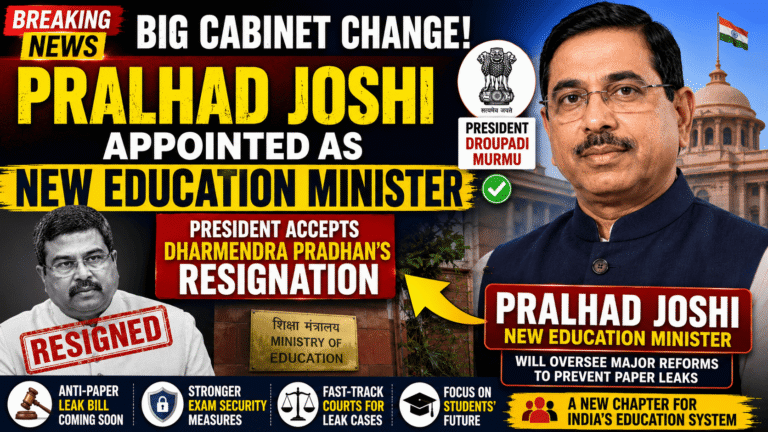
Pralhad Joshi Appointed as India’s New Education Minister After Dharmendra Pradhan’s Resignation
In a significant political development following weeks of nationwide student protests over the NEET-UG paper leak controversy, Pralhad Joshi has been appointed as India’s new Union Education Minister after President Droupadi Murmu accepted the resignation of Dharmendra Pradhan.
The appointment comes at a crucial time as the government faces increasing pressure to restore public confidence in India’s examination system and implement long-awaited reforms to prevent future paper leaks.
President Accepts Dharmendra Pradhan’s Resignation
The Rashtrapati Bhavan announced that President Droupadi Murmu accepted Dharmendra Pradhan’s resignation on the advice of Prime Minister Narendra Modi.
Immediately afterward, senior BJP leader Pralhad Joshi was entrusted with the additional responsibility of heading the Ministry of Education while continuing to oversee his existing ministerial portfolios.
The transition marks one of the biggest Cabinet changes linked directly to a nationwide public movement in recent years.
Who is Pralhad Joshi?
Pralhad Joshi is among the BJP’s most experienced parliamentarians.
Currently, he serves as:
Union Minister for Consumer Affairs, Food and Public Distribution
Union Minister for New and Renewable Energy
Previously, he also handled major ministries including:
* Parliamentary Affairs
* Coal
* Mines
Joshi represents Dharwad Lok Sabha constituency in Karnataka, where he has been elected five consecutive times, reflecting his strong political base and long administrative experience.
His appointment is expected to bring experienced leadership to the Education Ministry during a period of major policy reforms.
Why Did Dharmendra Pradhan Resign?
Dharmendra Pradhan stepped down amid growing public outrage over alleged irregularities in the NEET-UG 2026 examination.
For more than a month, thousands of students participated in demonstrations demanding accountability over repeated examination paper leak controversies.
The resignation became the central demand of the youth-led Cockroach Janta Party (CJP), whose continuous protests at Delhi’s Jantar Mantar attracted nationwide attention.
Following discussions between government representatives and protest leaders, Pradhan submitted his resignation, stating that protecting students’ interests remained his highest priority.
What Did Dharmendra Pradhan Say in His Resignation Letter?
In his resignation letter, Dharmendra Pradhan emphasized that his decision was motivated by concern for students rather than political considerations.
He wrote that India’s youth represent the country’s greatest strength and that their dreams should never be compromised by uncertainty or prolonged controversy.
Pradhan also said he had accepted responsibility from the very beginning of the NEET controversy and believed his resignation would help restore confidence while allowing students to focus on their education instead of prolonged political conflict.
He further expressed gratitude to Prime Minister Narendra Modi for giving him the opportunity to serve as Education Minister.
A Turning Point for India’s Education System
Pralhad Joshi now assumes office at a time when India’s examination system is under unprecedented scrutiny.
The new Education Minister is expected to oversee several key reforms, including:
Introduction of the proposed Anti-Paper Leak Bill.
Strengthening examination security systems.
Expanding digital monitoring during competitive examinations.
Improving coordination among examination agencies.
Restoring public trust in national entrance examinations.
Education experts believe the coming months will be critical in determining whether these reforms can successfully rebuild confidence among millions of students preparing for competitive exams.
Political Significance
Dharmendra Pradhan’s resignation and Pralhad Joshi’s appointment are widely viewed as one of the most significant political developments of 2026.
The decision demonstrates the government’s willingness to respond to sustained public pressure while signaling a renewed focus on education governance.
Analysts also believe the Cabinet reshuffle reflects the increasing importance of youth issues in national politics.
Students Hope for Faster Reforms
Across India, students have welcomed announcements regarding proposed examination reforms but continue to expect concrete action.
Many aspirants believe leadership changes must be accompanied by stronger technology, improved transparency, and strict action against organized paper leak networks.
Attention will now focus on how quickly the new Education Minister implements promised reforms and introduces measures to safeguard future examinations.
Key Highlights
* President Droupadi Murmu accepted Dharmendra Pradhan’s resignation.
* Pralhad Joshi becomes India’s new Union Education Minister.
* Joshi continues to hold additional Cabinet portfolios.
* Appointment follows nationwide protests over NEET paper leak.
* Government plans major examination reforms.
* Anti-Paper Leak Bill expected soon.
* Students demand transparency and accountability.
* New leadership faces challenge of restoring trust in India’s examination system.
ಪ್ರಮುಖ ಅಂಶಗಳು (Kannada)
* ಧರ್ಮೇಂದ್ರ ಪ್ರಧಾನ ಅವರ ರಾಜೀನಾಮೆಯನ್ನು ರಾಷ್ಟ್ರಪತಿಗಳು ಅಂಗೀಕರಿಸಿದ್ದಾರೆ.
* ಪ್ರಲ್ಹಾದ್ ಜೋಶಿ ಹೊಸ ಕೇಂದ್ರ ಶಿಕ್ಷಣ ಸಚಿವರಾಗಿ ನೇಮಕಗೊಂಡಿದ್ದಾರೆ.
* ನೀಟ್ ಪ್ರಶ್ನೆಪತ್ರಿಕೆ ಸೋರಿಕೆ ವಿವಾದದ ನಂತರ ಈ ಮಹತ್ವದ ನಿರ್ಧಾರ ಕೈಗೊಳ್ಳಲಾಗಿದೆ.
* ಶಿಕ್ಷಣ ವ್ಯವಸ್ಥೆಯಲ್ಲಿ ಪ್ರಮುಖ ಸುಧಾರಣೆಗಳ ನಿರೀಕ್ಷೆ ಇದೆ.
* ವಿದ್ಯಾರ್ಥಿಗಳ ವಿಶ್ವಾಸವನ್ನು ಮರಳಿ ಪಡೆಯುವುದು ಹೊಸ ಸಚಿವರ ಮೊದಲ ಸವಾಲಾಗಿದೆ.
What Does Pralhad Joshi’s Appointment Mean for India’s Education System?
The appointment of Pralhad Joshi as India’s new Union Education Minister marks a significant leadership change at a time when the country’s examination system is under intense public scrutiny.
With millions of students preparing for national competitive examinations such as NEET, JEE, CUET, SSC, UPSC, Banking, Railway, and State PSC exams, restoring confidence in the education system has become the government’s immediate priority.
Education experts believe that the new minister’s first few months in office will be crucial in determining whether the promised reforms can effectively prevent future examination irregularities.
Major Challenges Before the New Education Minister
Pralhad Joshi is expected to address several urgent issues, including:
1. Strengthening Examination Security
The government is expected to introduce advanced digital security measures to reduce the risk of paper leaks and cyber threats during examinations.
Possible reforms include:
End-to-end encrypted question paper distribution.
AI-powered monitoring systems.
Stronger cybersecurity infrastructure.
Better coordination between examination agencies and law enforcement.
2. Anti-Paper Leak Bill
One of the government’s biggest commitments is introducing the Anti-Paper Leak Bill in Parliament.
The proposed legislation is expected to provide:
Stricter punishment for organized paper leak syndicates.
Faster investigations.
Time-bound trials through fast-track courts.
Higher accountability for officials responsible for examination management.
Students and education experts believe effective implementation will be more important than the legislation itself.
3. Restoring Public Trust
Perhaps the biggest challenge is rebuilding confidence among students.
Repeated examination controversies have affected millions of aspirants who spend years preparing for competitive examinations.
The new Education Minister will be expected to ensure:
Transparent examination processes.
Timely investigations.
Faster publication of results.
Fair grievance redressal mechanisms.
Political Significance
Pralhad Joshi’s appointment comes immediately after one of the largest student-led movements in recent years.
Political analysts believe the Cabinet reshuffle demonstrates:
Increased government responsiveness to youth concerns.
Greater political importance of education reforms.
Rising public demand for accountability.
Stronger focus on examination transparency.
The resignation of Dharmendra Pradhan and appointment of a new Education Minister may also influence future education policy discussions across Parliament.
What Students Expect
Students across India now expect more than leadership changes.
Their primary expectations include:
Leak-proof examination systems.
Timely conduct of exams.
Transparent recruitment processes.
Reduced examination-related stress.
Faster action against organized cheating networks.
Many student organizations have stated that the success of the reforms will depend on implementation rather than announcements.
How This Could Impact Future Competitive Exams
If the proposed reforms are implemented successfully, competitive examinations may witness:
Stronger digital security.
Improved biometric verification.
Enhanced surveillance during examinations.
Better coordination between central and state agencies.
Faster legal action against examination fraud.
These measures could significantly improve fairness and transparency for future aspirants.
Expert Opinion
Education policy specialists believe that leadership changes alone cannot solve systemic challenges.
Long-term improvements will require:
Modern technology infrastructure.
Independent examination oversight.
Continuous cybersecurity upgrades.
Transparent auditing mechanisms.
Strong coordination among examination authorities.
If implemented effectively, these reforms could significantly strengthen India’s examination ecosystem over the coming years.
Frequently Asked Questions (FAQs)
Who is the new Education Minister of India?
Pralhad Joshi has been appointed as the new Union Education Minister after Dharmendra Pradhan’s resignation.
Why did Dharmendra Pradhan resign?
He resigned following nationwide protests over alleged NEET-UG examination irregularities and paper leak concerns.
What ministries does Pralhad Joshi currently handle?
Apart from Education, he continues to oversee Consumer Affairs, Food & Public Distribution, and New & Renewable Energy.
What is the Anti-Paper Leak Bill?
It is a proposed law aimed at introducing stricter punishment and stronger preventive measures against examination paper leaks.
What will be Pralhad Joshi’s biggest challenge?
Restoring public confidence in India’s examination system through transparency, technology, and stronger examination security.
Disclaimer
This article is based on official government announcements and publicly available reports available at the time of publication. Developments may change as further official notifications are issued. Readers should refer to official government statements for the latest updates.
Do Follow For More Info @ http://roydailyupdate.in
Do WhatsApp @ https://chat.whatsapp.com/K5POJK9KbpN8egjjOCaOw6