

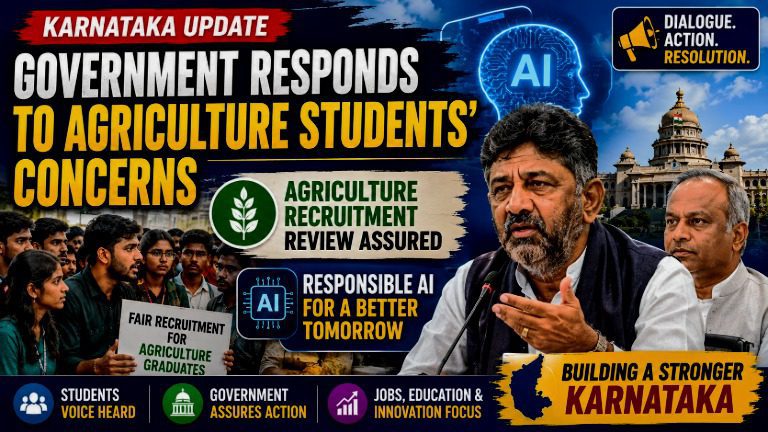
Karnataka Government Responds to Agriculture Recruitment Concerns as AI Takes Center Stage at Bengaluru Innovation Events
Karnataka Sees Focus on Student Concerns and Responsible AI Development
Two significant developments in Bengaluru have highlighted the Karnataka government’s focus on education, employment, and technology. While students pursuing agricultural studies sought government intervention regarding recruitment opportunities, policymakers also emphasized the responsible use of artificial intelligence during a major technology event.
Together, these developments reflect two important priorities for the state: addressing employment-related concerns among graduates and strengthening Karnataka’s position as a leading hub for innovation and emerging technologies.
Agriculture Students Seek Clarity on Recruitment Opportunities
Students from agricultural institutions have recently raised concerns regarding recruitment eligibility for government positions related to the agriculture sector. Their primary demand is that recruitment policies should appropriately recognize specialized agricultural education for technical roles connected to farming, crop science, and agricultural extension.
Many students believe that positions requiring field-level agricultural expertise should align closely with academic qualifications designed specifically for the sector. They argue that specialized education provides practical knowledge that is directly relevant to serving farmers and implementing agricultural development programs.
Student representatives have requested greater clarity regarding eligibility criteria and have appealed to the state government to review the existing recruitment framework.
Government Assures Students Their Concerns Will Be Examined
Senior state leaders interacted with student representatives and assured them that their concerns would receive careful consideration through the appropriate administrative and legal processes.
According to officials, the objective is to ensure that recruitment remains transparent, legally compliant, and fair to all eligible candidates while maintaining the quality of public services.
The government also encouraged students to continue engaging through peaceful dialogue while the matter is examined by the concerned departments.
Constructive discussions between students and policymakers are often viewed as an important mechanism for resolving issues affecting higher education and public employment.
Why Recruitment Policies Matter
Recruitment rules play a critical role in ensuring that government departments appoint candidates with the qualifications necessary for specialized responsibilities.
In technical sectors such as agriculture, eligibility criteria can influence:
Quality of agricultural advisory services
Implementation of government schemes
Research and field extension activities
Rural development initiatives
Career opportunities for graduates
Because these positions directly support farmers and agricultural productivity, recruitment policies frequently attract attention from educational institutions, professional organizations, and aspiring candidates.
Karnataka’s Agriculture Sector Remains a Key Economic Pillar
Agriculture continues to support millions of livelihoods across Karnataka.
The state produces a wide range of crops including cereals, pulses, oilseeds, horticultural products, coffee, spices, sugarcane, and fruits. Modern farming increasingly depends on scientific practices, improved seed varieties, climate adaptation, precision agriculture, and effective extension services.
Qualified agriculture professionals contribute by assisting farmers with:
Crop management
Pest and disease control
Soil health improvement
Water management
Technology adoption
Sustainable farming practices
As agriculture evolves, demand for skilled professionals is expected to remain significant.
Bengaluru Reinforces Its Position as a Technology Hub
Alongside discussions on education and recruitment, Bengaluru also hosted technology-focused events highlighting the growing role of artificial intelligence in economic and social development.
Industry leaders, researchers, policymakers, startups, and academic institutions continue collaborating to explore how emerging technologies can improve healthcare, education, agriculture, manufacturing, governance, and environmental sustainability.
The city remains one of India’s leading centres for innovation, attracting investment across software, biotechnology, deep technology, semiconductors, and AI research.
Responsible AI Remains a Key Theme
Artificial intelligence is increasingly influencing both public and private sectors.
Experts emphasize that successful AI adoption depends not only on technological capability but also on responsible implementation.
Important considerations include:
Transparency
Data privacy
Fairness
Accountability
Human oversight
Cybersecurity
Ethical decision-making
Responsible deployment can help organizations maximize AI’s benefits while minimizing potential risks.
AI’s Growing Role Across Public Services
Governments worldwide are evaluating how AI can improve service delivery and administrative efficiency.
Potential applications include:
Healthcare support
Smart agriculture
Traffic management
Disaster response
Public grievance systems
Education
Urban planning
When implemented responsibly, AI can complement human expertise rather than replace it.
Looking Ahead
The recent developments in Karnataka demonstrate the importance of balancing educational opportunities, employment policies, and technological progress.
As discussions continue regarding recruitment frameworks and responsible AI adoption, collaboration between students, educational institutions, government departments, industry, and researchers will remain essential.
Strengthening dialogue, ensuring transparency, and encouraging innovation can help Karnataka continue advancing both its agricultural sector and technology ecosystem while creating opportunities for future generations.
Karnataka’s Employment Landscape Is Evolving
Karnataka has one of India’s most diverse employment ecosystems, with opportunities spanning agriculture, manufacturing, information technology, biotechnology, aerospace, and startups. As new industries emerge, recruitment policies continue to evolve to match changing workforce requirements.
For students preparing for government employment, eligibility rules remain one of the most important factors influencing career planning. Any modification to recruitment criteria can affect thousands of aspirants, making transparency and timely communication essential.
Educational institutions also play an important role by helping students understand recruitment notifications, qualification requirements, and competitive examination procedures.
Importance of Specialized Education in Agriculture
Agricultural education extends beyond classroom learning. Degree programmes generally combine theoretical knowledge with practical field experience covering crop production, soil science, plant protection, irrigation management, agricultural economics, biotechnology, and extension services.
Graduates often contribute to:
Agricultural extension programmes
Farmer awareness initiatives
Sustainable farming practices
Crop productivity improvements
Climate-resilient agriculture
Research and innovation
As India’s agriculture sector modernises, professionals with specialised training are expected to remain important for improving productivity and supporting rural development.
Artificial Intelligence Is Transforming Agriculture
Artificial intelligence is increasingly becoming part of modern agriculture across the world.
Emerging applications include:
Crop health monitoring
Disease detection using images
Precision irrigation
Weather forecasting
Yield prediction
Smart fertiliser management
Drone-based field surveys
Combined with satellite imagery and Internet of Things (IoT) technologies, AI can help farmers make faster and more informed decisions while reducing resource wastage.
However, experts emphasise that technology should complement the knowledge and experience of farmers rather than replace it.
Karnataka’s Startup Ecosystem Continues to Expand
Bengaluru remains one of Asia’s leading startup destinations, attracting entrepreneurs, researchers, and investors from across the world.
The state has developed strong ecosystems in:
Artificial intelligence
Biotechnology
Agritech
Healthtech
Fintech
Deep technology
Semiconductor research
Government initiatives encouraging innovation, research partnerships, incubation centres, and skill development continue to strengthen Karnataka’s reputation as a technology leader.
Support for startups working on agricultural technologies could also help address challenges related to productivity, climate resilience, and food security.
Responsible AI Requires Human Oversight
Although AI offers significant opportunities, responsible deployment remains essential.
Experts generally recommend that AI systems should prioritise:
Human oversight
Transparency
Fairness
Privacy protection
Accountability
Security
Ethical decision-making
These principles help ensure that technological innovation serves society while reducing unintended consequences.
For governments and businesses alike, maintaining public trust will remain critical as AI becomes more deeply integrated into daily life.
What Students Should Focus On
Students preparing for public-sector careers may benefit from:
Monitoring official recruitment notifications
Verifying eligibility requirements carefully
Strengthening subject knowledge
Developing digital skills
Staying informed about policy updates
Preparing consistently for competitive examinations
Maintaining flexibility and continuous learning can improve long-term career opportunities in both government and private sectors.
Looking Ahead
Karnataka’s continued investment in education, research, agriculture, and technology positions the state for long-term economic growth.
Constructive engagement between policymakers, educational institutions, industry, and students can help create recruitment systems that remain transparent, efficient, and aligned with future workforce needs.
At the same time, responsible adoption of artificial intelligence presents opportunities to improve public services, strengthen agricultural productivity, support startups, and encourage sustainable development.
Balancing innovation with fairness, transparency, and inclusive growth will remain an important objective as Karnataka continues expanding its role as one of India’s leading knowledge and technology economies.
Conclusion
The recent discussions surrounding recruitment policy and responsible AI reflect broader conversations taking place across India about education, employment, and technological progress.
While recruitment frameworks may continue evolving, ensuring clarity, fairness, and effective communication will remain important for aspiring professionals.
Meanwhile, advances in artificial intelligence are creating new possibilities across agriculture, healthcare, education, governance, and industry. If implemented responsibly, these technologies have the potential to complement human expertise while supporting long-term economic and social development.
As Karnataka continues investing in innovation alongside workforce development, collaboration between government, academia, industry, and citizens will play a key role in shaping the state’s future.
FAQs
What is the importance of specialised agricultural education?
Specialised programmes provide technical knowledge in crop science, soil management, pest control, irrigation, and sustainable farming practices that support modern agriculture.
Why are recruitment policies important?
Eligibility criteria influence who can apply for public-sector positions and help ensure that technical roles are filled by appropriately qualified candidates.
How can AI support agriculture?
AI can assist with crop monitoring, weather forecasting, precision farming, disease detection, irrigation management, and resource optimisation.
Why is responsible AI important?
Responsible AI emphasises transparency, human oversight, privacy, fairness, and accountability while ensuring technology benefits society.
Why is Bengaluru considered a technology hub?
The city hosts a large concentration of technology companies, startups, research institutions, and innovation centres across multiple sectors.
Disclaimer
Disclaimer: This article is for informational purposes only and is based on publicly available information and general analysis. It should not be interpreted as legal, educational, employment, or professional advice. Readers should consult official government notifications and announcements for the latest information regarding recruitment policies and related matters.
Do Follow For More Info @ http://roydailyupdate.in
Do WhatsApp @ https://chat.whatsapp.com/K5POJK9KbpN8egjjOCaOw6
About the Author
Ravi H. Irannanavar is the founder and editor of Roy Daily Update, covering technology, education, public policy, business, and current affairs. His work focuses on producing clear, factual, and reader-friendly reporting on developments that matter to citizens across India.